
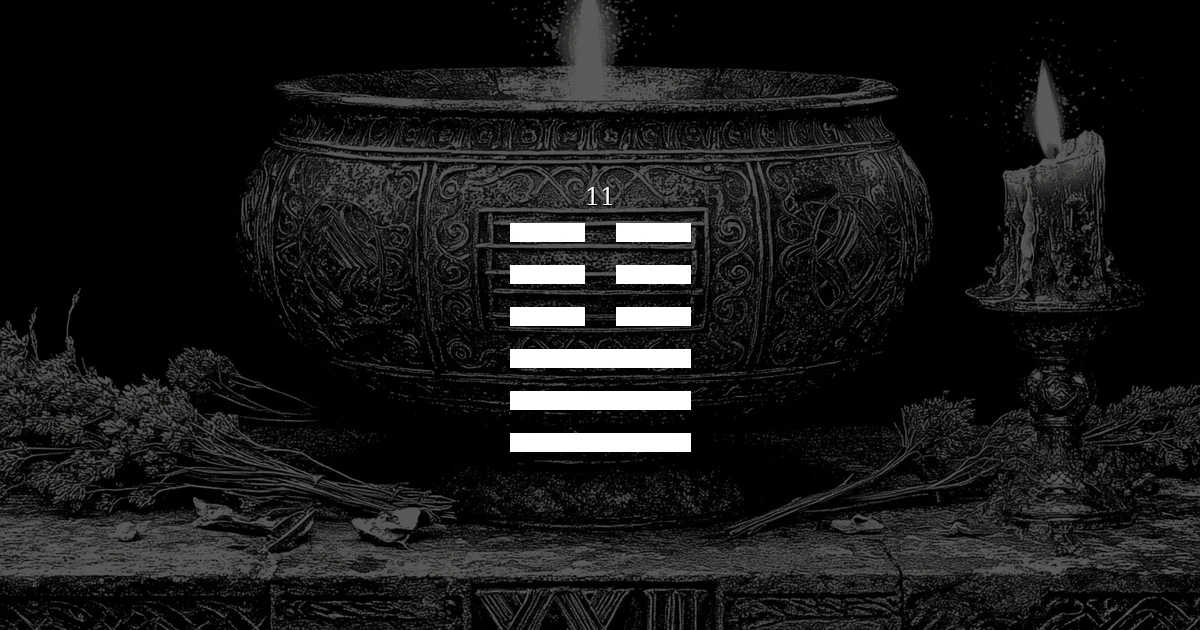
What is Hexagram 64, Before Completion?
Hexagram 64 of the I Ching is 未濟 (Wèi Jì), translated as Before Completion. It is the final hexagram, and its structure is the exact mirror of Hexagram 63 (After Completion): Fire (☲) above Water (☵), with every line in the opposite of its correct position. Where Hexagram 63 showed perfect order, Hexagram 64 shows perfect disorder. And yet this is the I Ching’s ending — not as a statement of failure or incompleteness, but as one of the most profound statements the text makes about the nature of reality itself.
The I Ching is one of the oldest continuously consulted texts in human history, with origins in Zhou dynasty China approximately three thousand years ago. The Wilhelm/Baynes translation (1923/1950) is the primary Western reference, though original meanings continue to be debated by scholars. The Whisper engages with this tradition as a lens for self-reflection rather than a predictive system.
In The Whisper, your daily hexagram is determined by a hash of your birth date and today’s date — a deterministic draw, the same for everyone born on your date reading on this day, framed as fated rather than random. When Hexagram 64 appears — the final hexagram, the threshold not yet crossed — the system is pointing toward the quality of potential, care, and the crossing that is still to come in your current situation.
The two trigrams: Fire above Water
The trigram Li (Fire) above Kan (Water) creates the mirror of After Completion’s structure: the two great opposites in the unproductive relationship — fire rising, water falling, each going in its own direction rather than working together. In contrast to the steam and harmony of Hexagram 63, Hexagram 64 describes the condition before the two have found their productive relationship. They are present; they are not yet integrated.
Yet the hexagram is not named Disorder or Failure — it is named Before Completion. The emphasis is on the threshold quality of the condition rather than on its disorder. Fire and water are both present. The potential for their integration — the productive relationship that Hexagram 63 describes — exists and is visible. What stands between the current condition and the completed one is the crossing not yet accomplished.
The traditional commentary’s image of the young fox who almost crosses the ice and gets its tail wet at the last moment is significant: this is not a fox who failed to reach the ice, or who refused to attempt the crossing. This is a fox who nearly made it — who got to the final moment and then lost the careful attention that the last step required. The difference between Before Completion and the completion itself is the care applied at the threshold.
The core teaching of Before Completion
The central teaching of Hexagram 64 is that the I Ching deliberately ends at the threshold rather than at the accomplished crossing — and that this is not an accident but a statement. The text’s final word is not completion but not-yet-complete, pointing toward the understanding that all completed states are also thresholds for what has not yet begun. The cycle is circular: Hexagram 64’s threshold leads, when crossed, to the cycle of growth and challenge that ends again at Hexagram 63’s completion, which itself contains the seeds of a new 64.
For practical purposes, the hexagram’s teaching is about the specific quality of attention required at thresholds. Thresholds are not the beginning (where attention is fresh) or the middle (where attention is trained by experience); they are the point just before completion, where the work is almost done and the natural tendency is to release attention slightly. Hexagram 64 identifies this as the precisely dangerous moment — and the young fox’s wet tail is the specific image of what happens when attention releases too soon.
This is also a hexagram of genuine potential rather than failure. The disorder of every line being out of its correct position is not a description of a failed situation — it is a description of a situation in which everything is present and waiting to be aligned. The fire is real; the water is real; the productive relationship between them has not yet been established. The not-yet of Hexagram 64 is not the never of impossibility; it is the threshold of the crossing that is genuinely available.
The traditional counsel is specific: the feast should not be called ready before it is served; achievement should not be counted before it is actually accomplished. This is not pessimism but precision. Counting the crossing complete before the other bank is reached leads to the relaxation of attention that produces the wet tail at the final step.
How Before Completion appears in daily life
The pattern of Hexagram 64 in daily life is recognizable at the specific moments just before genuine completion — the project in its final phase, the relationship at the point of genuine commitment, the creative work in its last revision, the negotiation at its closing moment. These are the situations where the hexagram’s teaching is most directly applicable: not the beginning, not the middle, but the threshold.
The young fox image points toward something specific about these threshold moments: they are often when the person involved is most ready to relax, because the outcome seems assured. The work has gone well; the crossing seems almost done; the careful attention that brought things to this point begins to feel like it can be released. The hexagram is identifying this as the precise moment to maintain it.
Before Completion also appears in situations that are not yet at their threshold — situations that are genuinely in the condition of disorder, where the fire and water have not yet found their productive relationship. In these situations, the hexagram is not pointing toward imminent completion but toward the genuine potential that exists if the crossing is approached with appropriate care. The disorder of the present situation is not its final state; it is the not-yet from which genuine completion can develop.
The ending quality of Hexagram 64 — being the I Ching’s final hexagram — also gives it a particular resonance in questions about endings, transitions, and the completion of one phase. The hexagram carries the teaching that every ending is also a threshold: what appears to be concluding is simultaneously opening onto what has not yet begun. This is one of the reasons the I Ching chose to end with not-yet-complete rather than with achieved completion.
What Before Completion means in The Whisper
In The Whisper’s synthesis, Hexagram 64 carries a particular significance as the final hexagram — the one that returns the cycle to its beginning. It resonates across multiple Nine Star Ki configurations depending on the specific threshold quality of the current period: a Water star year moving toward a Wood star year carries the Before Completion quality of potential transitioning toward new growth; the final days of a nine-year cycle before the new cycle begins are classically Before Completion moments.
In BaZi, the resonance appears in configurations where the current daymaster is at the beginning of a new ten-year luck cycle (大運) or approaching a significant structural change — the period just before a major new energy becomes operative, when the old structure is present but the new has not yet established itself.
From Western Astrology, Hexagram 64 carries qualities associated with Neptune (the dissolving of the old form before the new can take shape), with the final degrees of a sign before ingress into the next, and with the Balsamic phase of the lunar cycle — the dark of the moon just before the new moon’s potential becomes visible.
Frequently asked questions
Q: Why does the I Ching end with Before Completion rather than After Completion? The choice to end at the threshold rather than at achieved order is one of the I Ching’s most deliberate and profound structural decisions. It embodies the text’s central teaching about change: no state is final, all completion contains the seeds of a new beginning, and the nature of reality is cyclical rather than linear. Ending with 未濟 rather than 既濟 means the I Ching ends with potential and openness rather than with achieved closure — which is both philosophically accurate and practically useful for a divination text whose purpose is to illuminate the ever-changing situation.
Q: Is Before Completion a bad hexagram to receive? No — the hexagram describes a threshold condition, not a failed one. Every significant achievement passes through Before Completion on its way to After Completion. The young fox is not a failure; it is genuinely crossing the ice, genuinely close to completing the crossing. The hexagram’s counsel is care and attention at the threshold, not despair about the disorder of the present state. The potential described in the hexagram — fire and water both present, the productive relationship not yet established but available — is genuinely positive.
Q: What is the relationship between the I Ching’s final two hexagrams? Hexagrams 63 and 64 form a deliberate complementary pair. After Completion (63) shows perfect order — everything in its right place — but teaches vigilance against the complacency that disorder will use to return. Before Completion (64) shows perfect disorder — nothing in its right place — but teaches that this is the threshold before completion rather than the failure of it. Together they embody the I Ching’s view of change as cyclical: order contains the seeds of disorder, disorder contains the potential of order, and the crossing between them is always available to the person who applies genuine care.