
What is Hexagram 63, After Completion?
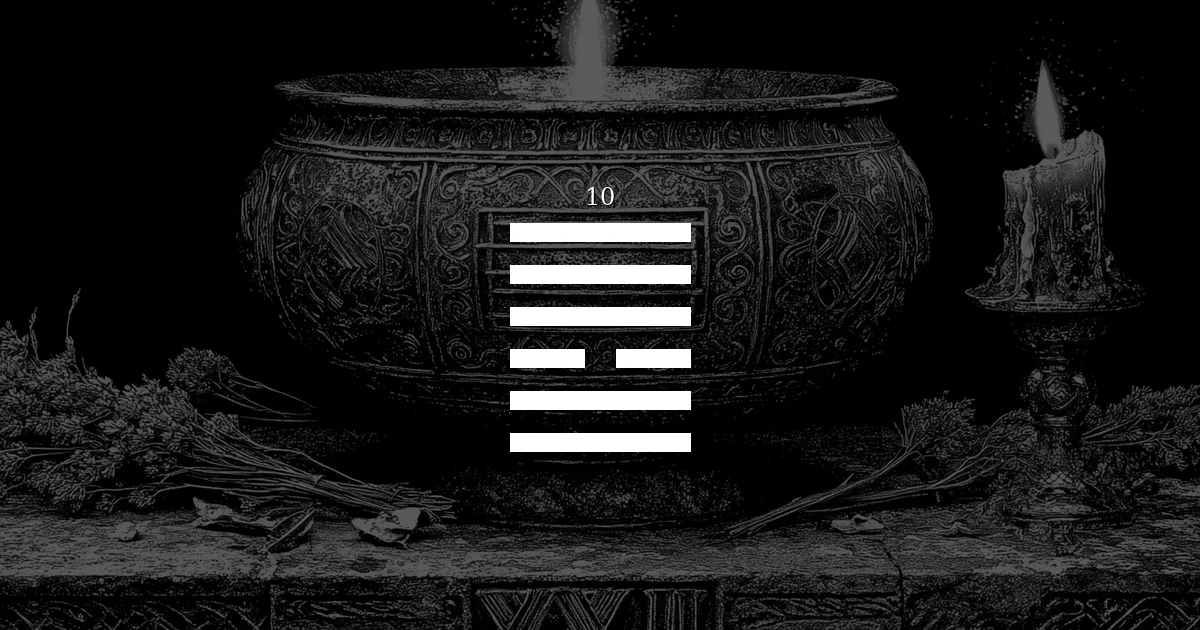
Hexagram 63 of the I Ching is 既濟 (Jì Jì), translated as After Completion. It is structurally unique: Water (☵) above Fire (☲), with every line in what the system considers its correct position — yang lines in yang positions, yin lines in yin positions. No other hexagram achieves this perfect alignment. Everything is in its right place. The crossing has been accomplished. And the hexagram’s primary teaching is that this is precisely when the greatest vigilance is required.
The I Ching is among the oldest continuously consulted texts in human history, with origins in Zhou dynasty China approximately three thousand years ago. The Wilhelm/Baynes translation (1923/1950) is the primary Western reference, though original meanings continue to be debated by scholars. The Whisper engages with this tradition as a lens for self-reflection rather than a predictive system.
In The Whisper, your daily hexagram is determined by a hash of your birth date and today’s date — a deterministic draw, the same for everyone born on your date reading on this day, framed as fated rather than random. When Hexagram 63 appears, the system is pointing toward the quality of vigilance following completion in your current situation.
The two trigrams: Water above Fire
The trigram Kan (Water) above the trigram Li (Fire) creates the perfect balanced opposition: water and fire in correct relationship, each in its appropriate position, neither overwhelming the other. In Chinese cosmological thinking, water above fire is actually the productive relationship — steam, warmth, the cooked rather than the raw, the harmonized rather than the opposed. This is why the hexagram represents completion: the two great opposites in their correct, mutually sustaining positions.
The structural perfection of Hexagram 63 is what makes its teaching so counterintuitive. The natural response to perfect order — to everything being in its right place — is satisfaction and rest. The hexagram consistently refuses this response. The commentary’s image of the fox crossing ice and getting its tail wet at the very last moment points to the specific danger of the moment of completion: attention relaxes precisely when the final step requires it most.
Water above fire is also an image of dynamic equilibrium — a state that requires constant maintenance. Water flows; fire consumes. To keep them in productive relationship requires continuous attention to the balance. The completed state is not a static achievement but a dynamic condition that must be actively sustained.
The core teaching of After Completion
The central teaching of Hexagram 63 is that completion is not rest — it is the beginning of the work of sustaining what has been achieved. This is one of the I Ching’s most paradoxical teachings, and one of its most practically significant. The human tendency to relax after achievement, to exhale and celebrate, is understandable — but the hexagram is specific about where the danger lies: in the complacency that follows success.
The traditional commentary notes that at the beginning, good fortune; but in the end, disorder. This is not pessimism — it is an observation about how achieved order tends to unravel without continued attentiveness. What was brought into alignment through effort, attention, and active cultivation will drift back toward disorder if the effort and attentiveness are withdrawn. Achievement creates the conditions for complacency; complacency creates the conditions for the achievement’s undoing.
This teaching has a specific application to the question of ongoing practice versus achieved results. Many valuable conditions — health, maintained relationships, professional competence, creative capacity — are not achievements in the sense of finished states. They are ongoing processes that must be actively sustained. Hexagram 63 appears often when someone has achieved a genuinely good condition — something that required real work to establish — and is now at the specific juncture where relaxing attention would begin to undermine it.
The fox image is particularly instructive. The fox does not fail to cross the ice; it crosses, almost completely, and then gets its tail wet at the final moment. The failure is at the end, not the beginning or the middle. The hexagram is pointing toward the final moments of any significant achievement as the moments requiring greatest, not least, attention. The feast is not eaten until it is cooked; the crossing is not complete until the other bank is reached.
How After Completion appears in daily life
The pattern of Hexagram 63 in daily life appears most recognizably at specific junctures: the relationship that has found genuine stability and is now, subtly, being taken for granted; the practice that has produced real results and is now being maintained less carefully because the results are assumed; the project that has reached a successful phase and whose success is now leading to the relaxation of the attentiveness that produced it. In all of these, the hexagram’s pattern is present: achieved order beginning to drift toward disorder through the natural human relaxation after effort.
The practical counsel the hexagram consistently offers is not to extend effort indefinitely without rest, but to maintain the specific quality of attentiveness that sustains what has been achieved — not the effortful attentiveness of creation, but the lighter, ongoing attentiveness of maintenance. The garden that has been brought into bloom requires a different kind of care than the garden that was being cultivated from bare ground; but it still requires care. Hexagram 63 points toward recognizing what that ongoing care actually consists of, in the specific situation, and maintaining it.
The hexagram also appears at times of genuine achievement as a kind of tempering counsel — not to diminish the achievement, but to hold it well. Celebrations are appropriate; the feast is meant to be eaten; the crossing accomplished deserves acknowledgment. The hexagram’s teaching is not that completion should produce no satisfaction but that the satisfaction should not produce inattention.
What After Completion means in The Whisper
In The Whisper’s synthesis, Hexagram 63 resonates with the Six White Metal Star (六白金星) in Nine Star Ki — the metal star of high standards, precision, and the continuing responsibility that comes with genuine achievement. Those who achieve find that achievement creates its own obligations; the principled attention of Six White Metal is precisely what After Completion requires. When both systems point toward the quality of vigilant maintenance, The Whisper may draw attention to where the current situation calls for the sustained attentiveness that preserves what has been built.
In BaZi, the resonance appears in configurations emphasizing the mature, preserving quality of strong Earth or Metal — the capacity to sustain what has been accumulated rather than continuing to add to it indefinitely, the wisdom to maintain rather than perpetually expand.
From Western Astrology, Hexagram 63 carries qualities associated with the opposition aspect — two planets in perfect balance across the chart, requiring constant awareness of both to maintain the productive tension rather than letting one overwhelm the other. The achieved balance that sustains through ongoing attention.
Frequently asked questions
Q: Does Hexagram 63 mean my achievement is about to fall apart? The hexagram is not predicting failure — it is pointing toward where attentiveness is required to prevent a natural drift toward disorder that follows any achieved order. The warning is an invitation to the kind of maintenance that preserves what has been built, not a forecast of inevitable decline. Many genuinely achieved conditions last for years or lifetimes through exactly the quality of ongoing attentiveness the hexagram describes.
Q: Is there ever a time when rest and satisfaction after achievement is appropriate? Yes — the hexagram does not prohibit satisfaction or rest; it specifies when attentiveness is required. The feast after completion is specifically mentioned in the traditional commentary; celebration is appropriate. The specific danger the hexagram identifies is when the satisfaction becomes complacency — when the relaxation of energy after achievement becomes the permanent state rather than a temporary pause. A genuine rest that returns to attentiveness serves the achieved condition; a complacency that never returns to attentiveness does not.
Q: How does After Completion (63) relate to Before Completion (64), which follows it? The relationship between the I Ching’s final two hexagrams is deliberately paradoxical. After Completion (63) describes perfect order — everything in its right place — but points toward the disorder that follows if attentiveness is withdrawn. Before Completion (64) describes perfect disorder — every line out of place — but points toward the potential of the crossing that is about to be accomplished. The I Ching ends not with perfect completion but with the hexagram of not-yet-complete, suggesting that completion is always also the beginning of a new cycle. The sequence is circular: the achieved order of 63 contains the seeds of 64’s threshold, and 64’s threshold leads back toward 63’s completion.