
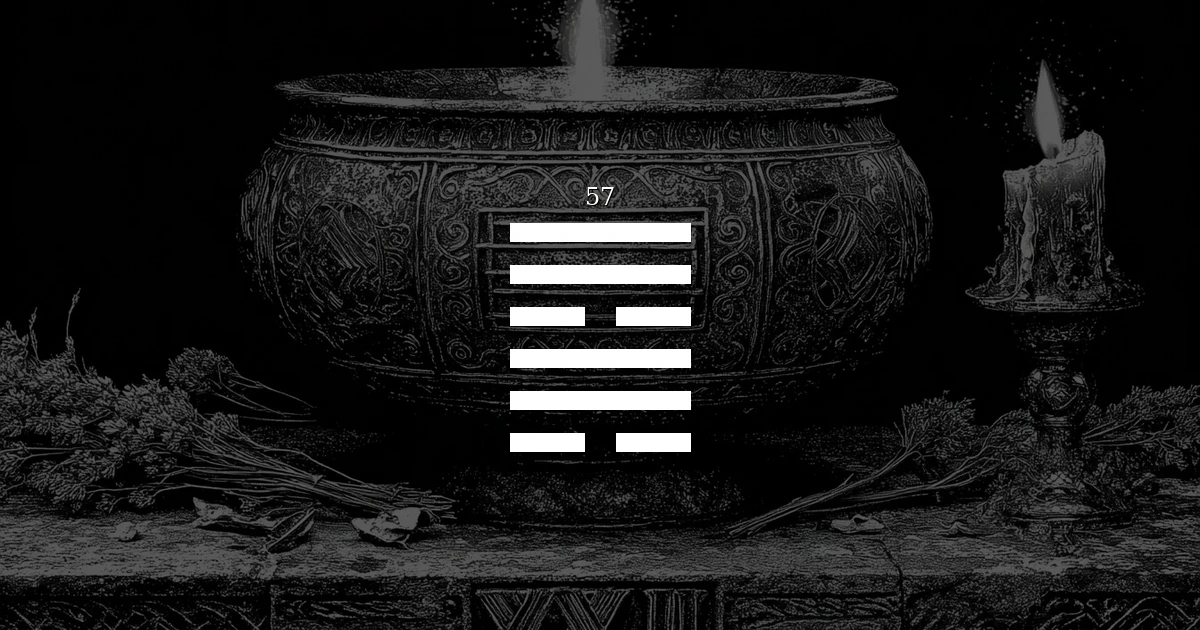
What is Hexagram 60, Limitation?
Hexagram 60 of the I Ching is 節 (Jié), translated as Limitation or Regulation. Its structure places Water (☵) above Lake (☱): the image of water that has filled to the brim and then, finding its level, limits itself naturally. Water does not overflow arbitrarily; it fills the available space to its natural capacity and stops. This is the hexagram’s first teaching: appropriate limitation is not external imposition but the natural self-regulation of a system that has found its proper measure.
The I Ching is among the oldest continuously consulted texts in human history, with origins in Zhou dynasty China approximately three thousand years ago. The Wilhelm/Baynes translation (German 1923, English 1950) remains the primary reference in Western practice, though original meanings continue to be interpreted and debated by scholars. The Whisper engages with this tradition as a lens for self-reflection rather than a mechanism for prediction.
In The Whisper, your daily hexagram is determined by a hash of your birth date and today’s date — a deterministic draw, the same for everyone born on your date reading on this day, framed as fated rather than random. When Hexagram 60 appears, the system is drawing attention to the quality of limitation and appropriate constraint in your current situation.
The two trigrams: Water above Lake
The trigram Kan (Water) above the trigram Dui (Lake) creates the image of a lake receiving water — filling, finding its measure, regulating through the relationship between container and content. Kan represents both flow and danger; Dui represents openness and the pleasure of genuine exchange. Together they describe a situation in which genuine joy and openness (Lake) encounters the necessary structuring of how it is contained and directed (Water finding its level).
The pairing also points toward the relationship between natural self-regulation and imposed limit. The lake filling to its natural level is self-regulation — the system finding its own appropriate measure. The painful limitation that the traditional commentary warns against is the limit imposed from outside, beyond what the situation genuinely requires, which cannot hold and which depletes rather than enables.
This distinction is central to understanding what Hexagram 60 is actually teaching: it is not a prescription for restriction or austerity for their own sake. It is a description of how genuine limitation — the appropriate constraint that gives form to what would otherwise dissipate — functions as a creative and sustaining force.
The core teaching of Limitation
The central insight of Hexagram 60 is that limitation is not the opposite of freedom or possibility — in many situations, it is what makes freedom and possibility real. Without form, energy disperses; without constraint, attention scatters; without the bank, the river loses both its power and its direction. The hexagram is making an affirmative case for the creative function of appropriate limits.
This teaching has both interior and exterior dimensions. Interiorly, it points toward the recognition that genuine capacity — in any practice, any relationship, any creative endeavor — develops through sustained constraint as much as through expansion. The musician who practices scales, the writer who commits to a form, the person who maintains a daily practice: all are using limitation as the condition for development that would not occur without it. The limit is not the obstacle to the work; it is part of what generates it.
Exteriorly, the hexagram addresses the limits that one establishes in one’s situation, relationships, and commitments. The traditional counsel here is careful: limits that are genuinely appropriate to the situation can be held and sustain; limits that go beyond what is genuinely appropriate — whether too strict or too lenient — cannot be sustained and should not be forced. The warning about painful limitation that does not work is not a warning against all strictness; it is a warning against the imposition of limits that are not genuinely calibrated to what the situation requires.
The question the hexagram consistently poses is: what is the appropriate measure here? Not “how much can be tolerated” or “what is the maximum restriction that can be imposed,” but rather “what is the genuine measure of this situation, this capacity, this relationship?” Finding that measure — not more, not less — is the work that Hexagram 60 points toward.
How Limitation appears in daily life
The pattern of Hexagram 60 in daily life appears in a distinctive range of situations: the person recognizing that their commitments have expanded beyond what they can genuinely sustain; the project that has accumulated scope beyond what can be done well; the relationship in which no genuine agreements about limits have been made, leading to the exhaustion of one or both parties; the creative practice that has stalled because it lacks the container of specific constraint. In all of these, the hexagram’s pattern is recognizable: something that could be good, could produce genuine quality, needs the definition of appropriate limitation to become what it actually is.
The practical movement Hexagram 60 often suggests is the deliberate establishment or recognition of genuine limits — not as resignation but as craft. The writer who decides this piece will be two thousand words, not four thousand, and finds that the decision liberates rather than restricts; the person who commits to a specific practice three days per week rather than aiming for every day and achieving none; the team that defines the scope of a project explicitly, accepting what will not be done in order to ensure what will be done is done well. These are expressions of Hexagram 60’s pattern in action.
The interior version of this practice involves attention to what one can genuinely sustain — not ideally, not in the best circumstances, but under the actual conditions of one’s situation. The limit that can actually be kept, consistently, is more valuable than the aspirational limit that is regularly exceeded and then abandoned. Finding the genuine measure of one’s actual capacity is one of the more practically demanding applications of this hexagram.
What Limitation means in The Whisper
In The Whisper’s synthesis, Hexagram 60 resonates with the Eight White Earth Star (八白土星) in Nine Star Ki — the earth star of the mountain, associated with boundaries, thresholds, and the capacity for genuine accumulation through sustained, appropriate constraint. When both systems point toward the quality of limitation, The Whisper may draw attention to where the current situation calls for the definition of genuine measure rather than continued expansion.
In BaZi, the resonance appears in configurations emphasizing Earth and Metal — the elements associated with containment, definition, and the capacity to hold form. Wu Earth (戊) day masters particularly carry this quality of the mountain that defines the landscape by establishing what is and is not within its boundary.
From Western Astrology, Hexagram 60 carries qualities associated with Saturn and Capricorn — the principle of appropriate structure, the creative function of constraint, the development of genuine capacity through sustained practice within limits rather than expansion without definition.
Frequently asked questions
Q: Does Hexagram 60 mean I need to restrict myself more? The hexagram is not a general counsel for restriction — it is pointing toward the value of genuinely appropriate limits in situations where their absence is causing dissipation, exhaustion, or loss of direction. The key question is whether the current situation suffers from too little definition (which appropriate limitation would address) or from limits that are already too tight (which would be the painful limitation the hexagram warns against). The hexagram is equally a warning against excessive restriction as it is against insufficient definition.
Q: What makes a limitation “appropriate” versus “painful”? The traditional commentary’s distinction between limitation that works and painful limitation that does not rests on whether the limit is genuinely calibrated to the situation. Appropriate limitation is what the system actually requires to function well — no more, no less. Painful limitation is imposed beyond what genuine functioning requires, often by an excess of control or an attempt to use limitation as punishment rather than as structure. In practice, the test is often whether the limit can be sustained without force: genuine appropriate limits tend to hold naturally; forced inappropriate limits tend to require increasing enforcement and eventually collapse.
Q: How does Limitation relate to the previous hexagram, Dispersion? The sequence is deliberate. Hexagram 59 (Dispersion) addresses the dissolving of what has rigidified; Hexagram 60 (Limitation) addresses the defining of appropriate form for what has been cleared. The two hexagrams describe alternating phases of the same process: dissolution to release what is no longer genuinely structured, followed by the deliberate definition of appropriate new limits. Both are necessary; neither alone is sufficient.