
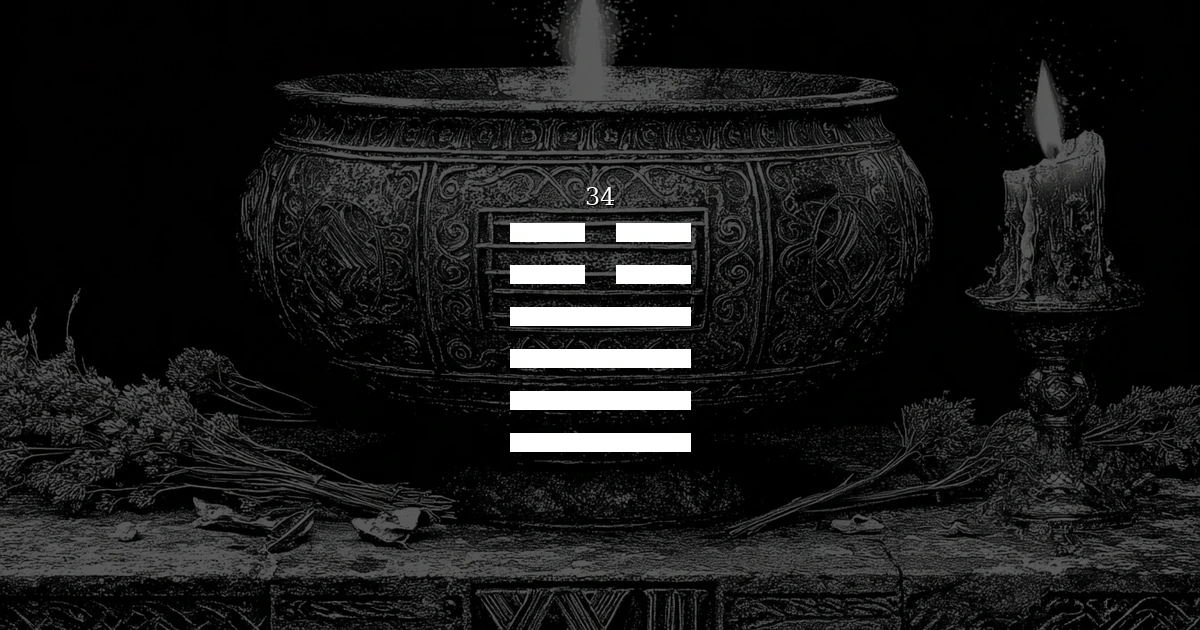
What is Hexagram 6: Conflict?
The I Ching (易經, Yì Jīng) has been consulted across East Asia for over 3,000 years as a tool for navigating difficult situations and understanding the deeper patterns of change. In The Whisper, the I Ching contributes a daily hexagram generated from your birth date and today’s date — a lens that changes each day and contributes to the oracle synthesis.
Hexagram 6 (訟, Sòng) — “Conflict” or “Contention” — is the I Ching’s direct address of opposition, dispute, and litigation. The character 訟 combines the elements for “words” and “public” — the conflict that has become a public matter, the dispute that has been brought before an authority. This is not the internal tension of Hexagram 38 (Opposition) or the personal difficulty of Hexagram 39 (Obstruction); it is the specific situation of being in active dispute with another party.
The two trigrams: reading the structure
The upper trigram is Qian (乾, Heaven ☰) — strength, creative force, heaven’s upward movement. The lower trigram is Kan (坎, Water ☵) — danger, depth, water’s downward movement. Heaven moves upward; water flows downward — they naturally move in opposite directions. This is the structural image of conflict: two genuine forces, each following their own nature, inherently moving away from each other.
The traditional commentary notes that this configuration — heaven’s strength combined with water’s danger — produces a particular kind of person: “clever and strong but deceitful.” The strength and intelligence that could be genuinely productive have been turned toward self-interest and manipulation. This is one of the hexagram’s important contextual points: conflict is often produced not by genuine incompatibility of purposes but by the cunning application of genuine strength to narrow self-interest.
The image also suggests why conflict is genuinely difficult to navigate: both trigrams represent real capacities. Heaven’s strength and Water’s depth are not weaknesses; their opposition produces genuine tension that cannot be easily dissolved. The hexagram honors this rather than pretending that conflict is simply a misunderstanding to be cleared up.
The core teaching of Conflict
Hexagram 6’s central teaching is remarkably specific: conflict can be addressed up to a midpoint, but pushing to the complete end is harmful. “Even with sincerity, obstruction. A cautious halt halfway brings good fortune. Going through to the end brings misfortune.” This is not advice to abandon all disputes; it is the specific wisdom that genuine resolution in conflict comes through finding the stopping point rather than pursuing total victory.
The image of the great man (a figure of genuine authority and wisdom) who can help resolve conflict is introduced as the appropriate resource: bringing conflict before genuine authority, rather than resolving it through force or cunning, is the path that preserves what matters. This is why the hexagram’s statement says “it furthers one to see the great man” — genuine dispute resolution requires the presence of genuine wisdom, not just the parties to the dispute.
The warning about “not crossing the great water” while in conflict is equally specific: undertaking major initiatives, large moves, significant new ventures while in a state of unresolved conflict is unfavorable. The conflict consumes the energy that the major venture would require.
The line about the old skin coat — the ancestral skin coat that has passed through three years of litigation — is one of the more poignant images: what has been in dispute for years eventually reaches a resolution, but what was originally at stake has often been consumed by the process. Lengthy litigation costs more than most outcomes are worth.
How Conflict appears in daily life
Hexagram 6 in daily life presents as the specific quality of active opposition with another party: not merely different perspectives, but genuine competing interests that have become visible and are being contested. The dispute with a colleague about the direction of a project; the negotiation that has become adversarial; the relationship tension that has surfaced as an explicit disagreement rather than a background dissonance.
The midpoint teaching appears in daily life as the discipline to pursue resolution rather than victory. The conflict that is resolved at the midpoint — where both parties have gotten some of what they needed and yielded some of what they wanted — tends to preserve more than the conflict that is pursued to complete victory, which typically destroys whatever relationship or shared context the dispute was occurring within.
The “do not cross great waters” teaching appears as the practical wisdom not to launch major initiatives, make large commitments, or undertake significant new investments while a significant conflict remains unresolved. The unresolved dispute creates a drain on attention and energy that is not compatible with the full presence that major ventures require.
What this means in The Whisper
In Nine Star Ki, Hexagram 6 resonates with years or periods when the personal star is in a position of direct clash with the annual or monthly star — particularly configurations involving Metal and Wood clash, or when stars associated with authority and structure (Six White, Seven Red) are in tension. These periods amplify both the likelihood of conflict and the importance of the hexagram’s counsel about seeking resolution rather than victory.
In BaZi, Hexagram 6 resonates with configurations showing direct clash between pillars (the Six Conflicts among the Earthly Branches: Rat-Horse, Ox-Goat, Tiger-Monkey, Rabbit-Rooster, Dragon-Dog, Snake-Pig), particularly when the clash involves the year or month pillar. Clash configurations in BaZi produce exactly the kind of genuine opposition the hexagram describes.
In Western Astrology, Hexagram 6 resonates with Mars in hard aspect (square, opposition) to Saturn or other natal planets, producing the specific quality of force meeting resistance. Mars-Pluto aspects produce the most intense version of this dynamic; Mars-Saturn produces the version most closely related to the hexagram’s “caution at the midpoint” teaching.
When multiple systems simultaneously indicate conflict, opposition, or the management of competing forces, The Whisper’s synthesis may produce a message specifically about the quality of engagement in a current dispute: whether you are approaching the midpoint of appropriate resolution, and what pursuing victory beyond that midpoint would actually cost.
Frequently asked questions
Q: Does receiving Hexagram 6 mean I am in the wrong in a current dispute?
No. The hexagram describes a situation of conflict without adjudicating who is correct. Both parties in most genuine disputes have legitimate perspectives; the hexagram’s concern is not with who is right but with how conflict is navigated. The counsel to seek the midpoint and to bring disputes before genuine authority applies regardless of the merits of either party’s position. The I Ching tradition does not use hexagrams to render judgment on the validity of competing claims.
Q: What does it mean to “stop at the midpoint” in a real conflict?
The midpoint in Hexagram 6’s terms is the point at which both parties have acknowledged the genuine tension, addressed the most important contested elements, and reached an arrangement that neither fully satisfies but both can live with. It is specifically not the complete victory of either position. In practice, it means being willing to say “this is enough resolution” before every issue has been litigated and before every advantage has been pressed. The things that are given up by stopping at the midpoint are typically less valuable than what is preserved.
Q: How does The Whisper’s emphasis on self-reflection apply to a hexagram about external conflict?
The Whisper’s oracle approach treats all hexagrams as reflective lenses rather than predictions about external events. When Hexagram 6 appears in the daily synthesis, The Whisper is not predicting that you will have an argument today; it is offering the conflict hexagram’s quality as a lens for examining where in your current experience something has the quality of genuine opposition — including the internal conflicts between competing values, priorities, or commitments that can be as demanding as external disputes. The midpoint teaching applies as much to internal resolution as to external negotiation.