
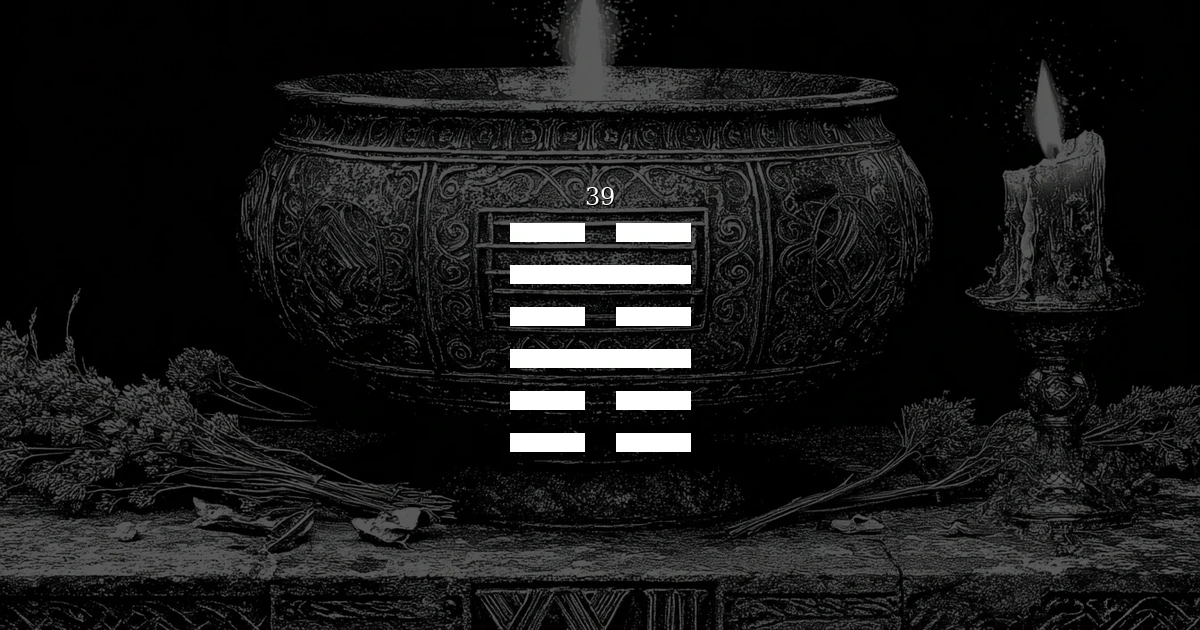
What is Hexagram 59, Dispersion?
Hexagram 59 of the I Ching is 渙 (Huàn), translated as Dispersion or Dissolution. Its structure places Wind (☴) above Water (☵): wind moving over water, the breath that breaks up ice, the movement that dissolves what has become rigid and allows what was frozen to flow again. The hexagram’s image is spring arriving at a frozen lake — not by force, but through the consistent presence of warmer, moving air.
The I Ching is one of the oldest continuously used texts in human history, with core origins in Zhou dynasty China approximately three thousand years ago, elaborated through centuries of commentary. The Wilhelm/Baynes translation (1923/1950) remains the most referenced in Western practice. The original meanings of the Zhou Yi continue to be interpreted and debated by scholars — The Whisper engages with this tradition as a framework for reflection rather than a system of fixed outcomes.
In The Whisper, your daily hexagram is determined by a hash of your birth date and today’s date — a deterministic draw framed as fated rather than random. When Hexagram 59 appears, the system is pointing toward the quality of dissolution and renewal in your current situation.
The two trigrams: Wind above Water
The trigram Xun (Wind) above the trigram Kan (Water) produces the image of wind on water — the scattering, dispersing action of moving air on a liquid surface. Kan, in its shadow aspect, represents obstruction, danger, and the tendency to become rigid under difficulty. Wind above is the force that breaks this rigidity without confronting it directly.
Wind does not hammer ice; it warms and moves the air above it, gradually dissolving the conditions that allowed freezing. This is the operative image of Hexagram 59’s teaching: dissolution works by changing the conditions rather than attacking the solidified form directly. What has rigidified — in attitudes, in relationships, in one’s own interior — responds to the consistent presence of warmth and movement more readily than it responds to direct assault.
The traditional commentary notes the image of the king going to the temple and the crossing of the great river. Both images point toward actions that precede practical movement: ritual renewal, the re-establishment of connection to what genuinely sustains, before the practical crossing is attempted. Spiritual opening precedes practical movement in Hexagram 59’s sequence — dissolution of interior rigidity first, then dissolution of relational or situational rigidity, then the practical action that the dissolution has made possible.
The core teaching of Dispersion
The central teaching of Hexagram 59 concerns the priority of dissolution over accumulation in specific conditions. Not all conditions call for building, consolidating, or persisting — some call for the deliberate releasing of what has congealed around a genuine flow. When fixed attitudes have hardened into obstruction, when group identity has calcified into defensiveness, when the self’s natural responsiveness has frozen under accumulated difficulty, the work is not to add more structure but to release what has blocked the natural movement.
The hexagram identifies a progressive quality to genuine dissolution. The commentary describes dissolving one’s own self-centeredness first — the interior ice — before addressing the rigidity in one’s group or situation. This sequence matters: dissolution attempted from a position of interior hardness tends to scatter what should be gathered, rather than releasing what should flow. The king goes to the temple before crossing the river because interior renewal prepares the ground for effective outer movement.
This is also one of the I Ching’s hexagrams that addresses the specific role of shared ritual, shared practice, and the renewal of collective connection in dispersing the rigidities that accumulate in any group over time. Communities, families, and working groups develop fixed patterns, unexamined assumptions, and calcified identities through the natural course of time. Hexagram 59 suggests that deliberate renewal — genuine reconnection with shared purpose, shared meaning, or shared practice — is the form of dissolution appropriate to these accumulated rigidities.
The shadow of Hexagram 59 is dispersion as loss of coherence: the dissolution that scatters what genuinely should have been held together, or the release that avoids rather than genuinely dissolves the necessary tension. Not everything that has become fixed should be dissolved; discernment about what has rigidified in ways that block genuine flow, versus what is simply structured appropriately for the situation, is essential to this hexagram’s application.
How Dispersion appears in daily life
The pattern of Hexagram 59 in daily life often appears at moments when one is recognizing that a way of approaching a situation has hardened into something that is no longer serving. The person who has been holding a position so long that they have forgotten whether they actually believe it anymore; the team whose communication patterns have become so established that no one is genuinely hearing anyone else; the relationship in which both parties have accommodated the other’s fixed qualities so thoroughly that genuine contact has frozen out — these are situations that Hexagram 59’s pattern addresses.
The practical movement the hexagram often suggests is not dramatic confrontation with the rigidity but deliberate creation of conditions under which natural dissolution can occur: a different context, a shared activity that bypasses the hardened patterns, a return to something that the group or relationship was before the current solidification established itself. Warmth and movement rather than direct attack; the wind changing the conditions rather than assaulting the ice.
Internally, Hexagram 59 often appears when fixed interpretations of one’s own situation — stories about why things are as they are, assumptions about what is possible or what one deserves — have calcified into obstacles to genuine perception. The dissolution called for is interior: a deliberate relaxation of certainty, a willingness to allow what has solidified to soften back into question, before attempting to assess the situation freshly.
What Dispersion means in The Whisper
In The Whisper’s synthesis, Hexagram 59 resonates with the One White Water Star (一白水星) in Nine Star Ki — the water star associated with flow, depth, and the renewal that comes through genuine release rather than forced clearing. When both systems point toward dissolution on the same day, The Whisper may draw attention to where the current situation calls for softening rather than pressing harder.
In BaZi, the resonance appears in water-dominated configurations and in Ren Water (壬水) day masters — the yang water that flows and disperses, finding its level by releasing accumulated pressure rather than containing it. The day quality of dissolution and flow.
From Western Astrology, Hexagram 59 carries qualities associated with Neptune and Pisces — the dissolving of fixed forms, the oceanic dissolution that allows new configurations to emerge, the sometimes necessary experience of losing a structure that had outlived its usefulness.
Frequently asked questions
Q: Does Hexagram 59 mean I should give up on what I have been working toward? Dispersion is not a counsel toward abandonment. The hexagram concerns the dissolution of what has rigidified in ways that block genuine flow — attitudes, fixed interpretations, calcified patterns — rather than the abandonment of genuine direction. The king goes to the temple and then crosses the great river; renewal precedes and enables the practical movement, not replaces it. If what you have been working toward is genuinely sound, Hexagram 59 may be pointing toward releasing what has become rigid in your approach to it.
Q: What does the traditional image of the king going to the temple mean in practice? The image points toward the priority of interior renewal before practical action in situations that call for dissolution. In practice, this might mean returning to the genuine source of one’s commitment before addressing the external situation — reconnecting with why a project or relationship matters before attempting to dissolve the patterns that have calcified around it. The spiritual renewal is not separate from the practical movement; it is what makes the practical movement effective.
Q: How can I tell whether dissolution is appropriate or whether I should persist? Hexagram 59 points toward dissolution when what has accumulated has blocked rather than channeled genuine flow — when fixed patterns, attitudes, or interpretations are preventing actual responsiveness to what the situation requires. The test is whether the rigidity is serving the genuine purpose or obstructing it. When accumulated structure is doing genuine work, persistence and consolidation (see Hexagram 60, Limitation) are appropriate. When it has frozen what should flow, dissolution is the relevant move.