
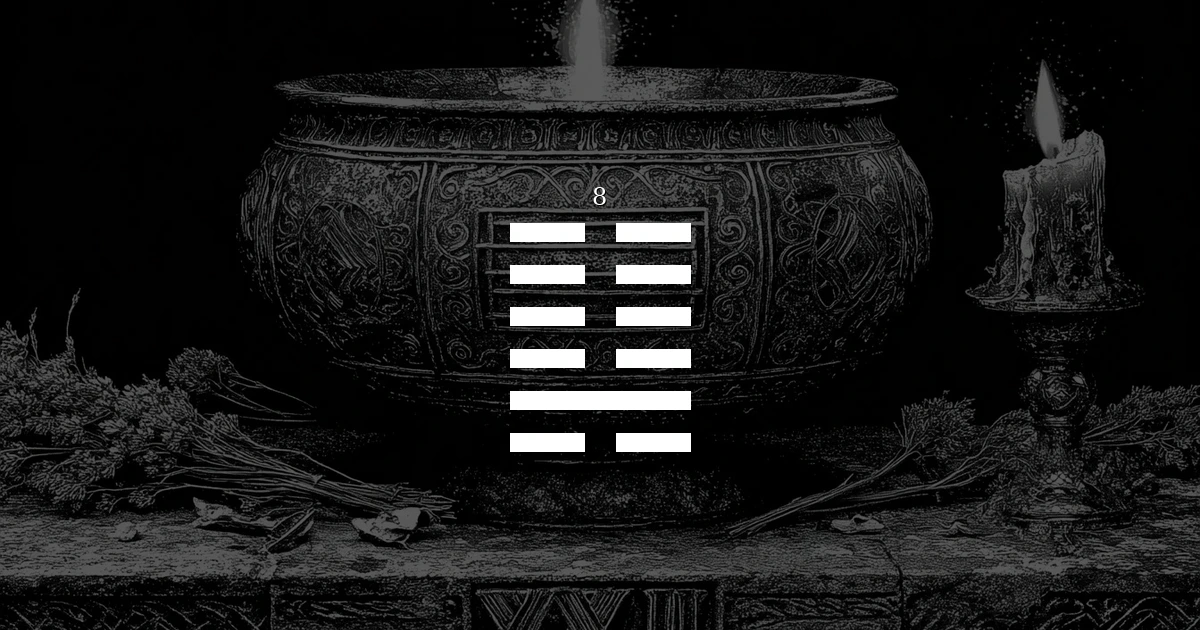
What is Hexagram 52: Keeping Still?
The I Ching (易經, Yì Jīng) is one of the oldest philosophical and divination texts in human civilization. In The Whisper, a daily hexagram is drawn from your birth date and today’s date — a deterministic, daily-changing lens within the oracle synthesis.
Hexagram 52 (艮, Gèn) — “Keeping Still” or “The Mountain” — is formed by doubling the trigram ☶ Gen (Mountain). Two mountains stacked: the keeping-still principle amplified and concentrated. Where Hexagram 51 is doubled thunder, doubled arousing, doubled shock — Hexagram 52 is the direct counterpart: doubled stillness, doubled mountain, the complete cessation of movement in both directions.
The character 艮 means to stop, to limit, to stand firm. In the Taoist understanding embedded in the I Ching, this is not inertia or avoidance — it is the specific practice of stillness that is as active and as demanding as the most vigorous movement. Keeping still well is not easy; it requires the same quality of genuine engagement as moving well.
The two trigrams: reading the structure
Both upper and lower trigrams are Gen (艮, Mountain ☶): two unbroken yin lines above one unbroken yang line — the mountain’s form. Gen is the youngest son, the quality of stopping at the appropriate moment, holding firm without forcing, the accumulation that has reached its natural resting point.
The doubled mountain creates a specific image: mountain upon mountain, the quality of genuine stillness applied to both the inner (lower trigram) and outer (upper trigram) dimensions of experience. It is not enough to be still in one direction while active in another; the hexagram describes the thoroughgoing quality of genuine rest that encompasses both what one does and what one is oriented toward internally.
The single yang line at the first position of each trigram — below the two yin lines — is structurally the mountain’s base: the genuine grounding from which the mountain rises. This solid foundation is what makes genuine stillness possible; without it, what appears to be stillness is merely the momentary pause of something that has temporarily run out of energy.
The core teaching of Keeping Still
The hexagram statement contains some of the I Ching’s most radical and specific imagery: “Keeping his back still so that he no longer feels his body. He goes into his courtyard and does not see his people. No blame.”
This is the hexagram’s central image of genuine stillness, and it is genuinely unusual. “No longer feels his body” — the complete integration of attention that genuine stillness produces, where the usual ego-oriented self-monitoring ceases. “Goes into his courtyard and does not see his people” — the quality of genuine inward focus that does not register the usual social field. These are not descriptions of dissociation or abandonment; they are the specific qualities of deep, genuine stillness — the absorption of complete presence.
The back — where ego tends to reside in this tradition, the place of self-assertion and defensiveness — is specifically the focus of the hexagram’s stillness. Keeping still in the back means neither asserting the self forward into what is not one’s business nor withdrawing the self from what is. The courtyard image is about appropriate limitation: the courtyard is one’s genuine domain; the people there are genuinely within one’s sphere; but in the moment of genuine stillness, even this is not the focus.
The progression through the lines from feet to calves to hips to torso to cheeks and head describes the practice of genuine stillness moving upward through the body — the gradual achievement of complete, integrated stillness that begins with the simplest stopping and develops toward the genuinely absorbed quality described in the central image.
How Keeping Still appears in daily life
Hexagram 52 in daily experience presents as both the invitation to genuine stillness and the specific difficulty of genuine rest in a culture and period that continuously stimulates activity.
The first form is the experience of having arrived at a natural stopping point — the moment when what has been in motion has genuinely completed its movement and the appropriate next thing is not more movement but genuine rest. Many people in this moment immediately initiate the next movement: the project ends and another begins before the completion has been genuinely acknowledged. The hexagram specifically addresses this: the stopping that the mountain quality calls for is not the brief pause between activities but the genuine rest of something that has actually come to its natural conclusion.
The “no longer feels the body” quality appears in daily life as the difference between the kind of stillness that is actually suppressed activity — the person sitting “still” while internally running through everything they need to do — and genuine rest, where the ordinary monitoring and planning have genuinely ceased. The former is not the hexagram’s stillness; it is movement in a different medium. The latter, which most people access rarely, is what the doubled mountain describes.
The back-stillness teaching appears practically as the specific discipline of not projecting the ego forward into what is not one’s genuine business. The mountain’s quality is its natural limitation: it occupies its own place fully and does not attempt to occupy other places. In daily terms, this appears as the discipline of genuinely minding one’s own genuine domain rather than the restless projection of attention and concern into what is beyond it.
What this means in The Whisper
In Nine Star Ki, Hexagram 52 resonates with Eight White Earth Star (八白土星) — the mountain archetype in the nine-star system, both associated with genuine stillness, accumulated stability, and the quality of the threshold between cycles. Eight White years are years of genuine consolidation and the specific rest that prepares for what follows.
In BaZi, Hexagram 52 resonates with configurations where Earth element is dominant and stable — the well-grounded chart that has its foundation without excessive movement. Also resonant: Earth Day Masters (戊 Wu, 己 Ji) in their most consolidated expression, particularly in seasonal configurations that support Earth.
In Western Astrology, Hexagram 52 resonates with Saturn in the 12th house — the specific period of genuine inner preparation and withdrawal that precedes the next Saturn cycle’s public expression — and with Capricorn themes generally: the mountain’s quality of patient, accumulated, grounded stability. Also resonant: meditation aspects in the natal chart, particularly Moon-Saturn or Neptune-Saturn contacts that support genuine stillness.
When the synthesis simultaneously points toward genuine rest, the completion of a cycle, or the specific practice of stillness — an Eight White Nine Star Ki year, a stable Earth BaZi configuration, Saturn in a preparation position — a daily draw of Hexagram 52 tends to produce a Whisper about the specific quality and location of genuine rest that is available today: where the back can be genuinely kept still, where the courtyard can be genuinely entered without projecting attention elsewhere.
Frequently asked questions
Q: Is Hexagram 52 telling me to stop everything and do nothing today?
The hexagram describes a specific quality of genuine stillness rather than prescribing that all activity cease. The mountain is not inactive — it simply does not move. Within its domain, within its genuine function, it is fully present. What the hexagram calls for is the quality of not-reaching-beyond: not projecting attention into what is beyond the genuine domain, not initiating movement that is beyond the natural rhythm of what is. This can coexist with genuine activity within one’s proper sphere; what it excludes is the restless, ego-driven projection beyond it.
Q: What is the difference between genuine rest and passive avoidance?
The hexagram’s image of the mountain is helpful here: the mountain does not avoid — it simply is, fully, in its place. Genuine rest has a quality of completion and presence: it is the rest that comes after genuine movement has genuinely concluded, or the stillness that is genuinely called for in the current moment rather than the stillness of someone who cannot engage. Passive avoidance has a quality of absence and tension: the person is technically still but is not genuinely resting because they are oriented away from what they are avoiding rather than fully present in the stillness. The back-still test is relevant: genuine rest can feel the body without the usual ego-monitoring; avoidance cannot fully feel the body because it is partially occupied with what is being avoided.
Q: The hexagram mentions going into the courtyard and not seeing one’s people. Is this about isolation?
Not isolation in the sense of permanent withdrawal from genuine relationship. The courtyard is specifically one’s own genuine domain — the appropriate scope of one’s genuine responsibility and engagement. The “not seeing one’s people” in this context describes the quality of complete inward focus during genuine stillness: the natural social field is temporarily not the focus. This is the quality of genuine meditation, genuine absorption, genuine rest — the temporary suspension of social orientation in favor of complete presence. It is not abandonment; it is the specific quality of the mountain’s stillness, which is available to return to genuine engagement when the period of keeping still has completed its function.