
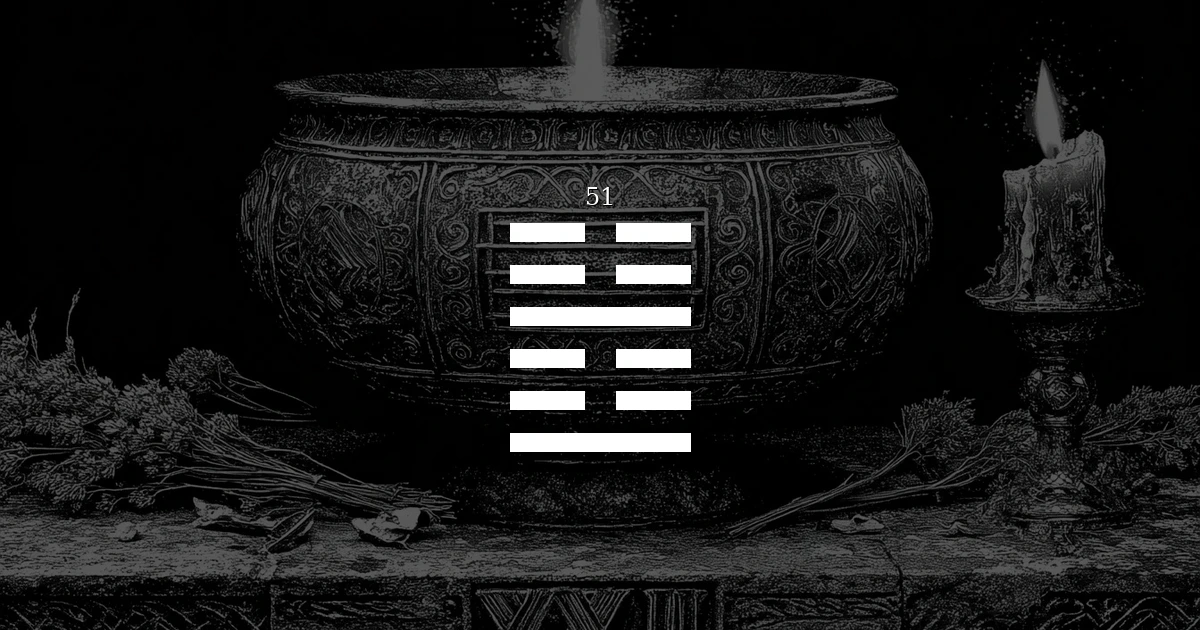
What is Hexagram 51: The Arousing?
The I Ching (易經, Yì Jīng) has guided reflection across East Asia for more than 3,000 years. In The Whisper, a daily hexagram is drawn from your birth date and today’s date through a deterministic process — a lens that changes each day and contributes to the oracle synthesis.
Hexagram 51 (震, Zhèn) — “The Arousing” or “Shock/Thunder” — is formed by doubling the trigram ☳ Zhen (Thunder). Both the upper and lower trigrams are the same: two broken yin lines above one unbroken yang line, the image of thunder breaking from beneath the earth, bursting upward through the ground. When two identical trigrams are stacked, the hexagram takes on the doubled and amplified quality of that trigram — in this case, shock upon shock, thunder upon thunder, the arousing quality repeated and intensified.
The character 震 means to shake, to tremble, to be aroused, to strike. It is the quality of the sudden, the awakening, the disruption of the established order by something that breaks through from below. In East Asian cosmology, thunder in spring is the annual arousing: it wakes what has been dormant through winter, initiates the year’s growing season, shakes free what has been frozen. Hexagram 51 is this quality doubled.
The two trigrams: reading the structure
Both upper and lower trigrams are Zhen (震, Thunder ☳): the eldest son, the initiating force, the energy that breaks through the surface and arouses what has been still.
The doubled Thunder creates a specific dynamic: the first shock arouses; the second shock tests whether the equanimity holds after the first has passed. This is the hexagram’s deepest teaching — not about handling a single shock but about maintaining inner composure through a pattern of shocks that arrive one after another. The first thunder may startle; the second thunder tests whether the fear that arose with the first has been genuinely integrated or only suppressed.
The yang line in the first position of each trigram — below the two yin lines — is the structural image of the initiating energy that breaks from beneath the yin into visible expression. This is the thunder that comes from within the earth: not imposed from above but arising from genuine depth, the energy that has been building and now erupts.
The core teaching of The Arousing
The hexagram statement describes a specific quality of engagement with shock: “The arousing brings success. Shock comes — oh, oh! Laughing words — ha, ha! The shock terrifies for a hundred miles, and he does not let fall the sacrificial spoon and chalice.”
This statement is one of the I Ching’s most specific images of the quality it admires. The first shock: fear, the “oh, oh” of genuine surprise and terror. The integration: laughter, the “ha, ha” that follows when the shock has passed through without overwhelming. And the most demanding image: the sacrificial ceremony continues even in the midst of the shock. The spoon and chalice are not dropped. What was in progress — the serious, intentional act of offering — is completed even while the thunder roars around it.
This is not an injunction to suppress fear or to pretend shock is not happening. The “oh, oh” is genuine — the terror is real. What the hexagram describes is the person who feels the shock genuinely and then recovers — who does not let the genuine fear become a permanent disruption of their genuine purpose. The ceremony is not stopped; the vessel is not dropped. This is the quality of genuine equanimity in the face of shock: not the absence of response, but the sustained purpose through and after the response.
The “hundred miles” image is significant: the shock is genuinely large and genuinely reaches far. The person who maintains composure while the shock radiates to a hundred miles is not undisturbed by something small; they are maintaining genuine equanimity through genuine disruption.
How The Arousing appears in daily life
Hexagram 51 in daily experience presents in two recognizable forms: the first shock and the question of its integration, and the second shock and the question of whether what was integrated holds.
The first form is the experience of genuine disruption: the unexpected event, the sudden change, the news or discovery that genuinely alters what you thought you knew. The hexagram acknowledges this is genuinely frightening — “oh, oh” is the appropriate initial response — and does not advise premature cheerfulness. The quality it calls for is not the suppression of the fear but the integration of it: allowing the shock to move through rather than holding it, so that the laughter — the genuine release of the recovered equanimity — can arrive.
The second form is the test of whether genuine integration has occurred: the second thunder that arrives before the first has fully resolved, or the pattern of repeated disruptions that tests whether equanimity is genuinely present or merely performed. Many people can handle one significant shock with apparent grace; the doubled thunder tests whether the composure that returned after the first was genuine or was only the calm of someone who has not yet had time to be shocked again.
The “don’t drop the spoon and chalice” quality appears practically as: what is most genuinely important, most genuinely in progress, should be sustained through shock rather than dropped at the first disruption. This requires clarity about what the spoon and chalice actually are — what the genuine ongoing purpose is that must be sustained — and the genuine composure that allows continuation without suppression.
What this means in The Whisper
In Nine Star Ki, Hexagram 51 resonates with Three Jade Wood Star (三碧木星) in its most intense, arousing expression — the thunder that has fully arrived, the initiating quality doubled and amplified. Three Jade years that coincide with other arousing energies in the nine-star system are particularly resonant with the doubled thunder quality.
In BaZi, Hexagram 51 resonates with configurations showing strong Thunder or Zhen element — particularly Yang Wood (甲 Jia) in a Wood-heavy configuration — and with days that bring multiple clash configurations simultaneously. The experience of multiple significant BaZi clashes in a single period mirrors the hexagram’s doubled-shock quality.
In Western Astrology, Hexagram 51 resonates with Uranus transiting significant natal points — the sudden disruption, the shock from within the established order that cannot be anticipated and cannot be resisted — and specifically with Uranus conjunct natal Mercury or Uranus (the nervous system at the point of maximum arousal). Also resonant: Mars triggers to Uranus in the natal chart, which tend to produce the specific quality of sudden arousing shock.
When the synthesis shows multiple systems pointing toward sudden disruption, unexpected awakening, or the testing of composure under shock, a daily draw of Hexagram 51 tends to produce a Whisper specifically about the quality of inner equanimity currently available: whether the spoon and chalice can be held, whether the “ha ha” of genuine recovery is accessible after the “oh oh” of genuine fear.
Frequently asked questions
Q: Is this hexagram telling me a shock is coming?
The Whisper does not predict specific events, and neither does the I Ching in its hexagram statements. Hexagram 51 appearing in the daily draw is not a prediction that something shocking will happen today; it is a description of the specific quality that the present moment has — the arousing, the awakening, the quality of thunder — as a lens for reflection. The question it poses is about the quality of your current relationship to disruption and shock: how you are currently positioned to maintain equanimity when shock arrives, and whether the spoon and chalice are clearly enough held that they can be sustained through disruption.
Q: What is the “laughter after shock” that the hexagram describes?
The “ha ha” of the hexagram’s statement is specifically the laughter of genuine recovery — the specific release that happens when genuine fear has genuinely passed through rather than been suppressed. This is different from the performed laughter of someone covering their fear, and different from the gallows humor of someone who has not yet genuinely faced what has happened. It is the specific quality of relief and recovery that comes from having genuinely passed through a genuine shock and emerged with the essential self intact. It is the body’s and spirit’s signal that the integration has genuinely occurred.
Q: How does one develop genuine equanimity in the face of shock, rather than just performing it?
The hexagram’s image is instructive: the person who maintains the ceremony in the midst of the thunder has a specific relationship to what they are doing — genuine purpose that is clear and prior to the shock. The composure comes not from training oneself to feel nothing in response to disruption but from having something so genuinely important in hand that it provides the stabilizing focus through the disruption. The “spoon and chalice” are not held through suppression of the shock but through the genuine importance of not dropping them. Identifying and deeply committing to what is most genuinely important tends to produce genuine equanimity more reliably than any practice specifically aimed at not feeling shock.