
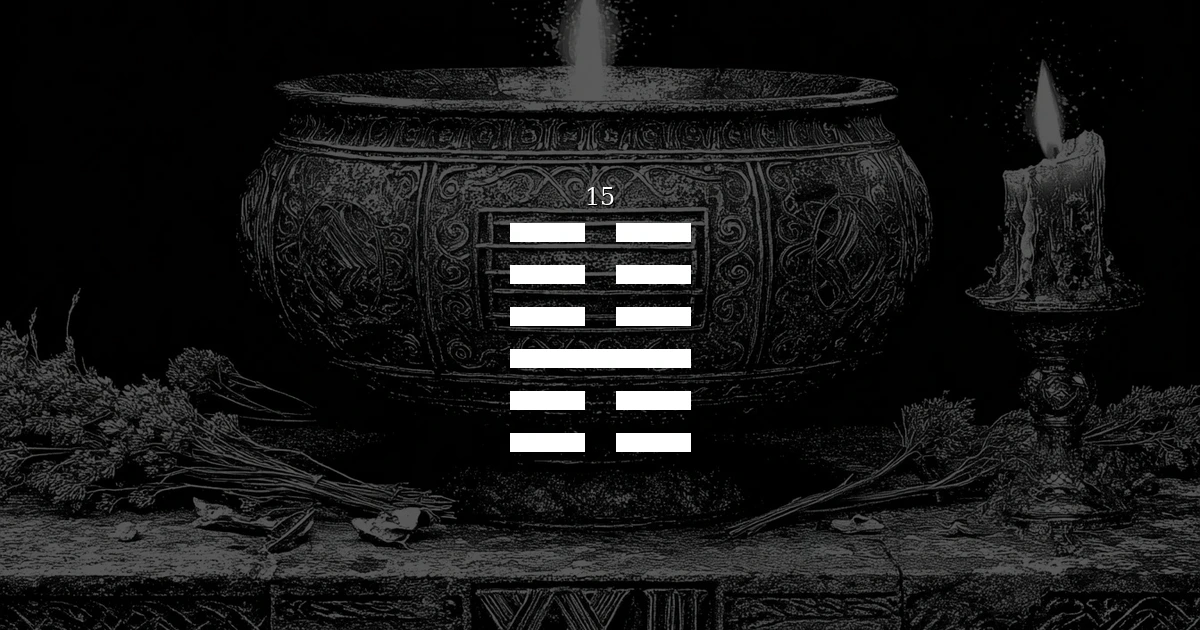
What is Hexagram 50: The Cauldron?
The I Ching (易經, Yì Jīng) provides a daily hexagram in The Whisper, drawn from your birth date and today’s date through a deterministic process. Hexagram 50 (鼎, Dǐng) — “The Cauldron” — is one of the I Ching’s most culturally significant hexagrams. The ding (鼎) is not merely a cooking vessel; it is the ritual bronze cauldron of ancient Chinese civilization — the sacred object used for ancestral sacrifices, the symbol of legitimate dynastic authority, and the vessel in which raw material is transformed into refined nourishment for the highest purposes.
The I Ching uses this specific, historically loaded object as the symbol of culture itself: the process by which civilization takes what is raw and transforms it, through sustained heat and careful attention, into something capable of genuinely nourishing what is most excellent in human life. This hexagram is specifically about the quality of transformation and the highest uses to which what has been transformed is offered.
The two trigrams: reading the structure
The upper trigram is Li (離, Fire ☲) — clarity, illumination, the clinging fire; the quality of brilliant consciousness that illuminates what it engages with. The lower trigram is Xun (巽, Wind/Wood ☴) — in its wood quality, the fuel that feeds the fire; in its wind quality, the breath that increases the fire’s intensity.
The image: fire above wood — wood and wind feeding the fire that burns within the cauldron. The cauldron itself stands on three legs (the hexagram’s legs are in the lower three lines), filled with material to be transformed (the middle two lines), and its handles and bronze ring are in the upper lines. The hexagram’s visual structure maps directly onto the cauldron’s physical form: this is the I Ching encoding its meaning in structure as well as text.
The fire that burns within the cauldron illuminates from above: the clarity of Li transforms what is held within the sacred vessel. The wood and wind below ensure the fire is properly fed and sustained. The transformation that the cauldron produces is therefore the direct result of: the quality of what is placed within it, the quality of the fire that transforms it, and the quality of the attention that tends the process.
The core teaching of The Cauldron
The hexagram statement is among the I Ching’s most straightforwardly favorable: “The cauldron. Supreme good fortune. Success.” But the fullness of this favorable judgment is conditional on the quality of what the cauldron is used for — the most important condition of all.
The traditional commentary specifies: the cauldron is the most excellent sacred vessel, used for nourishing the worthy and the wise; for making offerings to the Supreme Deity; and for treating guests at the great feast. The cauldron’s value is specifically in these highest uses — the nourishment of genuine excellence, the offering to what transcends the human, the genuine generosity of the great feast.
The cauldron’s legs that are inverted to dump out what is rotten — the first line’s image — is not a failure but a necessary beginning: before transformation can produce genuine nourishment, what is already spoiled must be removed. The cauldron that begins by clearing out what cannot be transformed is being properly prepared for its genuine function.
The jade handles and bronze fittings of the hexagram’s upper lines represent the quality of workmanship and attention that the highest uses of the cauldron require. The sacred vessel is not treated casually; it is maintained, attended to, and approached with the seriousness that its function requires. The cauldron that is carelessly handled — the handles broken, the fittings loose — cannot perform its highest function regardless of what is placed within it.
The pheasant’s fat — the image in the middle lines of the most excellent material, pure and ready for transformation — represents the quality of raw material that the cauldron’s highest uses require. Not everything placed in the cauldron produces the excellent nourishment; the quality of what is placed within matters as much as the quality of the vessel and the fire.
How The Cauldron appears in daily life
Hexagram 50 in daily experience presents as the specific quality of conscious transformation: the moment when raw material — experience, knowledge, talent, or genuine encounter with the world — is being deliberately transformed through sustained attention and genuine care into something that can nourish what is most excellent.
The hexagram appears in the experience of craft at its most serious: the artist, writer, musician, or craftsperson who is genuinely transforming what has come to them through the process of genuine making, producing something that can genuinely nourish those who encounter it. It appears in teaching at its highest: the transformation of knowledge into wisdom, offered to those genuinely capable of receiving it. It appears in any domain where genuine cultivation — sustained heat, careful attention, the quality of the vessel — is transforming raw capacity into genuine nourishment.
The “nourishment of the excellent” dimension is specifically important. The cauldron’s highest function is not to feed everyone indiscriminately but to nourish what is genuinely excellent — the worthy, the wise, what is most genuinely valuable. In daily terms, this appears as discernment about where the fruits of genuine transformation are most genuinely needed: offering what has been genuinely cultivated to what genuinely needs and can receive it, rather than diffusing it across every available context.
The care of the vessel is also practically present: the practices, structures, and conditions that sustain the quality of ongoing transformation need to be tended rather than taken for granted. The cauldron that is not maintained — the vessel whose structure is allowed to deteriorate — cannot perform its highest function regardless of the quality of the fire or the material.
What this means in The Whisper
In Nine Star Ki, Hexagram 50 resonates with Nine Purple Fire Star (九紫火星) in its highest cultural expression — the brilliance that transforms what it illuminates, the fire that produces genuine cultural nourishment rather than merely illuminating surfaces. Nine Purple years, particularly when combined with favorable supporting stars, amplify the cauldron’s transformative quality.
In BaZi, Hexagram 50 resonates with Fire Day Masters (丙 Bing, 丁 Ding) in configurations where the fire is properly supported and directed toward genuine transformation rather than simply burning. The 丁 (Ding) Fire — candlelight, the refined flame — specifically resonates with the sacred vessel’s quality of precise, intentional illumination. Configurations showing Fire transforming Metal (金火相剋 in a creative rather than destructive direction) are particularly resonant.
In Western Astrology, Hexagram 50 resonates with Chiron placements — the wounded healer who transforms personal experience into genuine nourishment for others — and with Neptune in the 5th or 10th house, the transcendent quality that elevates creative work from personal expression into cultural contribution. Also resonant: Sun-Neptune contacts that carry the quality of illuminated, transformative creativity.
When the synthesis shows multiple systems pointing toward transformation, refinement, and the offering of what has been genuinely cultivated to what genuinely needs it — Nine Purple Nine Star Ki energy, Fire-based BaZi configurations, Neptune-Sun contacts — a daily draw of Hexagram 50 tends to produce a Whisper specifically about the quality of current transformation: what is being transformed, by what fire, in what vessel, and toward whose genuine nourishment.
Frequently asked questions
Q: The cauldron is used for feeding the worthy and wise. Is the hexagram saying I should be selective about who I share my work with?
The hexagram’s “nourishment of the excellent” teaching is less about social selection than about genuine function. The cauldron nourishes what is genuinely excellent in the moment — what is most genuinely capable of receiving and using what has been transformed. In practice, this means offering what has been genuinely cultivated to contexts that are genuinely able to receive it, rather than either withholding it universally or dispersing it indiscriminately. The question is not “is this person worthy” but “is this context one where what I have genuinely made can genuinely function as nourishment?”
Q: What does it mean to “maintain the vessel” in the cauldron hexagram?
The vessel’s maintenance is the practices, conditions, and structures that sustain genuine transformation over time rather than allowing them to deteriorate. For a creative practice, this includes the regular showing-up, the conditions of genuine attention, the maintenance of the skills and knowledge that make transformation possible. For a relationship, it includes the ongoing genuine investment that keeps the vessel capable of genuine nourishment. For any ongoing transformative process, it is the care that ensures what has been built continues to function at the level required for its highest use.
Q: How does The Cauldron (Hexagram 50) relate to The Well (Hexagram 48)?
Both address nourishment, but from complementary angles. The Well (Hexagram 48) is about accessing the inexhaustible inner source — the raw water that is always genuinely present, and the preparation required to draw from it. The Cauldron (Hexagram 50) is about what happens after the water has been drawn: the transformation of raw material into refined nourishment through sustained heat and careful attention. Together they describe the full arc of genuine nourishment: accessing what is genuinely present, and then transforming it into the specific form that can genuinely serve the highest purposes.