
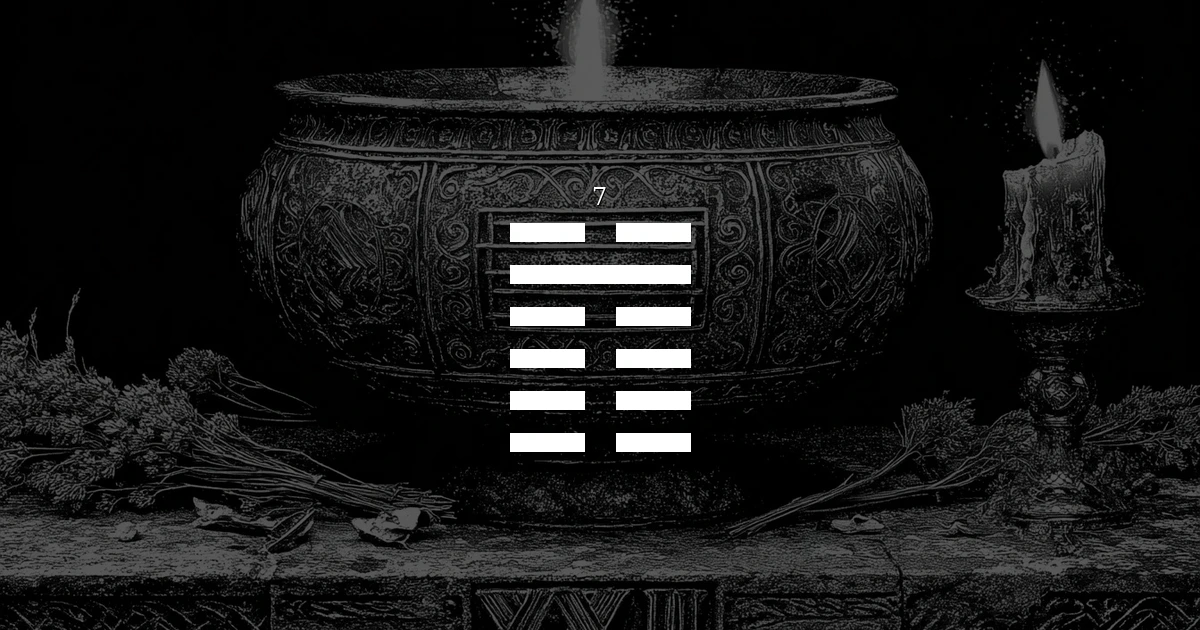
What is Hexagram 49: Revolution?
The I Ching (易經, Yì Jīng) has been consulted across East Asia for over 3,000 years as a guide to the nature of change. In The Whisper, a daily hexagram is drawn from your birth date and today’s date — a deterministic process producing a consistent result for each unique date pairing.
Hexagram 49 (革, Gé) — “Revolution” or “Molting” — is the I Ching’s hexagram of fundamental change. The character 革 originally depicted an animal hide being stripped and tanned — the transformation of raw material into something fundamentally different through a complete process. Later it came to mean revolution, reform, fundamental change of system. Both meanings remain active in the hexagram: the organic transformation that produces genuine new form, and the systemic change that replaces what was with something genuinely different.
The hexagram’s central question is one of timing and genuine necessity: is the revolution whose time has genuinely come? Premature revolution fails; the revolution that comes when its time has arrived succeeds with a completeness that produces genuine transformation rather than mere disruption.
The two trigrams: reading the structure
The upper trigram is Dui (兌, Lake ☱) — the joyous, open quality; the lake; genuine pleasure and receptive expression. The lower trigram is Li (離, Fire ☲) — clarity, brilliance, the clinging fire that illuminates as it transforms.
The image: fire within the lake — or more precisely, lake above fire. Water and fire in direct opposition: each transforms the other. Fire heats water to steam, changing its state completely; water extinguishes fire, ending its form. The radical opposition between these two elements is precisely why this is the hexagram of revolution rather than mere change: when fire and water meet directly, fundamental transformation is the only outcome. Partial change is not available; the meeting of these two forces produces complete transformation in one direction or the other.
The direction of the transformation in a revolution — which element transforms which — depends entirely on the specific conditions and the specific quality of the engagement. The hexagram’s teaching is about ensuring that the revolutionary transformation is genuine and complete rather than premature and destructive.
The core teaching of Revolution
Hexagram 49’s statement is remarkably specific about timing: “Revolution. On your own day you are believed. Supreme success, furthering through perseverance. Remorse disappears.” The “own day” is the key phrase — the moment when the revolution has genuinely arrived at its proper time, when the accumulated pressure and preparation and necessity have all converged at the specific moment of genuine possibility.
“On your own day” suggests that there is a specific moment — not any moment, not before the preparation is complete, not after the opportunity has passed — when revolutionary change is genuinely possible and genuinely believed. Before this day, the same revolutionary proposal will be met with doubt and resistance; after it, with regret that it did not happen sooner. The timing is not arbitrary; it is the specific convergence of genuine readiness and genuine necessity.
The sequence described in the tradition’s commentary is important: before the revolution, there is doubt; after the revolution is complete, confidence and recognition return. The “day of doubt” is specifically not a signal that the revolution is wrong; it is the characteristic initial response to genuine fundamental change. The tradition’s acknowledgment of this doubt is honest: genuine change is always initially doubted, because it genuinely disrupts what was established.
The tiger and leopard images in the hexagram’s later lines are among its most memorable: the superior man changes like a tiger — bold, clearly defined patterns, the change is visible and complete. The common people change like a leopard — elegant smaller patterns, the change is in the smaller details. After the revolution, the lesser people follow superficially — adapting their surface appearance to the new order. These three levels of response to genuine revolutionary change are all present in any genuine transformation.
How Revolution appears in daily life
Hexagram 49 in daily life appears in two forms: the recognition that the time for fundamental change has genuinely arrived, and the active engagement with that change at the appropriate level.
The first form — recognition of genuine timing — is often the most important and most missed dimension of the hexagram. Many attempted revolutions (in personal life as well as social life) fail not because the change was wrong but because the time had not yet arrived. The person who attempts to fundamentally change a relationship, a career, a habit, or a life direction before the “own day” has arrived typically finds that the change does not hold — the conditions were not yet ripe for the transformation to complete. The hexagram’s counsel is genuine patience with the preparation phase combined with bold, complete action when the moment of genuine possibility arrives.
The second form — the quality of action when the time is right — is about completeness. Revolution in the hexagram’s sense is not incremental; it is the fundamental change of state, like water becoming steam. When the time is genuinely right, the revolutionary action should be bold and complete rather than hedged. The tiger’s change is visible and clearly patterned; the leopard’s is elegant in its detail. Both are complete.
The doubt that precedes genuine revolutionary change is particularly important to recognize. If the change is premature, doubt signals genuine unreadiness. But if the change is genuinely timely, the initial doubt is the characteristic response to genuine disruption — it passes as the new form establishes itself and its genuine quality becomes visible.
What this means in The Whisper
In Nine Star Ki, Hexagram 49 resonates with years when the personal star completes a full nine-year cycle and begins the next — the specific revolutionary moment in the nine-star system when the pattern of the previous nine years is genuinely complete and the next pattern genuinely begins. This is recognized in Japanese Nine Star Ki practice as a year requiring and supporting genuine fundamental reassessment.
In BaZi, Hexagram 49 resonates with major luck pillar transitions — the ten-year shifts in the BaZi system that bring genuinely new elemental conditions. The transition years when the old luck pillar is completing and the new one is just beginning carry exactly the hexagram’s quality: fundamental change of the elemental environment, the “own day” of BaZi’s long cycles.
In Western Astrology, Hexagram 49 resonates most strongly with Pluto transits — the planet of fundamental, irreversible transformation in the Western astrological tradition. Pluto conjunct or square significant natal chart positions brings the hexagram’s quality directly: genuine fundamental change that, once begun, completes itself fully rather than producing partial transformation. Also resonant: major Saturn returns (at age 29 and 58), the astrological markers of genuine new phases.
When the synthesis shows multiple systems simultaneously pointing toward genuine fundamental change — a nine-star cycle completion, a BaZi luck pillar transition, a Pluto transit — a daily draw of Hexagram 49 tends to produce a Whisper that is unusually direct about the specific nature of the transformation that is genuinely available in this moment and what bold, complete engagement with it would look like.
Frequently asked questions
Q: How do I know if it’s “my own day” — if the revolution’s time has genuinely arrived?
The hexagram’s image suggests several qualities that accompany genuine readiness: the accumulated pressure has built to the point where the current form is genuinely no longer adequate; the resources for the transformation (whether material, relational, or inner) are genuinely present rather than just hoped for; and there is a quality of “now or never” that is genuine rather than manufactured by impatience. The “on your own day you are believed” quality appears as the specific experience of the idea or change being received differently — with more genuine recognition — than it was before. This reception change is one of the most reliable indicators that the timing has genuinely arrived.
Q: What makes revolutionary change fail when attempted prematurely?
Premature revolution fails for the specific reason that the conditions for the new form to establish itself have not yet developed. Like the animal hide that is not yet ready for tanning — the transformation process is initiated before the material is prepared, and the result is damaged rather than transformed. In personal terms, the premature revolution typically involves changing the external form before the internal preparation is complete: changing the external structure of a relationship before the inner work is done, changing the career before the genuine capability in the new direction is developed, attempting to establish new patterns before the old ones are genuinely exhausted. The external change without the internal preparation tends not to hold.
Q: The hexagram mentions that common people “change their faces.” Is this a criticism?
Not exactly. The tradition describes three levels of genuine response to revolutionary change: the tiger (bold, complete, clearly patterned change), the leopard (elegant, detailed, thorough change), and the people who change their faces (surface adaptation to the new order). These are not ranked in terms of moral value but in terms of the depth of genuine engagement with the transformation. Most genuine revolutionary change involves all three: the deep, fundamental change in the tiger pattern; the elegant refinement in the leopard pattern; and the surface adaptation of the many who are affected by the change without being at its center. Each is genuine at its own level.