
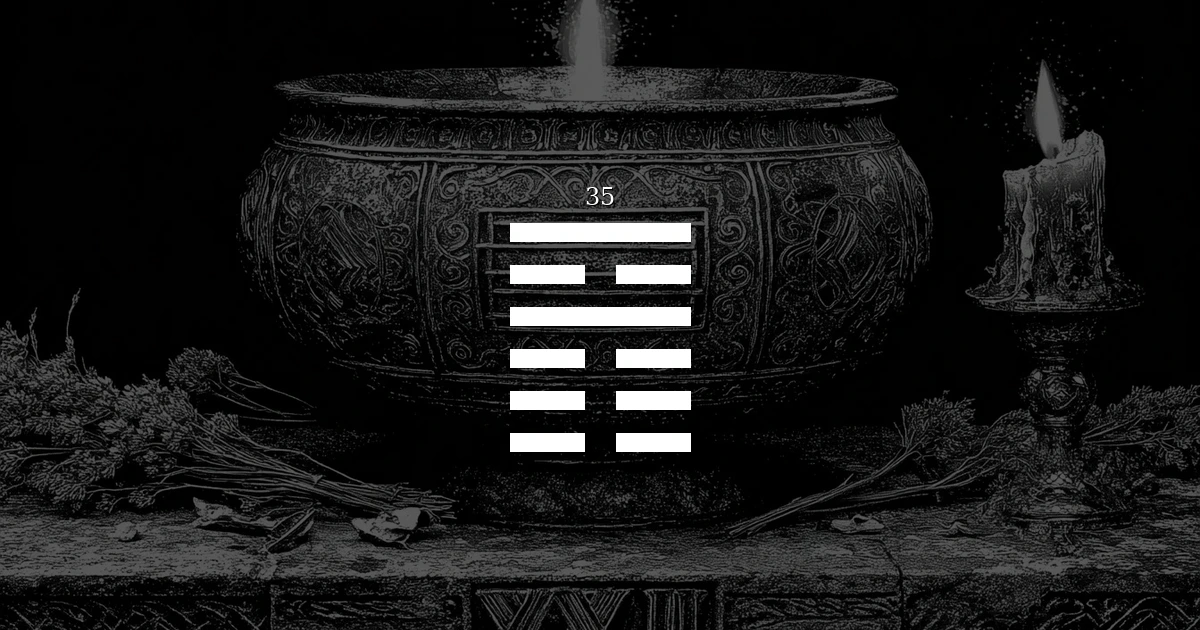
What is Hexagram 48: The Well?
The I Ching (易經, Yì Jīng) provides a daily hexagram in The Whisper, drawn from your birth date combined with today’s date. The hexagram’s appearance is deterministic — the same combination of dates always produces the same hexagram — framed as the specific alignment of when you were born with what today is, rather than as random selection.
Hexagram 48 (井, Jǐng) — “The Well” — is one of the I Ching’s most enduring images. The well is among humanity’s oldest and most universal structures: the shaft sunk into the earth to access the water that sustains life, the technology that makes permanent habitation possible, the source that remains constant while everything around it changes. In the I Ching, the well becomes the symbol of the inexhaustible inner resource — and of the conditions required to actually draw from it.
The two trigrams: reading the structure
The upper trigram is Kan (坎, Water ☵) — depth, the water that is genuinely there, the source of genuine nourishment. The lower trigram is Xun (巽, Wind/Wood ☴) — in its wood quality, the wooden structure that lines the well shaft, that provides the form through which the water can be reached.
The image: water above wood — the wooden bucket and rope that draw the water up; the wooden structure that makes the well function. The water is in the depths; the wood is the means of access. Without the wood, the water cannot be drawn; without the water, the wood serves no purpose. The hexagram is specifically about this relationship between the inexhaustible source and the technology, practice, or preparation required to access it.
The well image is particularly powerful because it is both static and dynamic simultaneously. The well doesn’t move — “people come and go, the well remains” is the hexagram’s central image. Cities change, governments change, people change — and the well remains, offering the same water to each generation. But the drawing of water is dynamic: it requires the rope, the bucket, the ongoing act of letting down and pulling up. The source is constant; the access requires continuous, properly prepared engagement.
The core teaching of The Well
The hexagram statement contains one of the I Ching’s most specific and practical teachings: “The town may be changed, but the well cannot be changed. It neither decreases nor increases. They come and go, drawing from the well. If one gets down almost to the water and the rope does not quite reach the water, or the jug breaks, it brings misfortune.”
Each element of this statement is practically significant. “The town may be changed, but the well cannot” — the deepest sources of genuine nourishment do not change with surface conditions. The same practices, the same genuine wisdom, the same quality of inner attention that nourished human beings in previous generations are still present and still nourishing — they are not invalidated by the changed surface conditions of modern life.
“It neither decreases nor increases” — the genuine source is genuinely inexhaustible. This is not optimism; it is the specific quality of genuine inner resource. The practice of genuine attention, genuine wisdom, genuine cultivation of what is most deeply human — these do not run out through use. They are more available, not less, the more genuinely they are drawn from.
“If the rope does not quite reach the water, or the jug breaks, it brings misfortune” — this is the most practically important line. The tragedy described is specifically the tragedy of being almost there. The source is present; the intention is present; the effort has been made — and the rope is just too short, or the jug breaks at the critical moment. The nearness of genuine nourishment combined with the failure to actually access it is genuinely painful and specifically preventable.
The implication is clear: the preparation — the rope length, the quality of the jug — is as important as the presence of the well. Approaching genuine inner sources with inadequate preparation produces the most frustrating kind of failure: the near-miss of what was genuinely available.
How The Well appears in daily life
Hexagram 48 in daily experience appears in two primary forms, which are the two sides of the hexagram’s teaching.
The first is the recognition of the inexhaustible source: the realization that what is genuinely nourishing — genuine creative capacity, genuine wisdom, genuine connection, genuine practice — is not a finite resource that depletes through use but a well that offers more the more genuinely it is drawn from. This experience has a specific quality: the sense that what is most genuinely valuable about oneself and one’s life does not diminish through genuine engagement but actually becomes more available. The artist who draws from genuine creative source finds it more present after genuine creation; the person who genuinely gives from genuine care finds themselves more genuinely caring rather than depleted. This is the well’s quality.
The second form is the short rope or broken jug: the experience of genuine near-miss, of arriving at the source with inadequate preparation and failing to actually draw the water that was genuinely present. This might appear as: the meditation practice that is genuine but too brief to actually settle into the deep water; the creative work that begins genuinely but doesn’t reach the material that matters before the session ends; the relationship conversation that approaches genuine depth but breaks off before arriving there. The hexagram specifically addresses this form of preventable failure — not the failure of intention or source, but of preparation and equipment.
What this means in The Whisper
In Nine Star Ki, Hexagram 48 resonates with One White Water Star (一白水星) — both associated with depth, genuine inner resource, and the inexhaustible quality of the water that does not deplete through genuine use. One White years and months are particularly resonant with the hexagram’s quality of genuine inner depth.
In BaZi, Hexagram 48 resonates with configurations where Water element in the natal chart represents genuine inner resource rather than excessive flow — the well-structured Water that nourishes rather than floods. Also resonant are configurations showing strong Ren (壬) Water in the Day Master or supportive positions: the deep, structured water of the well rather than the undirected flow.
In Western Astrology, Hexagram 48 resonates with Neptune in favorable aspect to the natal chart — the access to deep collective nourishment through properly prepared vessels; and with Moon in the 4th house or strong lunar themes generally — the inexhaustible inner source that the lunar principle represents. Periods of Saturn-Neptune contacts often raise the specific question of whether the current structures are adequate to draw from the source that is genuinely available.
When the synthesis shows multiple systems pointing toward genuine inner depth, the inexhaustible source, or the question of adequate preparation for genuine nourishment — One White Nine Star Ki energy, strong Water in BaZi, Neptune or deep lunar themes in Western Astrology — a daily draw of Hexagram 48 tends to produce a Whisper specifically about the quality of current access to what is most genuinely nourishing: whether the rope is long enough, whether the jug is whole, and what preparing more adequately for genuine access would look like.
Frequently asked questions
Q: What does “the town changes but the well remains” mean for modern life?
The hexagram is pointing toward the specific quality of genuine human resources — those that are not relative to particular cultural conditions, particular technologies, or particular surface arrangements. The practices that produce genuine presence, genuine creativity, genuine compassion, genuine wisdom — these are the well’s water, available to each generation and not diminished by the previous generation’s use. The “changed town” is everything that is genuinely relative to particular conditions; the well is what remains when the surface changes. The practical question: in your own life, what has the quality of genuine well — genuinely nourishing regardless of surface conditions, available more the more genuinely you draw from it?
Q: How do I know if my rope is too short or my jug is broken?
The near-miss experience has a recognizable texture: you reach toward something that is genuinely present — genuine creativity, genuine insight, genuine connection — and almost arrive before losing access. The rope is too short when the practices or structures that should take you into depth are just barely insufficient: the session too short, the preparation too superficial, the engagement too distracted to settle into what is actually there. The broken jug is when the container that should hold what is drawn (the ability to sustain what has been accessed, to integrate what has been received) cannot hold it. Both are specific, addressable problems: the rope can be lengthened, the jug can be repaired.
Q: Does this hexagram have anything to say about situations where I’m trying to support others rather than access my own source?
Yes. The well nourishes the town — it is specifically the source that sustains not only its drawer but the broader community. The hexagram’s image of people coming and going, all drawing from the same well, applies directly to the situation of someone trying to genuinely nourish others. The first question is whether the well is being maintained — whether the source that makes genuine support possible is being kept clear rather than allowed to silt up through neglect. A well that is not maintained stops providing water. The second question is the rope-and-jug question applied to how you access your own genuine resources in order to make them available to others: is the preparation adequate for genuinely drawing what is needed before it is offered?