
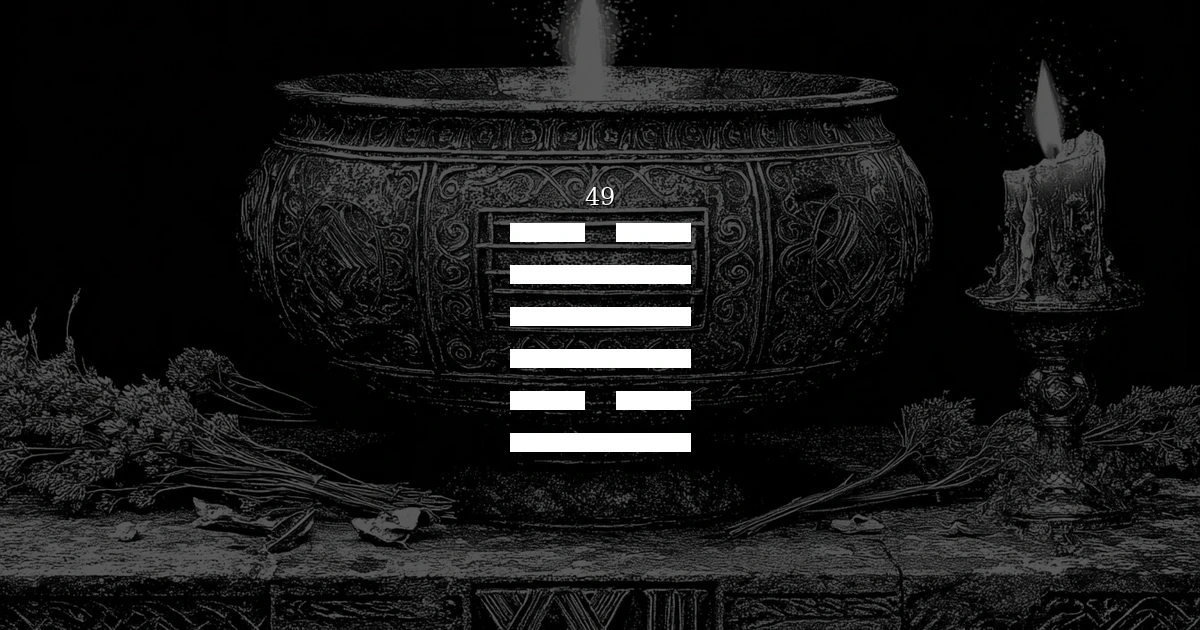
What is Hexagram 47: Oppression?
The I Ching (易經, Yì Jīng) has been consulted for over 3,000 years as a tool for understanding the specific quality of different moments in a life. In The Whisper, a daily hexagram is generated from your birth date and today’s date — a lens that changes each day and contributes to the oracle synthesis. The hexagram that arrives is not chosen; it is the specific quality of this date’s combination with your birth date.
Hexagram 47 (困, Kùn) — “Oppression” or “Exhaustion” — is one of the I Ching’s most honest hexagrams. It does not soften or reframe; it names directly what is happening: genuine constraint, genuine exhaustion, the specific condition where what is genuinely valuable cannot currently express itself in the world. The character 困 shows a tree trapped within a square enclosure — life that is genuine and real but has nowhere to grow.
This is not failure. It is a specific phase of genuine life — one that the tradition addresses with care precisely because it is genuinely difficult and genuinely common.
The two trigrams: reading the structure
The upper trigram is Dui (兌, Lake ☱) — the joyous, open quality; the lake that normally expresses freely. The lower trigram is Kan (坎, Water ☵) — danger, depth, the abyss, water seeking its lowest level.
The image: the lake above water — but in this configuration, the lake has been drained. The water that should fill the lake has leaked out below; the lake is empty. What should contain and express the joyous, open quality has been depleted at the source. The vitality that the lake represents is still genuine — the lake structure remains — but the water that fills it and makes it genuinely the lake has been lost.
This structural image captures the specific quality of genuine oppression: the capacity is real, the structure for expression is present, but the conditions have drained what was supposed to fill it. The exhaustion is not a fundamental incapacity; it is the depletion of what was there, in a context that has not allowed replenishment.
The two genuine yang lines in the hexagram — at the second and fourth positions — are each surrounded and constrained by yin lines. The strong is genuinely present but genuinely constrained. This is the hexagram’s honest acknowledgment: genuine strength and genuine constraint can coexist, and the constraint in this configuration is real, not merely perceived.
The core teaching of Oppression
The hexagram statement opens with one of the I Ching’s most specific paradoxes: “Oppression. Success. Perseverance. The great man brings about good fortune. No blame. When one has something to say, it is not believed.” The success and perseverance in the midst of oppression are specifically the success and perseverance of maintaining inner quality — not of overcoming the constraint through external action, but of sustaining genuine purpose while the constraint is present.
“When one has something to say, it is not believed” — this is the specific texture of genuine oppression. It is not merely that conditions are difficult; it is that the genuine person’s genuine words do not reach. The communication is blocked; the quality is present but cannot express itself in a way that is received. This is what makes oppression specifically oppressive rather than merely difficult.
The great man’s response: no complaint, because complaining is the specific misuse of the energy that genuine oppression requires for inner preservation. The tradition’s commentary is unsparing: “the man of strong will is not moved by any outward influence.” The inner quality is sustained regardless of whether it is currently being received or expressed.
The hexagram’s six lines describe a range of oppressive conditions with unusual specificity: sitting oppressed under a bare tree; oppressed under stone; coming into a dark valley; oppressed in a golden carriage; imprisoned; afflicted by creeping briers. What is notable is that the oppression appears at every level — material, psychological, social, even in conditions of relative material comfort (the golden carriage). The hexagram acknowledges that genuine oppression is not always visible from outside and is not limited to material deprivation.
The turning point in the hexagram — the movement toward eventual resolution — comes specifically through the inner work rather than through external action. The person who genuinely laments, who does not pretend the constraint is not real, who maintains their genuine purpose through the lamenting — this person eventually arrives at the resolution that the person who forces through or who pretends there is no difficulty cannot reach.
How Oppression appears in daily life
Hexagram 47 in daily experience appears in the specific quality of genuine exhaustion and constraint that does not respond to direct effort: the period when what you are genuinely trying to do keeps meeting resistance regardless of how hard you work; when what you say is consistently misheard or dismissed; when the conditions of your life do not currently support the expression of what is most genuinely you. This is not always dramatic; sometimes it is the slow, grinding quality of sustained conditions that simply don’t provide what genuine development requires.
The “words not believed” quality appears practically as the experience of genuine communication failure — not because the communication is poor but because the conditions are not currently receptive to what is being communicated. The person in genuine oppression often begins to doubt the quality of their communication, when the problem is actually the context’s current incapacity to receive it. The hexagram specifically names this so that the person can distinguish between a genuine communication problem (which calls for improvement) and a contextual reception problem (which calls for sustained inner quality rather than increased effort).
The “no complaint” teaching is subtle and important. It does not mean no honest acknowledgment — the hexagram names the condition directly rather than pretending it is not what it is. It means specifically the complaint that replaces inner work: the ongoing verbal processing of how bad conditions are that consumes the energy needed to maintain genuine purpose through them. Acknowledging the difficulty to oneself honestly, sustaining genuine purpose within it, and not exhausting one’s energy on complaint — this is the specific discipline Hexagram 47 calls for.
What this means in The Whisper
In Nine Star Ki, Hexagram 47 resonates specifically with years when the personal star is in the Five Yellow position — the central oppression position in the nine-palace cycle where the star’s expression is most significantly constrained. This is recognized in Japanese Nine Star Ki practice as a year requiring exceptional attention to inner quality rather than external expression.
In BaZi, Hexagram 47 resonates with unfavorable luck pillar periods where the Day Master’s most needed supporting elements are absent or suppressed, and the constraining elements are dominant. These periods — which appear in everyone’s BaZi chart — are specifically the periods that require the inner-quality focus the hexagram describes.
In Western Astrology, Hexagram 47 resonates with Saturn conjunct the natal Sun or Ascendant — the sustained pressure that tests the quality of what was previously able to express more freely — and with Saturn in the 12th house, the period of inner preparation and genuine constraint that precedes the next Saturn return. Also resonant: any period of significant outer planet pressure (Pluto square natal chart, Neptune dissolving what was structured) where the inner quality is being tested.
When the synthesis shows multiple systems pointing toward genuine constraint, the period of inner preparation, or the specific challenge of maintaining quality under sustained pressure — a Five Yellow year, an unfavorable BaZi luck period, a Saturn-Sun transit — a daily draw of Hexagram 47 tends to produce a Whisper that is unusually honest about what is actually present and what the specific quality of sustained inner work, rather than external effort, would look like in this moment.
Frequently asked questions
Q: Is this hexagram telling me to just accept a bad situation?
No. Hexagram 47 makes a specific distinction between accepting what genuinely cannot currently be changed and giving up genuine purpose in response to constraint. The tree in the square enclosure does not stop being a tree; it sustains its genuine nature while unable to grow in the directions currently blocked. The counsel is to maintain inner quality — to not lose what is most genuinely you in response to conditions that are genuinely constraining — rather than to suppress appropriate action or resign oneself to permanent diminishment. When conditions change (which the hexagram’s implied cyclical view suggests they will), what was maintained through the oppression period is what will be available for expression.
Q: What is the difference between “oppression” and an ordinary difficult period?
The hexagram’s specific indicators are the combination of genuine constraint with the specific failure of communication — “words not believed” — that distinguishes oppression from ordinary difficulty. Difficulty can often be addressed through increased effort or better approach; oppression is characterized by the specific blockage where genuine effort and genuine quality are not currently able to reach the contexts that would receive them. The tree trapped in the enclosure is not simply in hard soil; it is structurally prevented from growing in the directions that would allow natural development. If direct effort genuinely produces results, a different hexagram is likely more applicable.
Q: How long does an oppression period last in the I Ching’s view?
The hexagram does not specify a duration, which is honest: the length varies enormously depending on what is producing the constraint. The cyclical structure of the I Ching’s broader view suggests that oppression periods are genuinely temporary — that the cycle will eventually move toward more favorable conditions — but this does not diminish the genuineness of the constraint while it is present. The practical counsel is to engage with the inner quality work during the oppression period rather than either forcing through it (which tends to produce futile expenditure of energy) or waiting passively for conditions to change (which risks losing the quality that makes the next favorable period genuinely productive).