
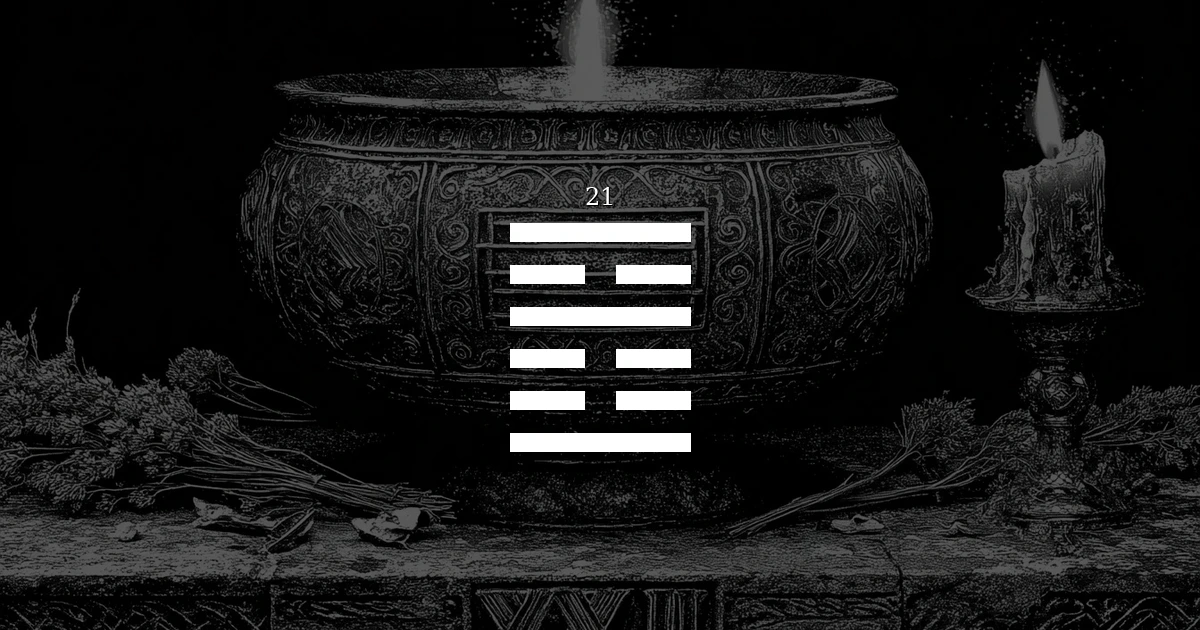
What is Hexagram 41: Decrease?
The I Ching (易經, Yì Jīng) has been consulted across East Asia for over 3,000 years. Its foundational layer, the Zhou Yi, was compiled during the Western Zhou dynasty (roughly 11th–8th century BCE), and the text was subsequently developed through centuries of Confucian and Taoist commentary. In The Whisper, a daily hexagram is drawn from your birth date combined with today’s date — a deterministic process that produces a consistent result for each unique date pairing, framed as “fated rather than random.” This changes each day as the date changes, contributing a specific lens to the oracle synthesis.
Hexagram 41 (損, Sǔn) — “Decrease” — is among the I Ching’s most counterintuitive hexagrams. In a culture — and a world — that tends to equate more with better, the hexagram asks a different question: what should be reduced, and what does the act of sincere reduction make possible? The character 損 means to decrease, diminish, or subtract — but in the hexagram’s usage, it specifically describes the voluntary reduction that serves something genuinely larger.
This is not decrease as loss. It is decrease as offering: taking from what is in surplus and giving to what genuinely needs it, simplifying what has become unnecessarily complex, clearing what has accumulated beyond usefulness. The two bowls of the hexagram’s central image — simple, sufficient, sincere — are the offering that is genuinely adequate, regardless of what ceremony might ideally accompany it.
The two trigrams: reading the structure
The upper trigram is Gen (艮, Mountain ☶) — stillness, keeping still, the quality of stopping at the appropriate moment, holding firm without forcing. The lower trigram is Dui (兌, Lake ☱) — the joyous, open, the quality of receptive expression and genuine pleasure.
The structural image: the lake offering upward to the mountain. Water from the lake evaporates upward, nourishing the higher ground; the lake decreases itself to feed what is above it. This is not the lake diminishing from neglect or loss — it is the deliberate offering of what the lake has in service of what the mountain needs. The reduction in the lake is also the nourishment of the mountain; the two are not separate events.
This combination also carries a specific dynamic tension: the joyous, open quality of the lake (Dui) is being contained and directed by the stillness of the mountain (Gen). The pleasure and expressiveness that Dui represents is not suppressed but channeled — decreased in its scatter, concentrated in its service. The mountain’s stillness gives direction to the lake’s generosity.
The combination of these two trigrams appears in Hexagram 31 (Influence) in reverse order — Lake above Mountain. There, the joyous openness is above, and the stillness holds it from below: attraction and genuine meeting. Here, the mountain is above: the stillness contains and directs the joyous generosity, ensuring that the decrease serves something genuinely stable rather than dissipating into attractive but impermanent expression.
The core teaching of Decrease
The hexagram statement addresses an almost philosophical question: “Decrease combined with sincerity brings about supreme good fortune without blame. One may be persevering in this. It furthers one to undertake something. How is this to be carried out? One may use two small bowls for the sacrifice.”
The two small bowls are the hexagram’s central image and its most direct practical teaching. In traditional Chinese practice, ceremonial offerings were supposed to be elaborate and costly. The hexagram says: if you can only offer two simple bowls and you offer them sincerely, that is genuinely sufficient. Sincerity — genuine engagement with the offering, genuine intentionality — outweighs elaborateness. The elaborate ceremony without sincerity fails; the simple offering with genuine sincerity succeeds.
This teaching extends to every domain where decrease is present. The relationship that cannot offer grand gestures but can offer genuine, consistent attention — the simple bowl, offered sincerely — is more genuinely nourishing than the relationship that produces elaborate demonstrations of affection without the daily reality of genuine care. The work that cannot be done at maximum scale but can be done with genuine quality in its smaller form — the simple bowl, offered sincerely — accomplishes what the stretched, compromised larger version cannot.
The hexagram also addresses the source of the decrease. The traditional commentary describes moving from the lower trigram (the people’s resources) to supplement the upper trigram (the ruler’s resources) — the voluntary contribution of those with something to give to what stands above and serves the collective. This is decrease in service of something that genuinely represents or sustains the larger structure. The decrease that flows from someone with more to someone with less, in service of genuine need, carries a different quality than decrease imposed from above.
There is also an important reciprocal principle embedded in the hexagram sequence: Hexagram 41 (Decrease) is followed immediately by Hexagram 42 (Increase). The tradition sees these as complementary: genuine decrease in the right direction creates the conditions for genuine increase. Simplifying what is excessive makes room for what is genuinely needed to grow. The decrease is not the end state; it is the clearing that enables what follows.
How Decrease appears in daily life
Hexagram 41 in daily life tends to appear in several recognizable forms. The first is the moment when something has grown beyond its genuinely useful scope and is now consuming more energy than it is producing: the project that has expanded into too many directions, the commitment that has accumulated obligations beyond what can be genuinely honored, the relationship dynamic that has developed patterns that are costing more than they are returning. The hexagram asks: what specifically can be reduced, simplified, or released in a way that makes what remains more genuinely functional and alive?
The second form is the experience of genuine material or energetic scarcity — less available than would be ideal — and the question of how to offer what is available with genuine sincerity rather than apologizing for its insufficiency. The two small bowls: what is genuinely there, offered with full presence and genuine intentionality, is sufficient. The comparison to what ideally would be offered is the trap; the genuine offering of what is actually present is the path.
The third form is the recognition that something that has been held — an attitude, a habit, an approach that has served well — has now exceeded its useful life and needs to be voluntarily decreased or released in order to free the energy it is consuming. The mountain’s stillness holding the lake: the reduction is not a collapse but a conscious holding-still of what is ready to be offered upward.
In reflection prompted by The Whisper, receiving Hexagram 41 may invite the question: what in my current situation would benefit from sincere simplification? What can I offer right now, in its genuinely present form, with complete sincerity — rather than waiting for the conditions that would allow a more elaborate offering?
What this means in The Whisper
In The Whisper’s daily synthesis, Hexagram 41 creates specific resonances with systems that address simplification, voluntary reduction, and the offering that serves something larger than immediate satisfaction.
In Nine Star Ki, Hexagram 41 resonates with Eight White Earth Star (八白土星) in its accumulation-and-offering mode: the mountain that has accumulated over time and now makes what it has accumulated available at a threshold moment. Eight White years and months associated with consolidation and preparation for the next cycle are particularly resonant with this hexagram’s quality of conscious, voluntary decrease.
In BaZi, Hexagram 41 resonates with configurations showing Earth element containing or directing Water — the mountain containing the lake — and with BaZi’s “Indirect Wealth” (偏財) star in situations requiring genuine generosity rather than hoarding. Periods in the BaZi lucky cycle when the Day Master’s supporting elements are reduced, requiring more careful management of available energy, amplify the hexagram’s practical teachings about sincere sufficiency.
In Western Astrology, Hexagram 41 resonates with Saturn in the 2nd house — the reduction of material resources in service of genuine values — and with Virgo placements in their quality of discerning what is genuinely necessary from what is merely accumulated. Periods of Saturn transit to Venus, or Saturn return energy in general, often bring the Hexagram 41 question to the foreground: what can be genuinely simplified, and what small offering can be made with complete sincerity?
When multiple systems simultaneously point toward simplification, conscious reduction, and the cultivation of sincere sufficiency — a Nine Star Ki Eight White year, a BaZi configuration showing consolidation energy, a Saturn transit involving Venus or the 2nd house — a daily draw of Hexagram 41 tends to produce a Whisper that is specifically about the quality and direction of what is being decreased and what the decrease makes possible.
Frequently asked questions
Q: Does Hexagram 41 mean I should cut back on spending or materially simplify my life?
Not necessarily in those specific terms. Hexagram 41’s decrease is specifically the voluntary reduction that serves something larger — it is not austerity for its own sake, and it is not a general instruction to have less. The question the hexagram poses is where in your current situation something has grown beyond its genuinely useful scope and is now consuming more than it is producing. That might involve material resources, but it equally applies to commitments, habits, relationship patterns, or ways of working that have accumulated beyond their genuinely useful form.
Q: What makes the “two small bowls” image so central to this hexagram?
The two small bowls capture the hexagram’s most essential teaching: genuine sincerity is more valuable than impressive ceremony. In a context where more and larger were expected (elaborate ritual sacrifice), the hexagram says that two simple bowls offered with complete sincerity are genuinely sufficient. This is not a concession to limitation; it is a statement about where genuine value actually resides. The offering that is genuinely present and genuinely intentional accomplishes what the elaborate offering made without full sincerity cannot.
Q: How does Hexagram 41 (Decrease) relate to Hexagram 42 (Increase) that follows it?
The I Ching tradition reads these two hexagrams as a complementary pair that describes a fundamental dynamic: genuine decrease in the right direction creates the conditions for genuine increase. The decrease is not the end state but the clearing that enables what follows. In the hexagram sequence, this suggests that whatever simplification or reduction Hexagram 41 calls for is not a permanent diminishment but the preparatory action that makes genuine growth possible. The lake offers upward to the mountain; the mountain, nourished, eventually offers downward to the valley — a cycle in which decrease and increase alternate in service of genuine flourishing.