
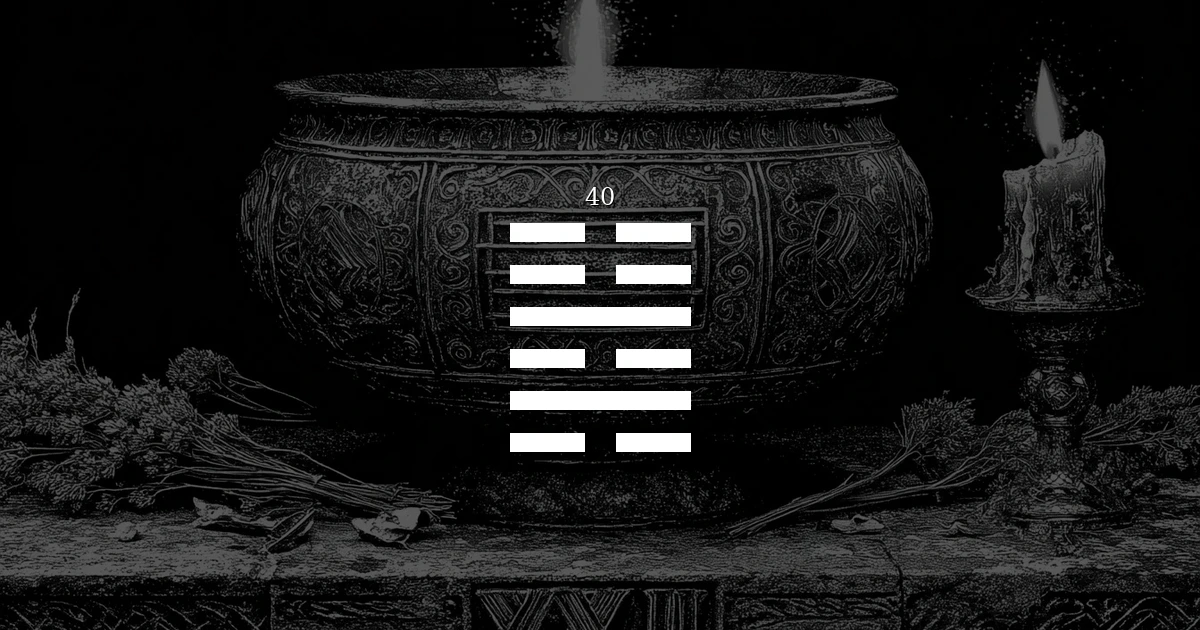
What is Hexagram 40: Deliverance?
The I Ching (易經, Yì Jīng) — the “Book of Changes” — has been consulted for guidance and reflection for over 3,000 years across East Asia, and increasingly across the world. Its 64 hexagrams each describe a specific quality of a moment: a situation, a dynamic, a particular disposition that the present calls for. In The Whisper, the I Ching contributes a daily hexagram to your oracle synthesis — generated deterministically from your birth date combined with today’s date. The draw is not random: the specific combination of when you were born and what today is produces a consistent hexagram, framing it as fated alignment rather than chance.
A note on interpretation: the original Zhou Yi texts are among the most debated in classical Chinese scholarship. Richard Wilhelm’s German translation (1923), rendered into English by Cary Baynes (1950), has shaped most Western I Ching understanding and carries its own interpretive choices alongside the original. The Whisper works within this living tradition while acknowledging genuine scholarly uncertainty.
Hexagram 40 (解, Jiě) — “Deliverance” — describes the release from obstruction and the specific wisdom of how to receive and work with that release — returning swiftly to normal conditions, forgiving what has passed, and not dwelling in the drama of the liberation.
The two trigrams: reading the structure
The upper trigram is Zhen (Thunder ☳) and the lower trigram is Kan (Water ☵). Thunder above Water — the storm that releases the tension. Thunder moves above; Water accepts below. The tension that had built during the obstruction phase is released by the thunder’s decisive movement, and the water — which had been the danger — now receives what the thunder brings. Rain: the release that nourishes rather than threatens.
The hexagram’s specific meaning arises from the dynamic relationship between these two trigrams — not from either alone. The lower trigram describes the interior or foundational quality; the upper trigram describes the outer or expressive quality. Together they define what Deliverance specifically addresses, and what quality of engagement it calls for from the person who encounters it.
The core teaching of Deliverance
The hexagram statement: “Deliverance. The southwest furthers. If there is no longer anything where one has to go, return brings good fortune. If there is still something where one has to go, hastening brings good fortune.” Two distinct situations: if the difficulty is genuinely over, return to normal conditions quickly and without drama. If something still requires attention, address it swiftly and completely rather than letting it linger.
Forgiving and forgetting — the hexagram’s specific instruction for what to do with what occurred during the obstruction — is both practical and psychologically demanding. The people who made difficulties during the obstructed phase; the compromises that were necessary; the aspects of oneself that the obstruction revealed — the hexagram calls for genuine release rather than sustained analysis, resentment, or the replaying of what has passed. What was necessary was necessary; what has been released deserves to be released.
The arrow that kills the hawk on the wall is the hexagram’s image of the swift, decisive action that completes what remains — removing the last element of the obstruction before it can reassert itself. This is not prolonged effort but the specific decisive action at the moment when a clear opportunity to complete the removal is available. The hawk on the wall is not threatening but is capable of threatening; this is the moment to act.
The unloading of the burden — the person who carries burdens for others and loads themselves down — is also addressed: during the resolution, those who had taken advantage of the obstruction phase to place their burdens on others are removed. The generous return to genuine relationships is what Deliverance’s resolution produces.
The I Ching tradition treats hexagrams situationally rather than as fixed states. Receiving Hexagram 40 in The Whisper’s daily draw means that the quality of deliverance is a particularly relevant lens for today — not a prediction, but a perspective from which to view what is already present in your experience.
How Deliverance appears in daily life
Hexagram 40 in daily life appears during the specific phase of genuine release after sustained difficulty: the resolution of a conflict, the completion of a demanding project, the lifting of a sustained period of pressure. The hexagram’s most specific teaching for daily life: when difficulty genuinely lifts, don’t continue living in the mode of difficulty. Return swiftly to the normal, nourishing conditions of non-crisis life rather than maintaining the crisis posture after the crisis has genuinely passed.
The forgive-and-forget teaching is practically challenging: the patterns, resentments, and adaptations that were appropriate during the obstruction phase can persist after the obstruction has lifted, creating a kind of inner continuation of the difficulty even after the outer difficulty has resolved. Hexagram 40 specifically addresses this persistence and calls for genuine release.
In reflection prompted by The Whisper, Hexagram 40 invites these questions: Where is the quality of deliverance most active in my current experience? What specific engagement does this hexagram suggest? What in the tradition’s guidance about deliverance is most relevant to today?
What this means in The Whisper
In The Whisper’s daily synthesis, Hexagram 40 creates specific resonances with the other active systems in your oracle stack.
In Nine Star Ki, transitions out of a challenging star year into a more favorable one — both associated with the genuine release from restriction and the wise reception of the return of favorable conditions.
In BaZi, the beginning of a new and favorable luck pillar after a difficult period; the Day Master returning to its seasonal strength after a suppressive configuration.
In Western Astrology, Saturn direct after retrograde; Jupiter crossing a difficult natal aspect point and continuing into more favorable territory; the Sun moving out of a difficult eclipse season.
When multiple systems point toward related themes — when the nine-star reading, the BaZi configuration, and the Western Astrology transits converge on qualities related to deliverance — The Whisper tends to produce a synthesis that is unusually specific about what this hexagram offers for the present moment. Convergence across ancient systems is the signal The Whisper treats as most meaningful.
Frequently asked questions
Q: What does it mean to ‘return’ when deliverance arrives?
Return in the hexagram’s sense is specifically returning to the normal, nourishing rhythms of life that the obstruction had interrupted. It is not returning to whatever created the obstruction in the first place, but to the genuinely good conditions of regular, non-crisis engagement with life. The specific wisdom is swift return rather than gradual resumption: don’t continue to operate in crisis mode once the crisis has genuinely resolved.
Q: How does ‘forgive and forget’ work when real harm occurred during the obstruction phase?
The hexagram’s forgiveness is not the denial of what occurred or the pretense that harm was not real. It is specifically the release of what is no longer serving any productive purpose — the continued carrying of resentment, the replaying of difficulty, the sustained posture of defense after the threat has passed. Some things from the obstruction phase require genuine acknowledgment and address; once they have been genuinely addressed, the forgetting is the release of what has been genuinely resolved rather than the avoidance of what has not.
Q: Why does the hexagram say ‘hasten’ when something still needs to be done?
The hastening is specifically in response to the available window. Once the release has occurred, there is typically a period when the clearing action is much easier than it was during the obstruction or will be if the window is missed. The hawk on the wall is already identified and the arrow is already in hand; this is the moment when the swift, decisive completion is possible. Delay at this specific moment allows the residual difficulty to reestablish itself. Hastening is appropriate precisely because the opportunity will not persist indefinitely.