
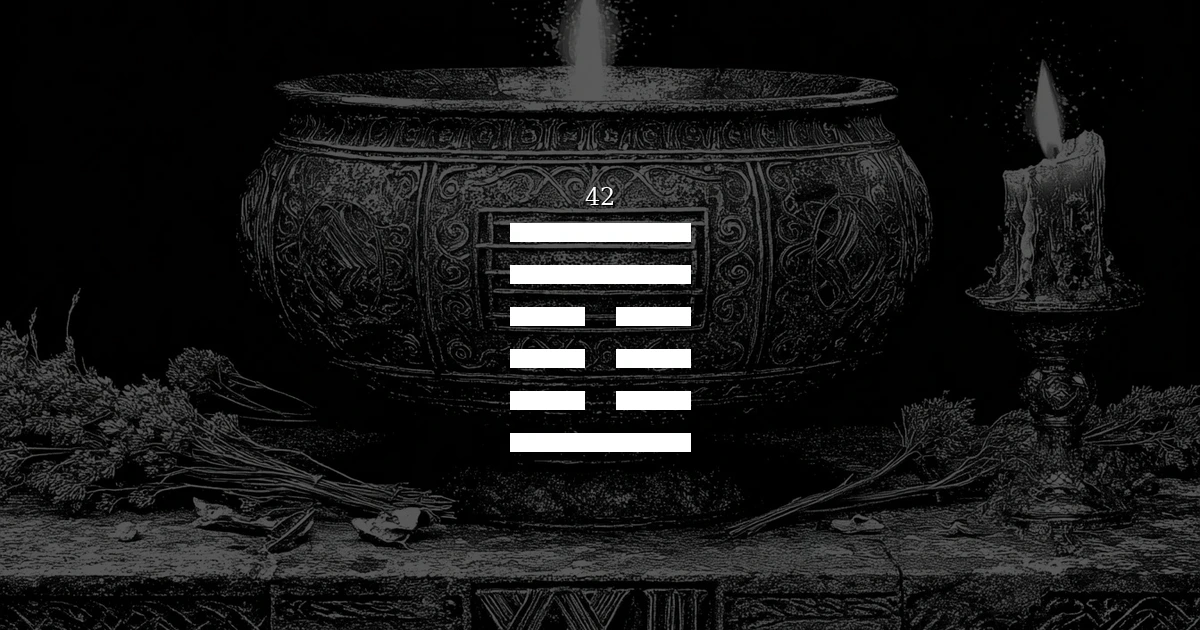
What is Hexagram 4: Youthful Folly?
The I Ching (易經, Yì Jīng) is one of the oldest texts in human civilization, developed over 3,000 years of commentary and use across East Asia. In The Whisper, the I Ching provides a daily hexagram draw generated deterministically from your birth date and today’s date — a specific lens that changes each day and contributes to the synthesized daily oracle message.
Hexagram 4 (蒙, Méng) — “Youthful Folly” or “Inexperience” — is the hexagram of the student. It describes the specific condition of genuine not-yet-knowing: the inexperience that is the starting point for all genuine learning, and the relationship between teacher and student that the learning process requires. The name 蒙 in Chinese means “covered” or “obscured” — the fog that has not yet been cleared by experience and proper instruction.
The two trigrams: reading the structure
The upper trigram is Gen (艮, Mountain ☶) — stillness, stopping, keeping still, the youngest son. The lower trigram is Kan (坎, Water ☵) — danger, depth, the abyss, the place where water seeks its way through.
The image: water at the base of a mountain — the spring that has just emerged from the mountain’s depths and has not yet found its direction. The water is fresh, alive, full of potential — but it does not yet know where to flow. The mountain is still; the water is searching. This is the condition of the genuine student: full of energy and potential, but needing both the guidance that will help find the direction and the stillness that genuine learning requires.
The combination of Mountain above and Water below also suggests the danger that accompanies inexperience: the water at the mountain’s base, not yet knowing which paths lead safely down and which lead to the cliff’s edge. The teacher’s role is precisely to provide this knowledge — not to eliminate the student’s experience of finding their way, but to prevent the most dangerous mistakes of inexperience.
The core teaching of Youthful Folly
The hexagram’s most quoted teaching addresses the relationship between student and teacher: “It is not I who seek the young fool; the young fool seeks me. At the first oracle I inform him. If he asks two or three times, it is importunity. If he importunes, I give him no information.”
This is a surprisingly specific and demanding teaching. The genuine teacher does not pursue the student; the student must bring genuine sincerity to the seeking. A single honest consultation receives genuine response. But the repeated asking — asking again when the answer has already been given, asking in hopes of a different answer, asking without having genuinely engaged with what was already offered — receives no response. The information must be used before more is given.
The teaching also addresses the student’s side: bringing genuine sincerity to the seeking, asking once with real openness, and doing the work of engaging with what has been offered before returning for more. This is the specific quality that distinguishes genuine learning from the performance of learning.
The traditional Wilhelm/Baynes commentary identifies three faulty responses to inexperience that Hexagram 4 warns against: harshness that humiliates the student, excessive indulgence that gives answers before the student has genuinely engaged, and importunate repetition from the student side. The healthy learning relationship avoids all three.
How Youthful Folly appears in daily life
Hexagram 4 in daily life tends to present as the specific quality of genuine beginner’s mind — the condition of being genuinely new to something and meeting that newness with either authentic openness or defensive performance. The day you are genuinely in a learning role — new situation, new challenge, new domain — is a Hexagram 4 day regardless of your general level of experience and competence.
The hexagram also appears as the invitation to recognize where you are pretending to know more than you do. The student who asks two or three times — seeking a different answer — is not genuinely engaging with the teaching already offered. In daily life, this appears as the pattern of repeatedly seeking confirmation or reassurance without actually engaging with the information already available.
The spring-at-the-mountain’s-base quality also shows up as the moment when something genuinely new has begun but has not yet found its direction. The energy is fresh; the path is unclear; the appropriate response is patient, sincere engagement with what will help find the way — not forced action in any direction just to be moving.
In reflection prompted by The Whisper, receiving Hexagram 4 may signal a day when genuine openness to instruction — from a person, from experience, from what is available to be learned — is the most valuable orientation. The question: where is there something genuinely new to learn today, and am I bringing genuine sincerity to the learning rather than the defensive performance of already-knowing?
What this means in The Whisper
In The Whisper’s daily synthesis, Hexagram 4 creates resonances with systems that address learning, development, and the beginning stages of genuine capability.
In Nine Star Ki, Hexagram 4 resonates with the developmental quality of Three Jade Wood Star (三碧木星) in its early, unformed expression — the thunder before it has found its voice and direction. The quality of genuine inexperience that still carries the full energy of what will develop is characteristic of both.
In BaZi, Hexagram 4 resonates with configurations showing strong but undirected Wood energy, particularly Young Wood (乙 Yi) that has not yet found its supporting structure. First luck pillar transitions — the move from childhood’s inherited energy into the person’s own developing direction — carry this hexagram’s quality strongly.
In Western Astrology, Hexagram 4 resonates with Mercury in its learning phase: the inquisitive, observational quality before it has developed the experience base that makes communication genuinely reliable. Mercury-Saturn aspects in the natal chart, or Mercury transits through the 9th house (the house of higher learning), may amplify this hexagram’s quality.
When The Whisper’s synthesis shows multiple systems pointing toward development, learning, and the beginning phase — a Nine Star Ki reading emphasizing Wood initiation, a BaZi configuration showing the beginning of a new luck cycle, a Western Astrology reading with Mercury prominent — a daily draw of Hexagram 4 may produce a message specifically about the quality of your current learning orientation and what genuine sincerity in the seeking would look like today.
Frequently asked questions
Q: Is Hexagram 4 a negative hexagram to receive? The name “Youthful Folly” sounds unflattering.
The name is descriptive rather than pejorative. 蒙 (Méng) describes the condition of being covered or obscured — a natural and necessary phase, not a permanent flaw. The hexagram is overall favorable: the spring at the mountain’s base is full of genuine potential. What the hexagram warns against is not the condition of inexperience itself (which is simply where all genuine learning begins) but the defensive responses to inexperience: pretending to know, asking without engaging, refusing instruction. The condition of genuine not-yet-knowing, met with genuine openness, is the most favorable possible position for actual learning.
Q: What does it mean that the teacher only responds once? Isn’t that harsh?
The teaching is specifically about the quality of the seeking, not about limiting the quantity of instruction. A student who asks with genuine sincerity and brings full engagement to the answer received can return many times — each return is a genuine first asking about the next genuinely unknown question. What receives no response is the asking that comes without genuine engagement with what was already offered: the repeated asking that seeks confirmation rather than information, or the asking that has not done the work of engaging with the previous answer. The restriction is on importunate seeking, not on genuine learning.
Q: How does The Whisper use the student-teacher framework in a daily oracle context?
The Whisper does not position itself as a teacher in the Hexagram 4 sense — The Whisper’s “AI as mirror, not oracle” philosophy means it reflects rather than instructs. However, when Hexagram 4 appears in the daily synthesis, The Whisper may use the hexagram’s quality to invite reflection on where you are genuinely in a learning or seeking role in your current life, and what quality of engagement — genuine sincerity, patience, the willingness to work with what is already available — would most serve that learning. The hexagram is less about The Whisper’s role and more about the quality of your orientation toward what is genuinely new in your present situation.