
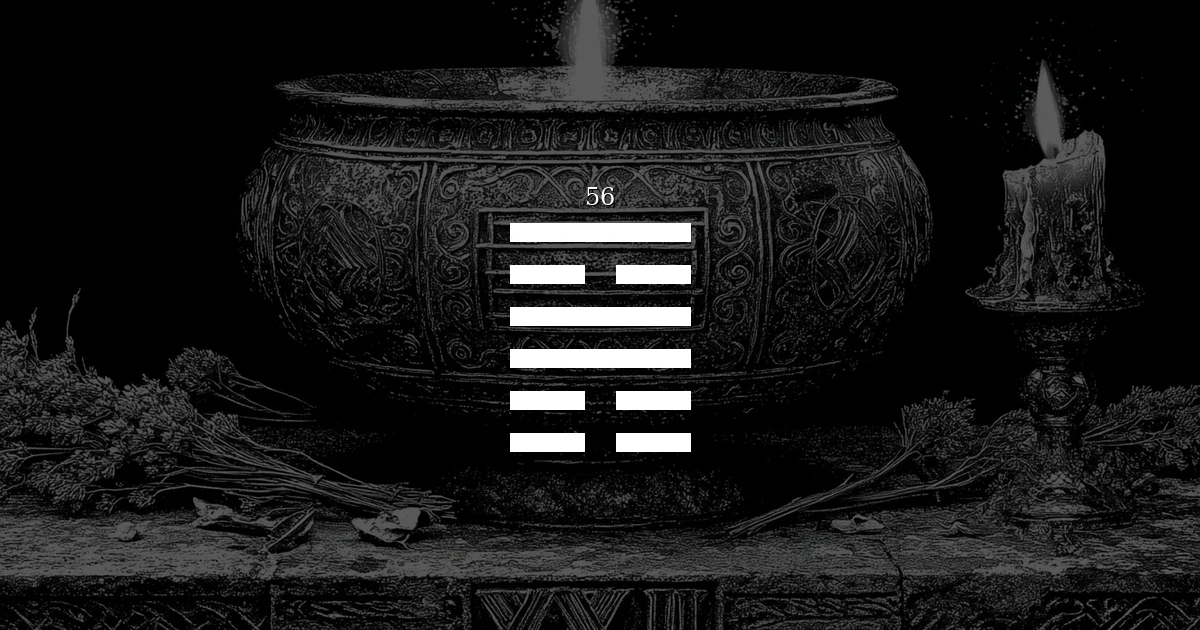
What is Hexagram 38: Opposition?
The I Ching (易經, Yì Jīng) — the “Book of Changes” — has been consulted for guidance and reflection for over 3,000 years across East Asia, and increasingly across the world. Its 64 hexagrams each describe a specific quality of a moment: a situation, a dynamic, a particular disposition that the present calls for. In The Whisper, the I Ching contributes a daily hexagram to your oracle synthesis — generated deterministically from your birth date combined with today’s date. The draw is not random: the specific combination of when you were born and what today is produces a consistent hexagram, framing it as fated alignment rather than chance.
A note on interpretation: the original Zhou Yi texts are among the most debated in classical Chinese scholarship. Richard Wilhelm’s German translation (1923), rendered into English by Cary Baynes (1950), has shaped most Western I Ching understanding and carries its own interpretive choices alongside the original. The Whisper works within this living tradition while acknowledging genuine scholarly uncertainty.
Hexagram 38 (睽, Kuí) — “Opposition” — describes the situation of genuine opposition and estrangement between two things whose natures move in fundamentally different directions, and the specific small connections that nevertheless become possible within genuine difference.
The two trigrams: reading the structure
The upper trigram is Li (Fire ☲) and the lower trigram is Dui (Lake ☱). Fire above Lake — fire rises, water descends; their natures fundamentally oppose each other. The middle daughter (fire) and youngest daughter (lake) in the same household: their natural movements are away from each other. Yet both are genuine; both have value; the opposition does not negate either.
The hexagram’s specific meaning arises from the dynamic relationship between these two trigrams — not from either alone. The lower trigram describes the interior or foundational quality; the upper trigram describes the outer or expressive quality. Together they define what Opposition specifically addresses, and what quality of engagement it calls for from the person who encounters it.
The core teaching of Opposition
The hexagram statement: “Opposition. In small matters, good fortune.” The specific limitation is important: in small matters — not in large ones. During opposition, genuine connection is possible in small, specific, concrete ways rather than through the resolution of the fundamental difference. This is not a counsel of despair but of precision: knowing what is possible within genuine opposition is itself a form of wisdom.
The opposition hexagram acknowledges that genuine difference exists and cannot always be resolved. The fire naturally rises; the water naturally descends. Trying to force them to move in the same direction destroys both. The specific wisdom of Hexagram 38 is learning to find the genuine meeting points within genuine opposition rather than demanding that the opposition be dissolved first.
The series of small meetings within opposition described in the lines — the isolated person who meets a companion, who meets a husband and wife, who sees the cart dragged back and the oxen halted, and who through the tension discovers the genuine meeting — describes the specific arc of how genuine connection becomes possible within genuine difference. The meeting is preceded by tension, isolation, apparent obstacles. The tension is not the enemy of the meeting; it is part of what makes the genuine meeting possible.
The final line’s transformation — the solitary person who appears to be surrounded by demons but who, on approach, recognizes friends rather than enemies — is the hexagram’s most important teaching about opposition: what appears to be hostile difference, when approached with genuine inner truth, often reveals itself to be genuine difference that can be worked with rather than destroyed.
The I Ching tradition treats hexagrams situationally rather than as fixed states. Receiving Hexagram 38 in The Whisper’s daily draw means that the quality of opposition is a particularly relevant lens for today — not a prediction, but a perspective from which to view what is already present in your experience.
How Opposition appears in daily life
Hexagram 38 in daily life appears whenever genuine difference — in values, perspective, temperament, or direction — creates real tension between two people or within one person between competing aspects. The hexagram’s specific wisdom: don’t demand that the fundamental difference be resolved before any genuine connection is possible. Look for the specific, small, concrete areas where genuine meeting is possible within the genuine difference.
The demon-becoming-friend arc appears in daily life as the experience of something that initially seems hostile — an opposing perspective, a challenging person, an uncomfortable difference — revealing itself on closer genuine approach to contain something genuinely meeting rather than purely hostile.
In reflection prompted by The Whisper, Hexagram 38 invites these questions: Where is the quality of opposition most active in my current experience? What specific engagement does this hexagram suggest? What in the tradition’s guidance about opposition is most relevant to today?
What this means in The Whisper
In The Whisper’s daily synthesis, Hexagram 38 creates specific resonances with the other active systems in your oracle stack.
In Nine Star Ki, periods when the personal star is in a position of genuine tension with the environmental star — both generating the creative friction that produces development rather than the destructive clash that depletes.
In BaZi, configurations showing genuine clash between elements that nonetheless have a productive relationship at a deeper level; Metal-Wood clash that is both genuine and generative.
In Western Astrology, Venus-Saturn aspects that produce the creative tension of genuine difference within relationship; opposition aspects in the natal chart that describe genuine polarities that must be worked with rather than resolved.
When multiple systems point toward related themes — when the nine-star reading, the BaZi configuration, and the Western Astrology transits converge on qualities related to opposition — The Whisper tends to produce a synthesis that is unusually specific about what this hexagram offers for the present moment. Convergence across ancient systems is the signal The Whisper treats as most meaningful.
Frequently asked questions
Q: Is Opposition saying that some differences simply cannot be resolved?
The hexagram acknowledges that some differences are genuine — fire does rise and water does descend; their fundamental natures oppose. But it also consistently shows that genuine meeting is possible within genuine opposition. The distinction is between resolving the fundamental difference (which fire and water cannot do without ceasing to be fire and water) and finding the specific meeting points that genuine difference makes possible. The hexagram is not pessimistic about connection; it is precise about what kind of connection is available.
Q: What are the ‘small matters’ where good fortune is possible?
The small matters are the specific, concrete, limited areas where genuine meeting is possible despite the fundamental difference. In a relationship characterized by genuine opposition of temperament, the small matters might be specific shared practices, specific domains of genuine agreement, specific moments of genuine encounter that are possible without demanding that the whole difference be dissolved. Working within these specific small possibilities rather than demanding comprehensive resolution is the hexagram’s practical wisdom.
Q: How does opposition relate to inner conflict?
The hexagram applies as naturally to inner opposition — competing values, conflicting commitments, genuine tensions between different aspects of oneself — as to outer opposition between people. The same wisdom holds: the inner opposition between genuinely different values or directions does not need to be resolved before any movement is possible. Finding the specific small actions that honor both aspects of the inner opposition, rather than forcing one side to win completely, is the inner work Hexagram 38 describes.
A closer look: the specific creativity of genuine opposition
One of Hexagram 38’s most practically significant teachings is that genuine opposition — the real difference that cannot be dissolved by either party simply becoming more like the other — is a source of genuine creative possibility rather than simply a problem to be resolved. The fire that rises and the lake that descends do not stop being what they are; their difference is the condition for their specific creative relationship. In The Whisper’s synthesis, when Opposition appears alongside readings that confirm genuine tension from multiple systems, the combined message tends to concern the specific dimension of the current opposition that contains genuine creative potential — where the real difference is producing real possibility, rather than either being denied or being taken as a reason for permanent separation.