
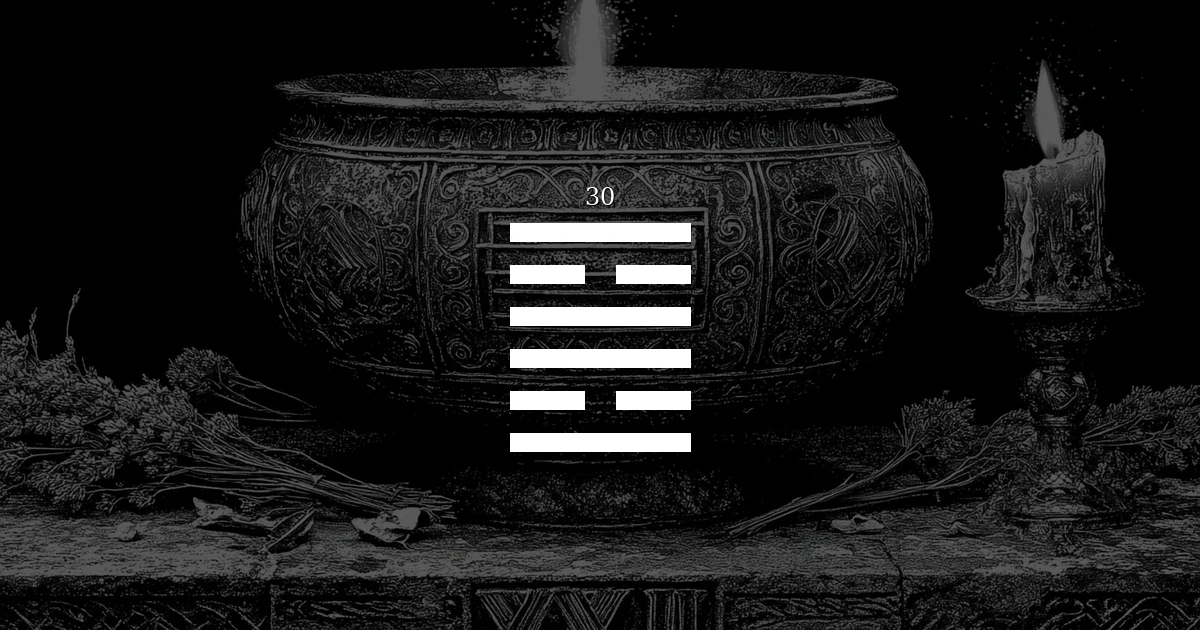
What is Hexagram 36: Darkening of the Light?
The I Ching (易經, Yì Jīng) — the “Book of Changes” — has been consulted for guidance and reflection for over 3,000 years across East Asia, and increasingly across the world. Its 64 hexagrams each describe a specific quality of a moment: a situation, a dynamic, a particular disposition that the present calls for. In The Whisper, the I Ching contributes a daily hexagram to your oracle synthesis — generated deterministically from your birth date combined with today’s date. The draw is not random: the specific combination of when you were born and what today is produces a consistent hexagram, framing it as fated alignment rather than chance.
A note on interpretation: the original Zhou Yi texts are among the most debated in classical Chinese scholarship. Richard Wilhelm’s German translation (1923), rendered into English by Cary Baynes (1950), has shaped most Western I Ching understanding and carries its own interpretive choices alongside the original. The Whisper works within this living tradition while acknowledging genuine scholarly uncertainty.
Hexagram 36 (明夷, Míng Yí) — “Darkening of the Light” — describes the time when genuine clarity must be preserved inwardly while being concealed from an environment that would punish its expression — not compromise, but intelligent concealment that allows inner quality to survive through darkness.
The two trigrams: reading the structure
The upper trigram is Kun (Earth ☷) and the lower trigram is Li (Fire ☲). Earth above Fire — the light has gone beneath the earth. The brightness is not extinguished; it is submerged. The receptive, nourishing earth has covered the light. The image is of a person of genuine clarity and intelligence in an environment where those qualities are not safe to express directly.
The hexagram’s specific meaning arises from the dynamic relationship between these two trigrams — not from either alone. The lower trigram describes the interior or foundational quality; the upper trigram describes the outer or expressive quality. Together they define what Darkening of the Light specifically addresses, and what quality of engagement it calls for from the person who encounters it.
The core teaching of Darkening of the Light
The hexagram statement: “Darkening of the light. In adversity it furthers one to be persevering.” The perseverance is specifically of inner quality rather than outer expression. When the environment is dominated by forces that punish or suppress genuine clarity, the appropriate response is inner preservation combined with the intelligence to conceal what must be protected.
The historical examples embedded in the hexagram’s commentary — the prince of Ji who had to feign madness to survive a tyrant’s court — describe the specific situation of genuine clarity navigating an environment that would destroy it if expressed directly. The feigning of madness is not the abandonment of clarity; it is the intelligent concealment that allows clarity to survive and eventually to be effective again when conditions change.
The specific warning about the concealment: preserving the inner light while dimming the outer expression requires genuine discipline. The fire under the earth has not been extinguished; it is tending itself. The darkening is of the external expression, not of the inner quality. The person who darkens their outer expression while losing their inner quality has not achieved Hexagram 36’s wisdom; they have simply been diminished.
The image of someone going into the left side of the belly of a large country and going out through the gate — the specific path through complete darkness — describes what genuine inner preservation through the period of darkening makes possible: eventually a path through opens, and the person who has maintained their inner quality is prepared to take it, while the person who lost their inner quality during the dark period is not.
The I Ching tradition treats hexagrams situationally rather than as fixed states. Receiving Hexagram 36 in The Whisper’s daily draw means that the quality of darkening of the light is a particularly relevant lens for today — not a prediction, but a perspective from which to view what is already present in your experience.
How Darkening of the Light appears in daily life
Hexagram 36 in daily life appears whenever the environment is genuinely hostile to the expression of genuine clarity, and the appropriate response is intelligent inner preservation rather than either full expression (which would be costly) or inner abandonment (which would be equally costly). The workplace that punishes honesty; the relationship dynamic that cannot currently receive genuine truth; the social environment that responds to genuine insight with hostility.
The practical wisdom is specific: maintain the inner quality, dim the outer expression strategically, and do not interpret the strategic dimming as permanent surrender. The fire under the earth is tending itself in preparation for when conditions change. The person of genuine clarity in Hexagram 36 conditions is not defined by what they cannot currently express; they are defined by what they are preserving.
In reflection prompted by The Whisper, Hexagram 36 invites these questions: Where is the quality of darkening of the light most active in my current experience? What specific engagement does this hexagram suggest? What in the tradition’s guidance about darkening of the light is most relevant to today?
What this means in The Whisper
In The Whisper’s daily synthesis, Hexagram 36 creates specific resonances with the other active systems in your oracle stack.
In Nine Star Ki, One White Water Star (一白水星) in a suppressed position — both associated with the hidden depth that maintains its quality even when outer conditions are unfavorable for expression.
In BaZi, configurations showing the Day Master’s favorable elements suppressed by unfavorable elements in the current luck cycle; the strong inner quality navigating a constraining outer configuration.
In Western Astrology, Pluto transits to natal Mercury or Sun that demand intelligent concealment of genuine capacity; Saturn opposing natal chart’s expressive planets.
When multiple systems point toward related themes — when the nine-star reading, the BaZi configuration, and the Western Astrology transits converge on qualities related to darkening of the light — The Whisper tends to produce a synthesis that is unusually specific about what this hexagram offers for the present moment. Convergence across ancient systems is the signal The Whisper treats as most meaningful.
Frequently asked questions
Q: Is this hexagram advising deception?
The feigning of madness in the hexagram’s historical example is not conventional deception — it is the specific protective measure of someone whose genuine inner quality would be targeted and destroyed if it were openly expressed. The hexagram distinguishes between strategic concealment that preserves something genuinely valuable and the deception that destroys inner integrity. The test: does the concealment serve the preservation of genuine inner quality, or does it serve self-interest at others’ expense? The former is Hexagram 36’s wisdom; the latter is simply deception.
Q: How long does the darkening last?
The hexagram does not prescribe a duration. The darkness lasts as long as the conditions that make it necessary persist. The tradition generally reads this hexagram as a temporary phase within a larger cycle — the darkness is not permanent. But the specific timing depends on the actual conditions rather than on any fixed prescription. The inner preservation that the hexagram calls for is explicitly ‘while in adversity’ — the condition that generates the appropriate response also defines when that response can change.
Q: How does the Darkening of the Light relate to genuine integrity?
The hexagram treats outer concealment and inner integrity as compatible rather than contradictory. Genuine integrity in adverse conditions often requires the specific intelligence to know when direct expression would destroy what it is trying to serve and when preservation through strategic concealment is actually the more genuinely honest response. The integrity lies in maintaining the actual quality rather than in insisting on expressing it in conditions where expression would be counterproductive.