
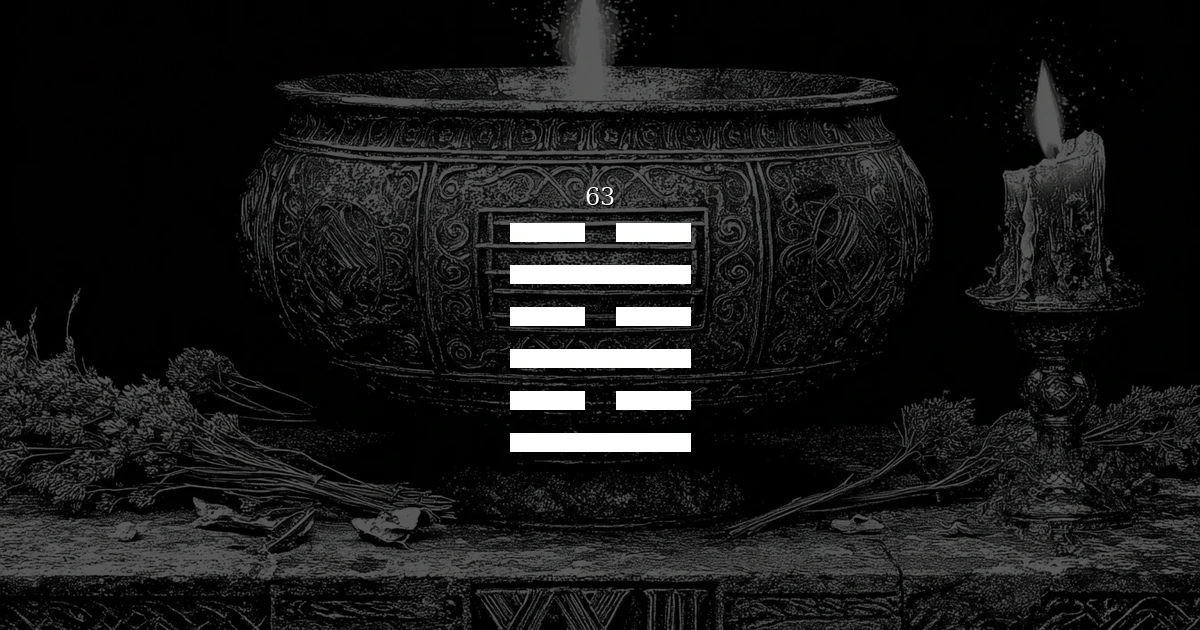
What is Hexagram 30: The Clinging Fire?
The I Ching (易經, Yì Jīng) — the “Book of Changes” — has been consulted for guidance and reflection for over 3,000 years across East Asia, and increasingly across the world. Its 64 hexagrams each describe a specific quality of a moment: a situation, a dynamic, a particular disposition that the present calls for. In The Whisper, the I Ching contributes a daily hexagram to your oracle synthesis — generated deterministically from your birth date combined with today’s date. The draw is not random: the specific combination of when you were born and what today is produces a consistent hexagram, framing it as fated alignment rather than chance.
A note on interpretation: the original Zhou Yi texts are among the most debated in classical Chinese scholarship. Richard Wilhelm’s German translation (1923), rendered into English by Cary Baynes (1950), has shaped most Western I Ching understanding and carries its own interpretive choices alongside the original. The Whisper works within this living tradition while acknowledging genuine scholarly uncertainty.
Hexagram 30 (離, Lí) — “The Clinging Fire” — describes the quality of clarity and brightness that clings to what it illuminates — fire that depends on fuel, light that depends on what it burns, and the specific wisdom of acknowledging dependence rather than pretending to self-sufficiency.
The two trigrams: reading the structure
The upper trigram is Li (Fire ☲) and the lower trigram is Li (Fire ☲). Fire doubled — Li (Fire ☲) above and below. Each Li trigram contains a single broken yin line within two yang lines — the empty within the bright. The hollow of the trigram is what gives fire its quality: the empty space at the center that the fire clings to and burns through. Doubled, the brightness and the dependence are both intensified.
The hexagram’s specific meaning arises from the dynamic relationship between these two trigrams — not from either alone. The lower trigram describes the interior or foundational quality; the upper trigram describes the outer or expressive quality. Together they define what The Clinging Fire specifically addresses, and what quality of engagement it calls for from the person who encounters it.
The core teaching of The Clinging Fire
The hexagram statement: “Clinging, perseverance brings success. Care of the cow brings good fortune.” The cow — patient, nourishing, not fighting its conditions — is the model the hexagram offers. Fire is brilliant; the cow’s qualities are what allow brilliance to be sustained. The juxtaposition is deliberate: the most brilliant element needs the most grounded management.
The dependence of fire is the hexagram’s most important teaching. Fire does not generate itself; it clings to what it burns and transforms it. Without ongoing fuel, the fire dies regardless of how brightly it burned. This is not a limitation to overcome but the fundamental nature of the clarifying principle: genuine clarity depends on genuine engagement with the substance that clarity illuminates.
The image of the sun and moon — their brilliant shining is what makes everything on earth visible — and the image of the great man whose continuous illumination transforms the world, describe the highest expression of the clinging quality: not a brightness that consumes and moves on, but a sustained illumination that nourishes what it transforms. The great man’s clarifying of all four quarters requires the sustained, nourishing quality of the cow alongside the brilliance of the fire.
The warning lines describe the failure modes of fire: the sunset brilliance that is beautiful but already declining; the fire that is not tended and sputters; the mourning song at sunset rather than the sustained illumination. The specific error of the clinging principle is burning brightly but briefly — achieving illumination without sustaining it.
The I Ching tradition treats hexagrams situationally rather than as fixed states. Receiving Hexagram 30 in The Whisper’s daily draw means that the quality of the clinging fire is a particularly relevant lens for today — not a prediction, but a perspective from which to view what is already present in your experience.
How The Clinging Fire appears in daily life
Hexagram 30 in daily life appears whenever clarity and brilliance are the central qualities — and whenever the question of how to sustain them is equally central. The insight that illuminates a situation but needs to be nourished through the follow-through; the creative period that needs the patient, cow-like care of sustained practice to be sustained; the understanding that clings to genuine engagement with its subject rather than floating free as abstraction.
The dependence acknowledgment is practically important: the person who pretends that their clarity is self-sufficient tends to deplete the fuel that the clarity depends on without renewing it, eventually producing the brilliant fire that burns briefly and then goes out. The cow-like management of what fire depends on is not glamorous; it is what makes sustained illumination possible.
In reflection prompted by The Whisper, Hexagram 30 invites these questions: Where is the quality of the clinging fire most active in my current experience? What specific engagement does this hexagram suggest? What in the tradition’s guidance about the clinging fire is most relevant to today?
What this means in The Whisper
In The Whisper’s daily synthesis, Hexagram 30 creates specific resonances with the other active systems in your oracle stack.
In Nine Star Ki, Nine Purple Fire Star (九紫火星) — both associated with brilliant illumination, clarity, and the specific wisdom of managing brilliance so it sustains rather than burns out.
In BaZi, strong Fire Day Masters who must also develop the Earth and Metal management of their expression to sustain their genuine capacity for illumination.
In Western Astrology, Sun-Leo emphasis; Mercury-Sun conjunctions that produce brilliant clarity; periods when the natal chart’s most illuminating planets are activated by transit.
When multiple systems point toward related themes — when the nine-star reading, the BaZi configuration, and the Western Astrology transits converge on qualities related to the clinging fire — The Whisper tends to produce a synthesis that is unusually specific about what this hexagram offers for the present moment. Convergence across ancient systems is the signal The Whisper treats as most meaningful.
Frequently asked questions
Q: How does the ‘clinging’ quality work in relationships and work?
Clinging in Li’s sense means genuine dependence and genuine engagement — the fire clings to the fuel it needs, not in a grasping way but in the way that allows it to do what fire does. In relationships, this describes the genuine reliance on the other that makes the relationship’s warmth and illumination possible. In work, it describes the genuine engagement with the actual material of the work that allows genuine clarity to arise from it. Premature independence — pretending not to need what genuine illumination requires — is what the hexagram specifically warns against.
Q: What is the significance of the cow image in a fire hexagram?
The juxtaposition is deliberate: the most brilliant element requires the most patient, grounded, nourishing management. The cow’s qualities — patience, consistent care, the willingness to nourish without seeking to be brilliant — are precisely what allow fire’s brilliance to be sustained. The brilliant person who lacks the cow-like qualities of sustained care for what their brilliance depends on tends to produce the sunset fire: beautiful but brief. The integration of both qualities — the fire’s clarity and the cow’s patient nourishment — is what produces sustained illumination.
Q: The hexagram seems to be about both light and attachment. How are these related?
In the Chinese cosmological framework, 離 (Lí) means both ‘fire’ and ‘to separate’ or ‘to cling’ — the paradox is built into the character. Fire separates (it transforms what it burns) and clings (it depends on what it burns). This paradox describes something real: genuine clarity illuminates what it clings to, separating it from confusion — and in doing so it depends on continued genuine engagement with its subject. The separation and the clinging are not opposites but two aspects of the same movement.