
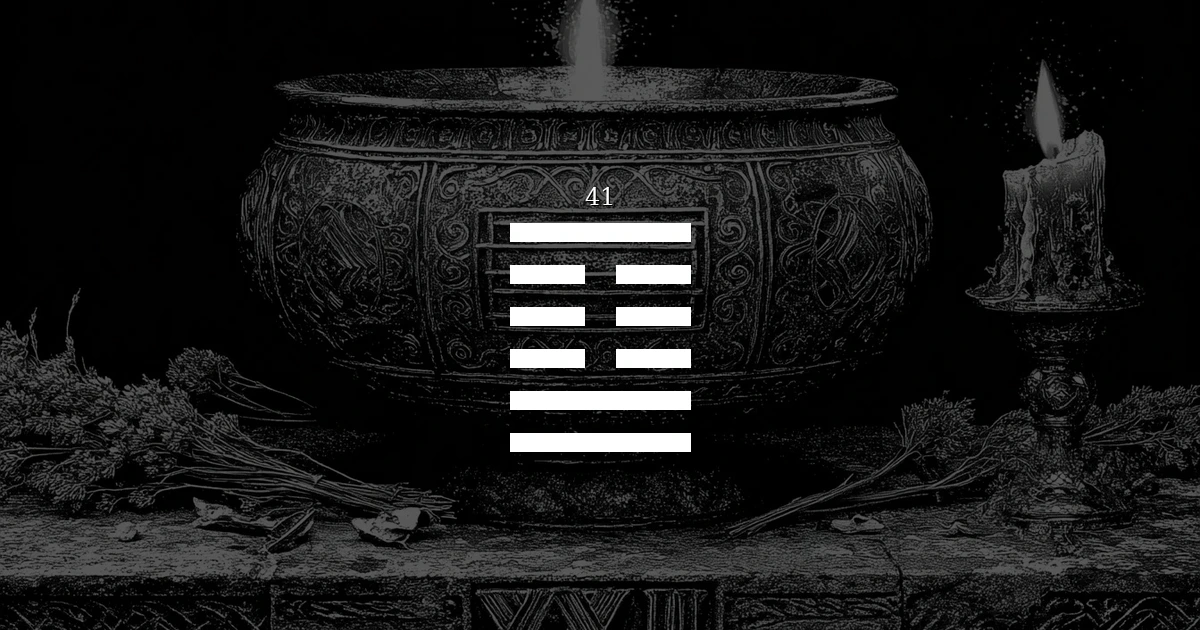
What is Hexagram 28: Great Excess?
The I Ching (易經, Yì Jīng) — the “Book of Changes” — has been consulted for guidance and reflection for over 3,000 years across East Asia, and increasingly across the world. Its 64 hexagrams each describe a specific quality of a moment: a situation, a dynamic, a particular disposition that the present calls for. In The Whisper, the I Ching contributes a daily hexagram to your oracle synthesis — generated deterministically from your birth date combined with today’s date. The draw is not random: the specific combination of when you were born and what today is produces a consistent hexagram, framing it as fated alignment rather than chance.
A note on interpretation: the original Zhou Yi texts are among the most debated in classical Chinese scholarship. Richard Wilhelm’s German translation (1923), rendered into English by Cary Baynes (1950), has shaped most Western I Ching understanding and carries its own interpretive choices alongside the original. The Whisper works within this living tradition while acknowledging genuine scholarly uncertainty.
Hexagram 28 (大過, Dà Guò) — “Great Excess” — describes the situation where the middle has become excessive, the ridgepole is bending under too much weight, and what is required is extraordinary rather than conventional action.
The two trigrams: reading the structure
The upper trigram is Dui (Lake ☱) and the lower trigram is Xun (Wind ☴). Lake above Wind/Wood — the lake has overflowed its banks; the wooden structure is submerged beneath water. Four strong yang lines in the middle, weak yin lines at top and bottom: the structure is strong in the middle but lacks genuine support at its foundations and summit. The ridgepole sags at both ends under the concentrated weight in the center.
The hexagram’s specific meaning arises from the dynamic relationship between these two trigrams — not from either alone. The lower trigram describes the interior or foundational quality; the upper trigram describes the outer or expressive quality. Together they define what Great Excess specifically addresses, and what quality of engagement it calls for from the person who encounters it.
The core teaching of Great Excess
The hexagram statement describes what the extraordinary situation requires: “The ridgepole sags to the breaking point. It furthers one to have somewhere to go. Success.” The appropriate response to Great Excess is not paralysis but decisive movement — going somewhere, taking action, even if the path is not yet clear. The extraordinary situation requires extraordinary action; ordinary solutions will not address what has exceeded ordinary parameters.
The traditional images — a withered poplar putting out new shoots, an old man taking a young wife — describe what becomes possible in the time of Great Excess: unconventional solutions that conventional thinking would dismiss. The old poplar’s vitality returning, the unlikely union that produces genuine renewal — these arise precisely because the extraordinary situation has broken the constraints of the ordinary.
The warning in the hexagram is also specific: the person who takes extraordinary action in an extraordinary situation, without taking account of their time, acts well. Blame is possible but not disgrace; the genuine engagement with what cannot be navigated conventionally is honored even when it leads to incomplete success. The person who doesn’t take extraordinary action in an extraordinary situation, who applies ordinary solutions to what has genuinely exceeded ordinary parameters, achieves nothing.
The image of the superior person standing alone without fear, retiring from the world without despondency — this describes the specific quality required: the independence from conventional approval that makes genuinely extraordinary action possible. When the ridgepole is bending, the person who waits for consensus is not serving the situation.
The I Ching tradition treats hexagrams situationally rather than as fixed states. Receiving Hexagram 28 in The Whisper’s daily draw means that the quality of great excess is a particularly relevant lens for today — not a prediction, but a perspective from which to view what is already present in your experience.
How Great Excess appears in daily life
Hexagram 28 in daily life appears specifically in situations that have genuinely exceeded the parameters that ordinary approaches can address. A project that has grown beyond its original scope; a relationship that has reached a genuinely critical point that small adjustments cannot navigate; a personal situation that requires a fundamental rethinking rather than continued incremental adjustment — these are Great Excess situations.
The independence quality is practically important: extraordinary situations tend to produce extraordinary opinions from everyone around you. The person who has not developed the capacity to act without consensus cannot navigate Great Excess situations effectively, because the very nature of the situation is that conventional solutions have been exceeded and the right path is not yet agreed upon.
In reflection prompted by The Whisper, Hexagram 28 invites these questions: Where is the quality of great excess most active in my current experience? What specific engagement does this hexagram suggest? What in the tradition’s guidance about great excess is most relevant to today?
What this means in The Whisper
In The Whisper’s daily synthesis, Hexagram 28 creates specific resonances with the other active systems in your oracle stack.
In Nine Star Ki, periods when the personal star is in a position that demands exceptional rather than ordinary response — particularly transitions between major cycles that require genuine re-evaluation rather than continuation.
In BaZi, configurations showing significant imbalance in the five elements, particularly when one element is excessively dominant — the structural equivalent of the ridgepole bending under concentrated weight.
In Western Astrology, Uranus transits that demand genuine innovation and independence; eclipses that mark moments requiring exceptional response; Pluto transits that transform what had been stable.
When multiple systems point toward related themes — when the nine-star reading, the BaZi configuration, and the Western Astrology transits converge on qualities related to great excess — The Whisper tends to produce a synthesis that is unusually specific about what this hexagram offers for the present moment. Convergence across ancient systems is the signal The Whisper treats as most meaningful.
Frequently asked questions
Q: How do I know if my situation genuinely qualifies as ‘Great Excess’ rather than ordinary difficulty?
The ridgepole image is diagnostic: ordinary difficulty has solutions within the ordinary range of responses. Great Excess is characterized by the specific quality that all the ordinary solutions have been tried and have been insufficient — the situation has genuinely exceeded what conventional approaches can address. If you have applied the standard approaches and they haven’t worked, and the situation is continuing to develop beyond ordinary parameters, Great Excess may be the relevant hexagram.
Q: What does ‘standing alone without fear’ mean practically?
It describes the specific capacity to act on genuine assessment of what the extraordinary situation requires, without being paralyzed by the absence of consensus or approval. In extraordinary situations, waiting for everyone to agree on the right approach generally means the situation worsens while the consensus forms. The capacity to act from genuine assessment of what the bending ridgepole requires — even without external validation — is what the hexagram specifically calls for.
Q: Does Great Excess mean I should take reckless action?
No. The extraordinary action the hexagram describes is the action that the extraordinary situation genuinely requires — not action for its own sake, not action to demonstrate independence, but the specific response that addresses what has genuinely exceeded ordinary parameters. The ridgepole is bending because something real has happened; the extraordinary action must address what is real, not perform extraordinariness. The judgment required is about what the situation actually needs, which is different from what would be comfortable, conventional, or approved.
A closer look: the specific quality required when the ridge pole is bending
The structure of Hexagram 28 — Lake above, Wind below, with weak lines at top and bottom surrounding four strong central lines — describes a specific kind of stress: the middle is strong but the ends cannot hold. In practical terms, this often describes the situation in which the core of something is genuinely sound but the supporting structures at the edges have become inadequate for the weight they are carrying. The action required is not to strengthen the core further but to address the weak points — the ends that cannot hold. In The Whisper’s synthesis, when Great Excess appears alongside readings that confirm both genuine central capacity and peripheral weakness, the message tends to concern precisely what kind of extraordinary action would actually address the structural problem rather than merely adding to the strength at the center where strength already exists.