
What is Hexagram 27: Nourishment?
The I Ching (易經, Yì Jīng) — the “Book of Changes” — has been consulted for guidance and reflection for over 3,000 years across East Asia, and increasingly across the world. Its 64 hexagrams each describe a specific quality of a moment: a situation, a dynamic, a particular disposition that the present calls for. In The Whisper, the I Ching contributes a daily hexagram to your oracle synthesis — generated deterministically from your birth date combined with today’s date. The draw is not random: the specific combination of when you were born and what today is produces a consistent hexagram, framing it as fated alignment rather than chance.
A note on interpretation: the original Zhou Yi texts are among the most debated in classical Chinese scholarship. Richard Wilhelm’s German translation (1923), rendered into English by Cary Baynes (1950), has shaped most Western I Ching understanding and carries its own interpretive choices alongside the original. The Whisper works within this living tradition while acknowledging genuine scholarly uncertainty.
Hexagram 27 (頤, Yí) — “Nourishment” — poses the fundamental question of nourishment in its fullest sense: what we take in, what we express, and whether both are genuinely sustaining rather than merely filling.
The two trigrams: reading the structure
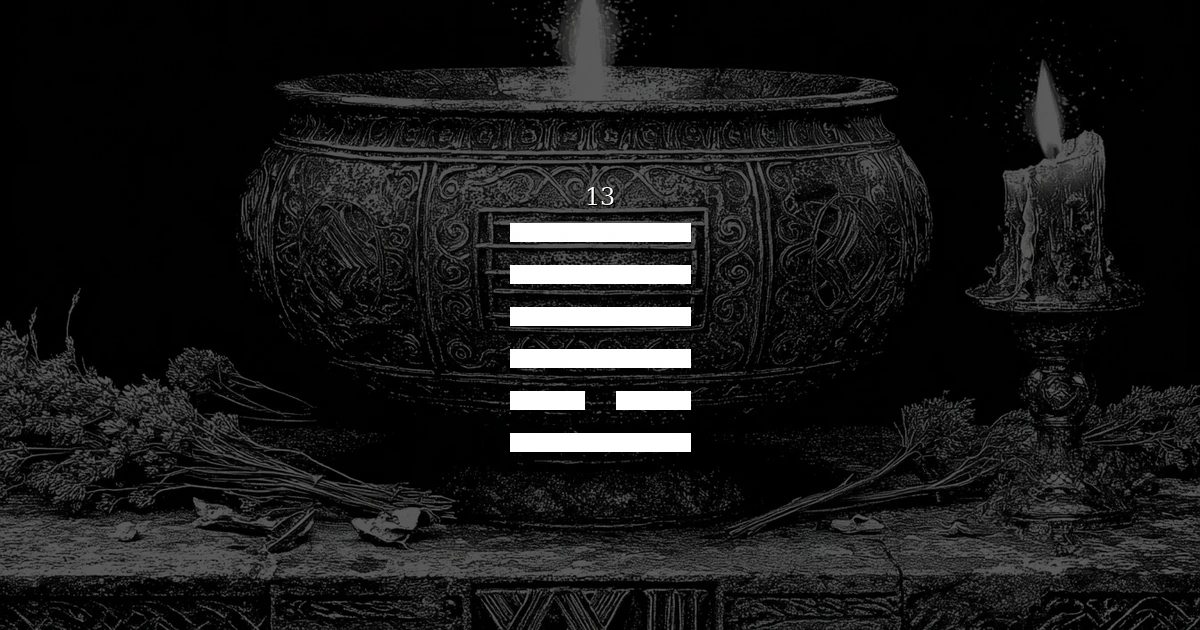
The upper trigram is Gen (Mountain ☶) and the lower trigram is Zhen (Thunder ☳). Mountain above Thunder — stillness above the initiating energy. The hexagram image is of the corners of the mouth: the strong lines at top and bottom, the empty interior. What is taken in and what is expressed both pass through this gate. The still mountain contains what thunder would initiate; the question is what is genuinely worth initiating through the act of nourishment.
The hexagram’s specific meaning arises from the dynamic relationship between these two trigrams — not from either alone. The lower trigram describes the interior or foundational quality; the upper trigram describes the outer or expressive quality. Together they define what Nourishment specifically addresses, and what quality of engagement it calls for from the person who encounters it.
The core teaching of Nourishment
The hexagram’s central image — looking at what one nourishes and seeking one’s own nourishment — points in two directions simultaneously. What are you feeding yourself? What are you feeding others? Both questions are essential. The tradition consistently reads this hexagram as demanding discernment: not everything that presents itself as nourishment genuinely nourishes; not everything that can be expressed through the corners of the mouth genuinely serves those who receive it.
The superior person who is careful about his words and temperate in eating and drinking — the hexagram’s image of how to respond to this situation — describes the two dimensions of nourishment: intake and expression. Both require discernment. The careless intake that nourishes whatever happens to be present rather than what genuinely needs nourishing; the careless expression that outputs whatever arises rather than what genuinely serves — these are Hexagram 27’s warnings.
The specific lines address different relationships to nourishment: seeking nourishment from below rather than above (the inferior seeking the superior, appropriate); seeking it from the wrong direction (the superior seeking from the inferior, a reversal that leads to difficulty); the tiger watching and gleaming, coveting what it sees — the desire for nourishment that has not developed the self-cultivation that would make receiving it appropriate.
The ten years of not acting in the final line describes the genuine commitment required for the most difficult nourishment undertaking: sustaining others at the highest level requires the sustained development of one’s own genuine capacity, not merely the provision of what comes naturally.
The I Ching tradition treats hexagrams situationally rather than as fixed states. Receiving Hexagram 27 in The Whisper’s daily draw means that the quality of nourishment is a particularly relevant lens for today — not a prediction, but a perspective from which to view what is already present in your experience.
How Nourishment appears in daily life
Hexagram 27 in daily life appears whenever the question of what genuinely sustains — versus what merely fills — is the central experience. The diet that is full but not truly nourishing; the media diet that fills attention without genuinely enriching it; the social engagement that occupies time without creating genuine connection — these are the ‘nourishment’ equivalents that the hexagram specifically addresses.
The expression dimension appears as the question of what comes out of the mouth in both its senses: the food that is expressed in choosing what to take in, and the words that are expressed in daily communication. The temperate, careful quality the hexagram calls for is not restriction but discernment — the genuine knowledge of what nourishes in the deepest sense, and the choice to seek and provide that rather than the merely available.
In reflection prompted by The Whisper, Hexagram 27 invites these questions: Where is the quality of nourishment most active in my current experience? What specific engagement does this hexagram suggest? What in the tradition’s guidance about nourishment is most relevant to today?
What this means in The Whisper
In The Whisper’s daily synthesis, Hexagram 27 creates specific resonances with the other active systems in your oracle stack.
In Nine Star Ki, Two Black Earth Star (二黒土星) in its nourishing, sustaining aspect — both associated with the quality of genuine sustenance and the careful attention to what genuinely feeds versus what merely occupies.
In BaZi, configurations where Earth element or the Output stars (Eating God, Hurting Officer) are prominent, governing what is expressed and what nourishes expression.
In Western Astrology, Moon-Venus contacts that describe the quality of nourishment and care; Cancer-Taurus emphasis; 4th and 2nd house themes of home sustenance and genuine resource.
When multiple systems point toward related themes — when the nine-star reading, the BaZi configuration, and the Western Astrology transits converge on qualities related to nourishment — The Whisper tends to produce a synthesis that is unusually specific about what this hexagram offers for the present moment. Convergence across ancient systems is the signal The Whisper treats as most meaningful.
Frequently asked questions
Q: How do I know if what I’m currently taking in is genuinely nourishing?
The hexagram’s traditional test is the quality of what results: genuine nourishment produces genuine growth, genuine capacity, genuine ability to then nourish others. The filling that is not nourishment tends to produce a particular kind of satiation that doesn’t actually satisfy — you can consume a great deal of it without feeling genuinely sustained. The discernment Hexagram 27 calls for is developing the sensitivity to notice this difference and responding to it with care rather than defaulting to the readily available.
Q: What is the significance of ‘nourishing the worthy’ mentioned in traditional commentaries?
The hexagram is concerned with nourishment at every level — including the nourishment of what is genuinely excellent and worthy in the world. The sage who nourishes all people through the people he nourishes describes a principle of leverage through genuine quality: genuine nourishment directed toward genuine capacity produces ripple effects. In daily life this appears as the wisdom of directing your most genuine nourishing attention toward what has the most genuine potential to develop.
Q: How does careful speech relate to nourishment?
Words, in the hexagram’s framework, pass through the same gate as food — they are both things that come out of the mouth and things that come in. What is said nourishes or depletes those who receive it; what is heard nourishes or depletes the one who takes it in. The careful attention to words that the hexagram calls for is not verbal restriction but the same quality of discernment applied to expression that it applies to intake: is this genuinely nourishing? Does it serve what needs to be served?
A closer look: the long-term quality of what we take in
The question of what one nourishes oneself with — and what one nourishes others with — is, in the hexagram’s frame, ultimately a question about long-term quality rather than immediate satisfaction. What feeds genuine strength is not always what feels immediately nourishing; what depletes is not always what feels immediately depleting. In The Whisper’s synthesis, when Nourishment appears alongside readings that emphasize discernment, the combined message tends to concern the specific quality of what is currently being taken in — through the senses, through information, through relationships, through practice — and whether it is building or depleting the genuine capacity the current situation requires. The mountain’s stillness at the top and the moving jaws at the bottom describe the two essential dimensions: what is held fixed (genuine values) and what is actively discerned (what actually nourishes those values).