
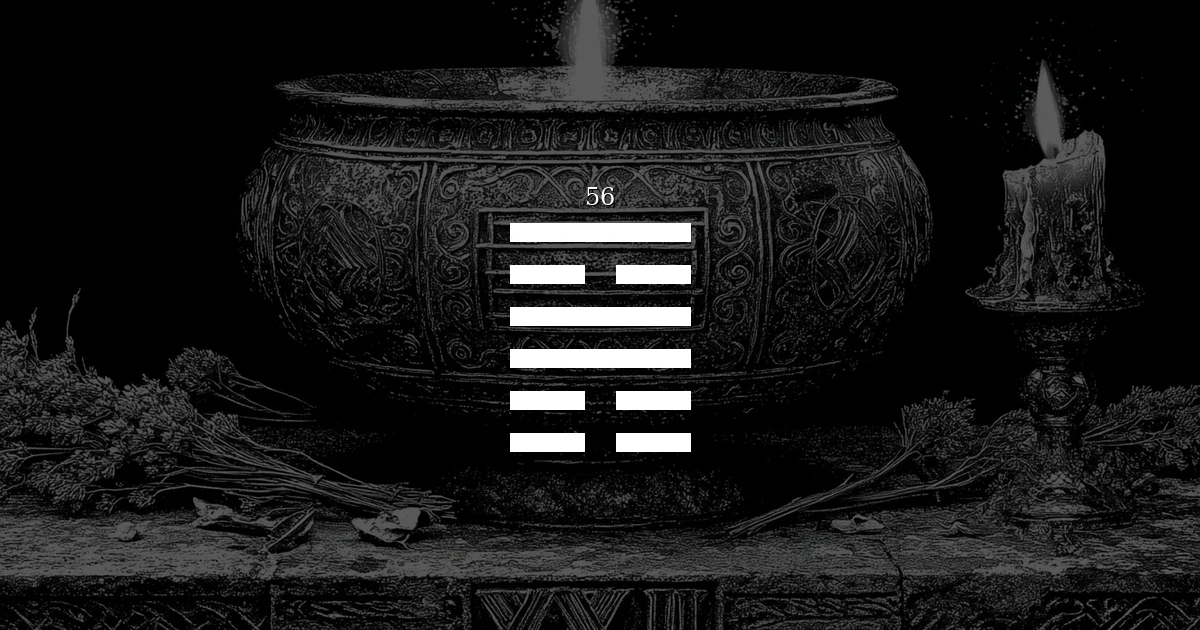
What is Hexagram 26: Great Taming?
The I Ching (易經, Yì Jīng) — the “Book of Changes” — has been consulted for guidance and reflection for over 3,000 years across East Asia, and increasingly across the world. Its 64 hexagrams each describe a specific quality of a moment: a situation, a dynamic, a particular disposition that the present calls for. In The Whisper, the I Ching contributes a daily hexagram to your oracle synthesis — generated deterministically from your birth date combined with today’s date. The draw is not random: the specific combination of when you were born and what today is produces a consistent hexagram, framing it as fated alignment rather than chance.
A note on interpretation: the original Zhou Yi texts are among the most debated in classical Chinese scholarship. Richard Wilhelm’s German translation (1923), rendered into English by Cary Baynes (1950), has shaped most Western I Ching understanding and carries its own interpretive choices alongside the original. The Whisper works within this living tradition while acknowledging genuine scholarly uncertainty.
Hexagram 26 (大畜, Dà Xù) — “Great Taming” — describes the great accumulation of wisdom and capability that results from sustained restraint of powerful energy — the mountain containing heaven’s creative force, building what can eventually be released as genuine sage wisdom.
The two trigrams: reading the structure
The upper trigram is Gen (Mountain ☶) and the lower trigram is Qian (Heaven ☰). Mountain above Heaven — the stable, still principle containing the most powerful creative force. This is a structurally unusual combination: the mountain, normally resting on the earth, is placed above even heaven’s creative force. The containing principle is genuinely in the upper position; it holds the most powerful energy beneath it.
The hexagram’s specific meaning arises from the dynamic relationship between these two trigrams — not from either alone. The lower trigram describes the interior or foundational quality; the upper trigram describes the outer or expressive quality. Together they define what Great Taming specifically addresses, and what quality of engagement it calls for from the person who encounters it.
The core teaching of Great Taming
The hexagram statement is direct: “Great taming. Perseverance furthers. Not eating at home brings good fortune. It furthers one to cross the great water.” The accumulated power should be applied outward — not spent in domestic maintenance — and is sufficient for genuinely major undertakings. The great accumulation of the taming has made the crossing possible.
The image of the superior person, who learns the many sayings of antiquity and the many deeds of the past in order to strengthen their character — the specific method of Great Taming — is the study of what genuine wisdom looks like in practice. The accumulated examples of how others have navigated major challenges are the substance of the great taming. This is not accumulation of information but the formation of character through sustained engagement with examples of genuine wisdom.
The vehicle held back, the axle-box removed — the traditional images describe the specific work of the taming phase: the power is genuine and present, but it is restrained from premature use while preparation continues. The young bull with a board attached to prevent goring, the boar with its tusks removed — the power is still there, but the sharp edge has been worked with, tamed, made usable rather than raw.
The daily renewal of virtue in the final line — the way of heaven is open — describes what genuine completion of the Great Taming phase looks like: not the exhaustion of the restraint, but the complete integration of the powerful energy into a character that can genuinely use it. The taming is complete when what was restrained has become wisdom.
The I Ching tradition treats hexagrams situationally rather than as fixed states. Receiving Hexagram 26 in The Whisper’s daily draw means that the quality of great taming is a particularly relevant lens for today — not a prediction, but a perspective from which to view what is already present in your experience.
How Great Taming appears in daily life
Hexagram 26 in daily life presents as the specific phase of building, accumulating, and deepening before a major application. The period of study before the work; the years of practice before the performance; the sustained engagement with how others have navigated what you are preparing to navigate — all of these carry Great Taming’s quality. The hexagram is specifically favorable: the restraint is productive, the accumulation is real, the preparation is building something genuine.
The “not eating at home” teaching appears practically as the wisdom to apply the accumulated capacity outward rather than spending it in maintenance of the familiar. The person who has genuinely accumulated something through sustained taming is prepared for the crossing of the great water — the major venture that lesser preparation could not support.
In reflection prompted by The Whisper, Hexagram 26 invites these questions: Where is the quality of great taming most active in my current experience? What specific engagement does this hexagram suggest? What in the tradition’s guidance about great taming is most relevant to today?
What this means in The Whisper
In The Whisper’s daily synthesis, Hexagram 26 creates specific resonances with the other active systems in your oracle stack.
In Nine Star Ki, Six White Metal Star (六白金星) in its accumulated authority aspect — both associated with the long development of genuine capacity that creates the authority to move with confidence when the time arrives.
In BaZi, periods in the luck cycle characterized by accumulation and study; configurations where the unfavorable elements gradually transform the Day Master’s capacity rather than simply obstructing it.
In Western Astrology, Saturn-Jupiter cycles where Saturn’s restraint has built something that Jupiter can eventually expand; the 9th house emphasis on wisdom through sustained learning.
When multiple systems point toward related themes — when the nine-star reading, the BaZi configuration, and the Western Astrology transits converge on qualities related to great taming — The Whisper tends to produce a synthesis that is unusually specific about what this hexagram offers for the present moment. Convergence across ancient systems is the signal The Whisper treats as most meaningful.
Frequently asked questions
Q: How is Great Taming different from Small Taming (Hexagram 9)?
Small Taming involves a gentle, yin force restraining and gradually redirecting a large yang force — the wind on heaven. Great Taming involves a massive, structuring force (the mountain) containing even heaven’s creative energy. The difference is in the scale and nature of the taming: Small Taming produces gradual, incremental influence; Great Taming produces a fundamental transformation of the contained energy into something that can eventually serve as wisdom. Small Taming is the sustained subtle influence; Great Taming is the formation of genuine character through the sustained restraint of great capacity.
Q: What does it mean to ‘learn the many sayings of antiquity’ in a modern context?
The specific image points toward sustained engagement with how others — particularly those who have navigated major challenges with genuine wisdom — have worked through what you are preparing to navigate. In a modern context this might mean deep study of a field, sustained engagement with mentors and teachers who have navigated similar territory, or the careful reading of biographies and case studies that illuminate how genuine wisdom has been applied in demanding circumstances. The accumulation is not information but character formed through engagement with genuine examples.
Q: When does the Great Taming phase end and the application begin?
The hexagram’s final line — the way of heaven is open, the daily renewal of virtue — describes the completion of the taming phase as a condition of genuinely integrated capacity rather than as a specific date or achievement. The crossing of the great water becomes appropriate when the accumulated wisdom has been genuinely integrated into character rather than merely acquired as information. There is a self-diagnostic quality: when what was restrained has become genuinely available as wisdom rather than remaining as raw energy that still needs external restraint, the taming has completed its work.