
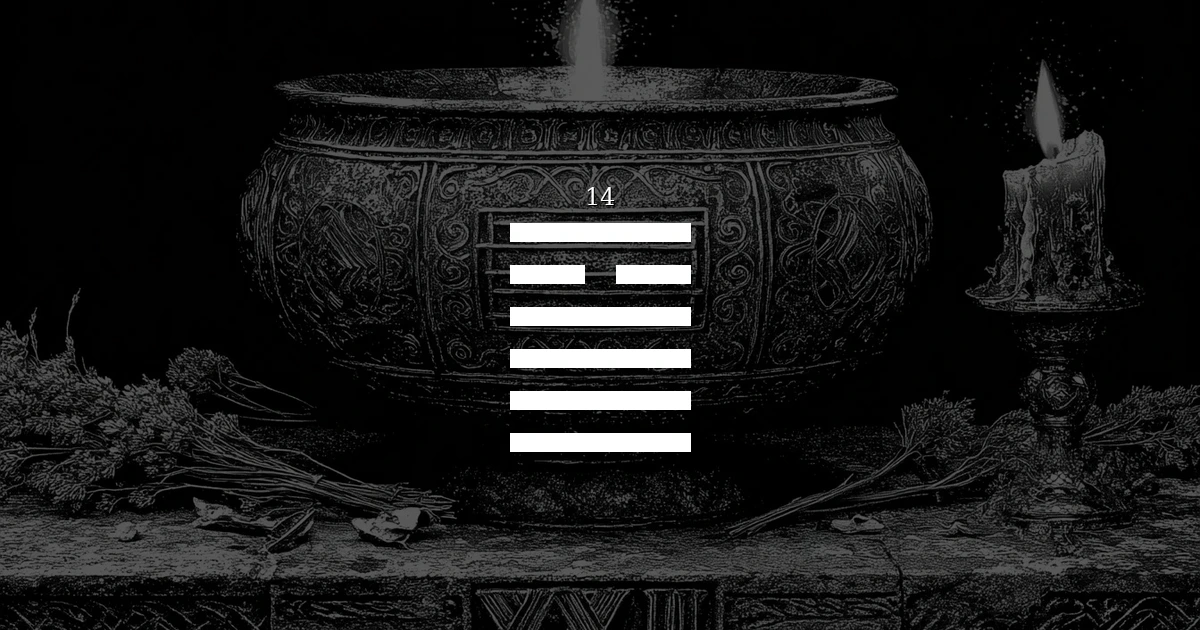
What is Hexagram 25: Innocence?
The I Ching (易經, Yì Jīng) — the “Book of Changes” — has been consulted for guidance and reflection for over 3,000 years across East Asia, and increasingly across the world. Its 64 hexagrams each describe a specific quality of a moment: a situation, a dynamic, a particular disposition that the present calls for. In The Whisper, the I Ching contributes a daily hexagram to your oracle synthesis — generated deterministically from your birth date combined with today’s date. The draw is not random: the specific combination of when you were born and what today is produces a consistent hexagram, framing it as fated alignment rather than chance.
A note on interpretation: the original Zhou Yi texts are among the most debated in classical Chinese scholarship. Richard Wilhelm’s German translation (1923), rendered into English by Cary Baynes (1950), has shaped most Western I Ching understanding and carries its own interpretive choices alongside the original. The Whisper works within this living tradition while acknowledging genuine scholarly uncertainty.
Hexagram 25 (無妄, Wú Wàng) — “Innocence” — describes the specific quality of action without calculation or hidden purpose — the acting that arises when the person is genuinely aligned with what is naturally so, rather than with what their preferences, hopes, or strategies would have be so.
The two trigrams: reading the structure
The upper trigram is Qian (Heaven ☰) and the lower trigram is Zhen (Thunder ☳). Heaven above Thunder — the creative principle above the arousing initiative. Heaven’s nature is to be what it is; Thunder’s nature is to initiate what genuinely needs initiating. Together they describe the action that arises from genuine alignment rather than from calculation: the movement that heaven’s nature initiates in thunder.
The hexagram’s specific meaning arises from the dynamic relationship between these two trigrams — not from either alone. The lower trigram describes the interior or foundational quality; the upper trigram describes the outer or expressive quality. Together they define what Innocence specifically addresses, and what quality of engagement it calls for from the person who encounters it.
The core teaching of Innocence
The hexagram name 無妄 (Wú Wàng) means literally “without falseness” or “without ulterior motive.” It is not describing naivety but a specific quality of action that has been purged of self-serving calculation — action that serves what is genuinely present rather than what the actor would prefer to be present.
The hexagram statement is unambiguous: “Supreme success. Perseverance furthers. If someone is not as he should be, he has misfortune, and it does not further him to undertake anything.” The condition for Innocence’s favorable qualities is the genuine alignment; without it, the hexagram’s apparent good fortune inverts. This is one of the I Ching’s clearest teachings about the relationship between inner alignment and outer results.
The plowing without expecting the harvest, the three years’ fallow field — these images describe the specific quality of doing what needs to be done without attaching the outcome to the doing. The farmer plows because plowing serves the field; the outcome of harvest is a natural consequence, not the motivation for the work. When motivation and outcome are confused — when the work is done for the sake of the expected harvest rather than for the intrinsic rightness of the work — Innocence has been lost.
The unexpected calamity in some lines — trouble that comes from the outside when the person is genuinely aligned — is the hexagram’s honest acknowledgment that inner alignment does not guarantee smooth external conditions. Innocence does not immunize against difficulty; it ensures that the response to difficulty remains genuine rather than distorted by reactive calculation.
The I Ching tradition treats hexagrams situationally rather than as fixed states. Receiving Hexagram 25 in The Whisper’s daily draw means that the quality of innocence is a particularly relevant lens for today — not a prediction, but a perspective from which to view what is already present in your experience.
How Innocence appears in daily life
Hexagram 25 in daily life presents as the specific question of motivation: are you doing what you are doing because it is genuinely the right action in this situation, or because it aligns with what you are hoping to produce? The distinction is subtle but the hexagram treats it as fundamental. The person who acts from genuine alignment with what is actually true receives different results than the person who acts from calculation, even when the outward behavior looks identical.
The unexpected difficulty lines also appear in daily life: situations where you are acting with genuine integrity and nonetheless encounter obstacles, misunderstandings, or complications from outside. Hexagram 25’s counsel in these situations is not to revise the inner alignment but to maintain it — the inner genuineness is not the cause of the outer complication and should not be abandoned in response to it.
In reflection prompted by The Whisper, Hexagram 25 invites these questions: Where is the quality of innocence most active in my current experience? What specific engagement does this hexagram suggest? What in the tradition’s guidance about innocence is most relevant to today?
What this means in The Whisper
In The Whisper’s daily synthesis, Hexagram 25 creates specific resonances with the other active systems in your oracle stack.
In Nine Star Ki, One White Water Star (一白水星) in its depth and genuine quality aspect — both associated with the authentic expression of what is truly present rather than the performance of what would be strategically advantageous.
In BaZi, configurations where the Day Master expresses its genuine nature without the distorting influence of excessive self-generating or controlling elements; the ‘proper’ configuration in BaZi that describes authentic expression.
In Western Astrology, Sun-Neptune harmonious aspects that produce genuine inspiration rather than delusion; Mercury direct after retrograde, when communication returns to authentic expression.
When multiple systems point toward related themes — when the nine-star reading, the BaZi configuration, and the Western Astrology transits converge on qualities related to innocence — The Whisper tends to produce a synthesis that is unusually specific about what this hexagram offers for the present moment. Convergence across ancient systems is the signal The Whisper treats as most meaningful.
Frequently asked questions
Q: How is Innocence different from naivety?
Innocence in this hexagram’s sense is a sophisticated quality rather than a lack of experience. It describes action purged of self-serving calculation — not the ignorance of someone who doesn’t know better, but the genuine alignment of someone who has developed past the need to distort reality in service of preference. Naivety doesn’t see the tiger; Innocence sees it clearly and chooses to act from genuine alignment anyway, without pretending the tiger isn’t there.
Q: What does ‘acting without expecting the harvest’ mean in practical terms?
It means doing the work because the work is genuinely the right action in this situation — not because you’ve calculated that doing it will produce a particular outcome. In practice this is demanding: most action is motivated by some anticipated result. The hexagram is pointing toward a quality of action where the rightness of the action is sufficient motivation regardless of outcome. This is not indifference to results; it is not allowing anticipated results to distort the quality of the action itself.
Q: What happens when unexpected difficulty arrives during a period of genuine Innocence?
The hexagram acknowledges this honestly: genuine alignment does not eliminate outer difficulty. When the unexpected complication arrives despite genuine inner integrity, the teaching is to examine whether the action was genuinely without calculation (if so, the difficulty is weather, not judgment) and to maintain the inner quality rather than revising it reactively. The medicine for accidental calamity is not blame but genuine engagement with what the situation actually requires.
A closer look: the freedom that comes without attachment to outcome
Hexagram 25’s teaching about action without anticipation of specific results points toward a specific quality of freedom: the freedom from the contraction that comes when action is calculated primarily in terms of expected return. This does not mean acting without consideration — it means acting from genuine inner truth rather than from strategic management of outcomes. In The Whisper’s synthesis, when Innocence appears alongside readings that emphasize both inner clarity and outer alignment, the combined message tends to concern the specific quality of non-attached action that serves both the person acting and what they are acting for. The unexpected harvest is not a reward for purity; it is the natural result of action that serves what is actually needed rather than what the actor projected.