
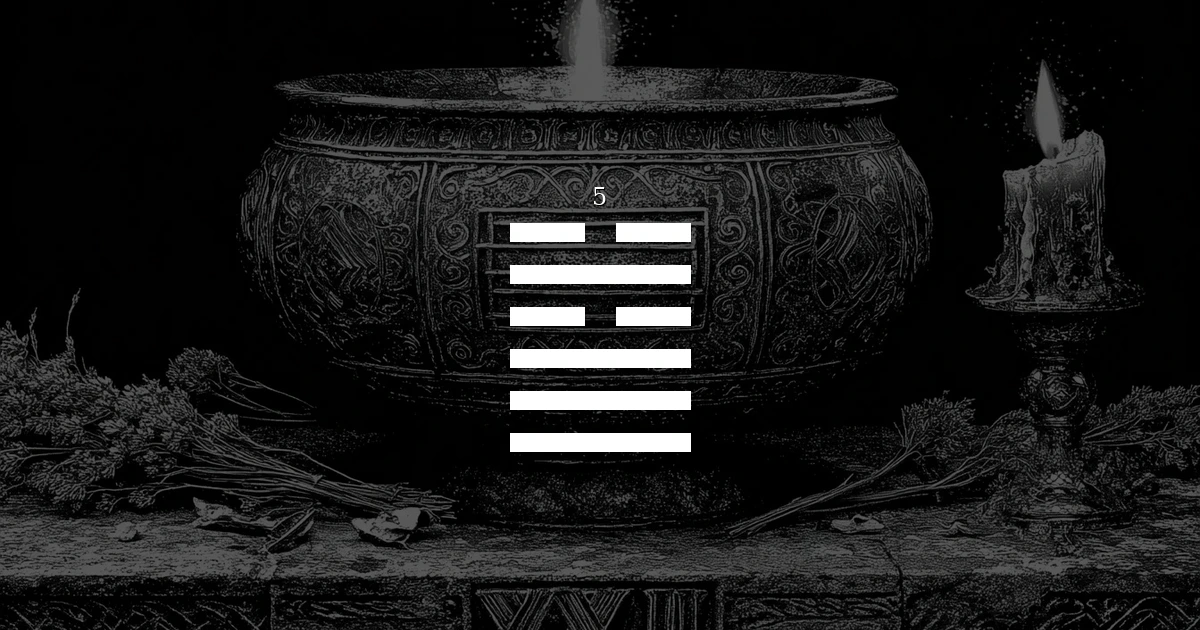
What is Hexagram 22: Grace?
The I Ching (易經, Yì Jīng) — the “Book of Changes” — is one of the oldest and most continuously consulted texts in human civilization, developed over more than 3,000 years of use across China, Japan, Korea, Vietnam, and increasingly the wider world. Its 64 hexagrams each describe a specific quality of a moment: a situation, a dynamic, a disposition that is called for. In The Whisper, the I Ching contributes a daily hexagram to your oracle synthesis — generated deterministically from your birth date combined with today’s date, changing each day as the date changes.
The draw is not random. Your birth date and today’s date together produce a consistent result for each unique pairing — a hash that returns the same hexagram whenever those two specific dates are combined. This framing reflects The Whisper’s philosophy: the hexagram you receive is fated by the alignment of when you were born and what today is, rather than produced by chance.
A note on interpretation: the Zhou Yi’s original texts are among the most debated in classical Chinese scholarship. Modern sinologists have significantly revised interpretations established by the Wilhelm/Baynes tradition (German 1923, English 1950). The Whisper works within the Wilhelm/Baynes interpretive lineage that has shaped most English-language I Ching practice, while acknowledging genuine scholarly uncertainty about many passages’ original meanings.
Hexagram 22 (賁, Bì) — “Grace” — addresses the appropriate beautiful form that genuine substance can take, and the important limits of that form.
The two trigrams: reading the structure
The upper trigram is Gen (Mountain ☶) and the lower trigram is Li (Fire ☲).
Fire illuminates from below; Mountain provides still form above. The fire of clarity, seen through the still form of the mountain, creates the aesthetic experience of genuine grace — beauty that is grounded in something real, not floating without substance.
The hexagram’s meaning arises specifically from this combination — not from either trigram alone but from the dynamic relationship between them. The lower trigram describes the interior, foundational quality; the upper trigram describes the outer, expressive quality. Their interaction defines what Grace specifically is and is not: how it differs from adjacent hexagrams in the sequence, and what particular quality of engagement it calls for.
The core teaching of Grace
Grace is not superficial beauty or decoration for its own sake; it is the beautiful form that genuine substance can take when it expresses itself appropriately. The fire at the base of the mountain illuminates the mountain’s contours — the beauty is not added, it is revealed. What is genuinely there, properly seen and expressed, is inherently beautiful.
The important limitation in the hexagram is carefully stated: grace is favorable for small things but not for large undertakings. White horses, silk, robbers turned aside — the hexagram’s images are of the beautiful expression of genuine quality in contained, specific situations. In larger matters — the genuine foundations of life and society — grace is insufficient. Substance must be there first.
The final line describes someone who has become so preoccupied with grace and adornment that they have lost their mount entirely — the beautiful has become the point rather than the expression. This shadow of the hexagram is recognizable in any domain where the appearance of quality has displaced the cultivation of actual quality.
The I Ching tradition reads hexagrams situationally: Hexagram 22 describes not an absolute state but a specific quality of the present moment. Receiving it in The Whisper’s daily draw means that the quality of grace is a particularly relevant lens for today’s self-reflection — not a prediction of what will happen, but a perspective from which to view what is already present.
How Grace appears in daily life
Hexagram 22 in daily life appears whenever the question of appropriate expression is central: how something genuine can be presented in a way that makes its genuine quality visible and accessible. The presentation that conveys the actual value of the work; the relationship expression that makes visible what genuinely exists between two people; the environment that appropriately reflects the quality it is supposed to contain.
The limitation teaching is equally important in daily life: in situations involving the genuine foundations — trust, deep commitment, the most important decisions — grace is insufficient. The beautiful presentation that has no genuine substance behind it fails precisely when the substance is most needed. Hexagram 22 invites discernment about which situations call for the cultivated expression of what is genuinely there and which call primarily for the deepening of what is there.
In reflection prompted by The Whisper, receiving Hexagram 22 may invite specific questions: Where is grace’s dynamic most active in my current experience? What specific quality of engagement does this hexagram call for in my present situation? And what does the tradition’s guidance about working with grace wisely suggest about today’s most important orientation?
What this means in The Whisper
In The Whisper’s daily synthesis, Hexagram 22 creates specific resonances with the other active systems in your oracle stack.
In Nine Star Ki, Seven Red Metal Star (七赤金星) — both associated with the aesthetic quality, the beautiful expression, and the specific intelligence of what makes genuine quality visible and appealing.
In BaZi, Configurations where Yin Metal (辛 Xin) — the polished metal, the gem — is prominent; the BaZi ‘Eating God’ star that produces beautiful, refined output.
In Western Astrology, Venus-Mercury contacts that produce beautiful expression of genuine content; Neptune-Sun aspects that produce the quality of inspired aesthetic vision.
When multiple systems simultaneously point toward the quality of grace — when the nine-star reading, the BaZi configuration, and the Western Astrology transits all converge on related themes — The Whisper tends to produce a synthesis that is unusually direct about what this specific hexagram’s teaching offers for the present moment. The convergence of multiple ancient systems on a single quality is the signal that The Whisper treats as most meaningful, and Hexagram 22’s quality on a day of genuine convergence tends to produce the oracle’s most specific message.
Frequently asked questions
Q: Is Grace advising me to focus on presentation and appearance?
Yes and no. Grace is specifically about the appropriate expression of what is genuinely there — the form that makes real substance visible and accessible. It is not advising superficial attention to appearances at the expense of substance; it is advising that genuine quality benefits from appropriate expression. The substance must be present first; the grace is how that substance presents itself well.
Q: What is the ‘limit’ of grace in large undertakings?
The hexagram’s statement that grace is ‘not applicable to large undertakings’ suggests that the foundations of major commitments and life directions must be built on genuine substance rather than on appropriate expression. A business built on beautiful marketing of a genuinely poor product, a relationship maintained primarily through pleasing behavior rather than genuine connection — these are the large undertakings where grace without substance fails.
Q: How does the mountain-fire image relate to the concept of grace?
The fire illuminating the mountain creates aesthetic experience — what is genuinely there becomes beautiful through appropriate illumination. This is the hexagram’s model of grace: not decoration applied to the outside, but illumination of what actually exists. The fire doesn’t change the mountain; it makes the mountain’s genuine qualities visible in a way that creates beauty. Grace in this sense is the appropriate light that reveals genuine quality.
A closer look: the relationship between form and substance
The specific question Hexagram 22 poses is about the relationship between genuine inner quality and its outer expression. Grace is not superficial decoration — in the hexagram’s terms, it is the form that genuine inner quality takes when it is expressed appropriately for the situation. The fire at the mountain’s foot illuminates the mountain’s true form; it does not create the form but makes it visible. In The Whisper’s synthesis, when Grace appears alongside readings that emphasize interior depth from other systems, the message often concerns the specific question of how inner quality is currently finding — or failing to find — its appropriate outer expression. Not all situations call for elaborate form; genuine discernment about what form serves the inner quality in each specific situation is the ongoing work the hexagram points toward.