
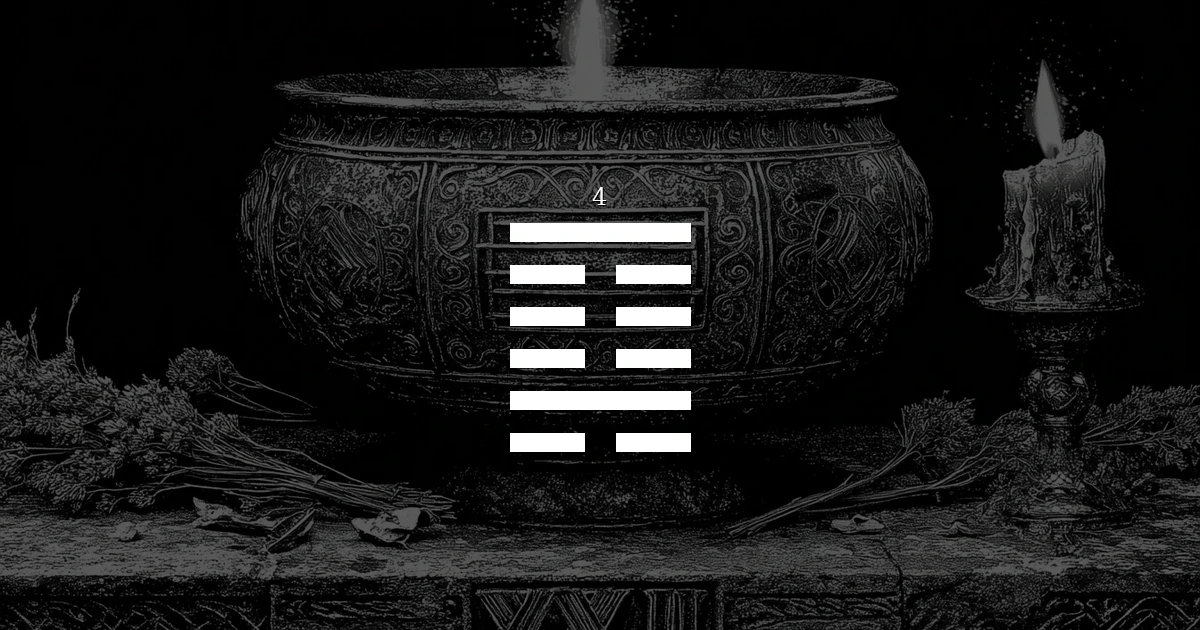
What is Hexagram 20, Contemplation?
Hexagram 20 of the I Ching is 觀 (Guān), translated as Contemplation, View, or Observation. Its structure places Wind (☴) above Earth (☷): wind moving across the broad surface of the earth, able to see everything from above, moving over all of it without fixing on any one part. The Chinese character 觀 depicts a heron looking — the alert, patient, unhurried observation of a creature whose capacity to act depends entirely on the quality of its prior seeing.
The I Ching is one of the oldest continuously consulted texts in human history, with origins in Zhou dynasty China approximately three thousand years ago. The Wilhelm/Baynes translation (1923/1950) is the primary Western reference, though original meanings continue to be debated by scholars. The Whisper engages with this tradition as a lens for self-reflection rather than a predictive system.
In The Whisper, your daily hexagram is determined by a hash of your birth date and today’s date — a deterministic draw framed as fated rather than random. When Hexagram 20 appears, the system is pointing toward the quality of genuine, clear observation — and the specific influence that genuine clarity of perception makes possible.
The two trigrams: Wind above Earth
The trigram Xun (Wind) above Kun (Earth) creates the image of something that moves freely over the full surface of the earth, touching everything it passes over without being bound to any of it. Wind is the great observer — present everywhere, influencing everything, tied to nothing in particular. Earth below is the full receptive surface: nothing is hidden from the wind that moves over it.
The traditional image associated with this hexagram is the watchtower of the ancient kings — the elevated position from which the entire kingdom can be observed, and from which the quality of governance can be assessed by direct observation rather than by reports. The hexagram is about seeing directly, from an elevated vantage point, without the distortions that arise from being too close, too invested, or too committed to a particular interpretation of what is seen.
Xun (Wind) carries the quality of penetrating observation — the wind that moves through everything, that finds every gap and passage. Kun (Earth) carries the quality of the full, unedited surface. Together they describe the condition in which observation is both broad (nothing is excluded from view) and penetrating (the wind finds what is in the gaps, not only what is on the surface).
The core teaching of Contemplation
The central teaching of Hexagram 20 involves a double movement: the contemplating person observes clearly, and the contemplating person is genuinely observed. This mutuality is one of the hexagram’s most significant features. The watchtower allows the king to see the kingdom; it also makes the king visible to the kingdom. The quality of the king’s governance is revealed by observation precisely because observation works in both directions.
The traditional commentary’s image of the ritual ablution — the washing of hands before the sacrifice, in the moment of sacred attentiveness — points toward the specific quality of observation the hexagram values: the unhurried, complete, genuinely present observation that precedes action rather than rushing into action before seeing clearly. The ablution before the sacrifice is not the sacrifice itself; it is the preparation of the observer for what they are about to do, the moment of bringing full, clean attention to what is genuinely there before acting.
This quality of prior observation — seeing clearly before acting — is the hexagram’s primary practical counsel. The influence that comes from genuine observation arises not from the observation itself but from the action that the clear observation makes possible. The heron waits with perfect patience and clarity; it acts when it has genuinely seen what is actually there, not when it has estimated or assumed.
The shadow of Hexagram 20 is observation as detachment — the voyeur quality that observes without ever genuinely engaging, the analytical distance that substitutes for the genuine contact that real engagement requires. Genuine contemplation, as the hexagram describes it, is not a retreat from engagement but the preparation that makes genuine engagement possible. The person who has genuinely seen what is there is equipped to engage genuinely; the person who acts without seeing engages with their projection rather than with what is actually present.
How Contemplation appears in daily life
The pattern of Hexagram 20 in daily life appears at moments when the most valuable contribution is the quality of genuine attention — seeing what is actually there rather than what one expects, hopes, or fears to find. This is recognizable in the experience of a conversation in which one is genuinely listening rather than preparing one’s response; the problem that yields when one stops trying to solve it and actually looks at what it genuinely is; the relationship that shifts when one stops managing it and actually sees the other person as they actually are.
The hexagram also appears as a kind of temporal orientation: a period in which observation rather than action is the primary work. These are the periods of genuine contemplation that precede genuine decisions, genuine creative work, and genuine changes of direction — the time spent genuinely seeing before acting. The ablution before the sacrifice is not wasted time; it is the preparation without which the sacrifice would not be genuine.
The being-seen dimension of Hexagram 20 is also practically significant. The person who is genuinely present — who is not managing their appearance but simply being what they actually are — tends to be observed accurately. This quality of genuine presence is both the result of genuine contemplation (one who sees clearly tends to present genuinely) and the condition for genuine observation of oneself.
What Contemplation means in The Whisper
In The Whisper’s synthesis, Hexagram 20 resonates with the Four Green Wood Star (四緑木星) in Nine Star Ki — the wind star of penetrating, far-reaching observation and the communication that arises from genuine seeing. When both systems point toward the quality of careful prior observation, The Whisper may draw attention to where the current situation calls for genuine seeing before acting, and what quality of attention is required for that seeing to be genuinely clear.
In BaZi, the resonance appears in configurations that favor the Water element’s quality of deep perception — Ren Water (壬水) particularly, with its quality of the broad surface that reflects everything that passes over it accurately, without distortion, before the deep movement begins.
From Western Astrology, Hexagram 20 carries qualities associated with Neptune in its clarity aspect — not the dissolving quality but the seeing-through quality, the perception that is not blocked by the surface presentation but sees the actual underlying condition. It also resonates with Virgo’s quality of precise, unhurried observation: the seeing that is interested in what is actually there rather than in what the observer wants to find.
Frequently asked questions
Q: What does it mean that the contemplating person is also being observed? The hexagram’s insight that observation is mutual — that the quality of one’s own observation is itself observable — has a specific practical implication: the person who contemplates genuinely is themselves genuine, and this genuineness is visible. The watchtower allows the king to see; it also shows the kingdom what kind of king they have. In personal terms, the person who looks at their situation with genuine clarity tends to be seen clearly in return, because the quality of their attention communicates through its presence.
Q: How long should the period of contemplation last before action? The ablution-before-sacrifice image suggests that the contemplation lasts as long as genuine preparation requires — which varies with the situation. The test is whether one has actually seen what is there rather than confirmed what one expected to see. If the observation has produced genuine surprise, genuine revision of prior assumptions, or genuine clarity about something that was unclear before, the contemplation has done its work. If the observation has only confirmed what one already believed, there is some chance the seeing has not yet been genuine.
Q: Can contemplation coexist with urgency and time pressure? The hexagram’s counsel is not about leisurely observation at the expense of timeliness; it is about the quality of attention brought to observation within the available time. The heron’s clarity is not the result of unlimited patience but of genuine present-moment attention — being completely where it is for the time it has. The same quality is available under time pressure; it is the quality of genuine presence rather than the quantity of time that the hexagram is pointing toward.