
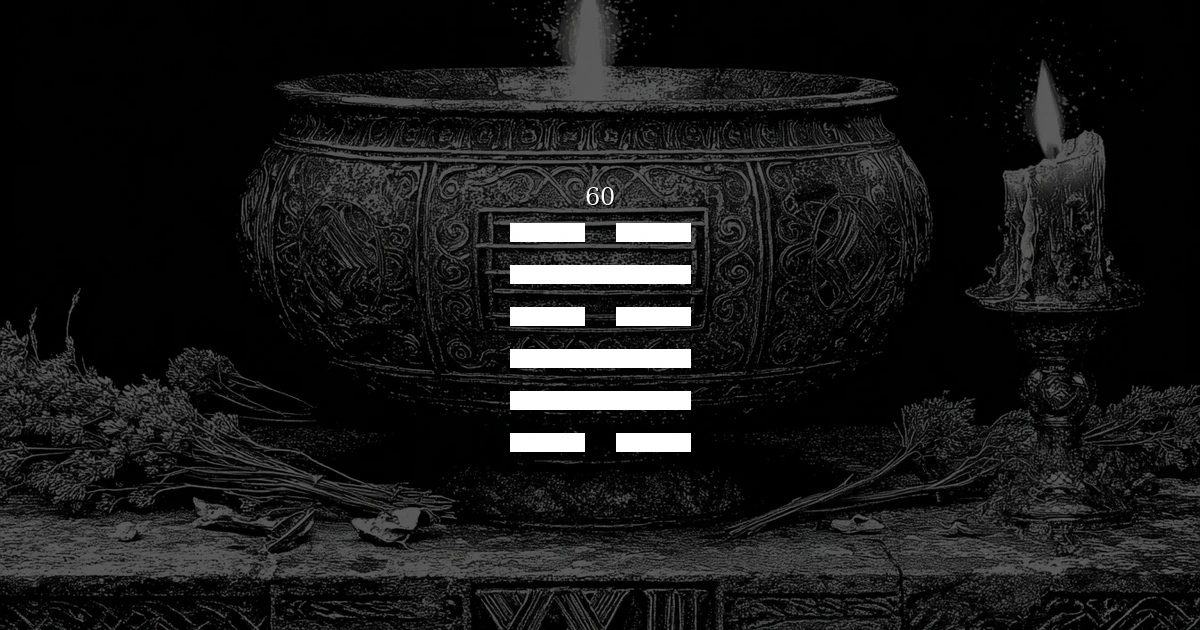
What is Hexagram 2: The Receptive?
The I Ching (易經, Yì Jīng) is among humanity’s oldest surviving texts, compiled during the Western Zhou dynasty roughly 3,000 years ago and developed over millennia through the commentaries of Confucian scholars, Taoist philosophers, and later Japanese, Korean, and Vietnamese interpreters. In The Whisper, the I Ching contributes a daily hexagram to your oracle synthesis — determined by a hash of your birth date and today’s date, changing each day, framed as fated alignment rather than random chance.
Hexagram 2 is formed by doubling the trigram ☷ Kun (Earth): six broken yin lines, the maximum concentration of receptive, yielding, nourishing energy in the system. Where Hexagram 1 (The Creative) represents the originating impulse, Hexagram 2 represents the ground that receives and brings that impulse to completion. These two hexagrams are the poles from which all 64 arise.
A note on interpretation: the original Zhou Yi is among the most debated texts in classical Chinese scholarship. The Wilhelm/Baynes translation (German 1923, English 1950) that shapes most Western I Ching practice carries its own interpretive choices. The Whisper works within this living tradition while acknowledging its limits.
The two trigrams: reading the structure
Both upper and lower trigrams are Kun (坤, Earth ☷): three broken yin lines, the trigram of pure receptivity, yielding, nourishment, and the completing principle. The Kun trigram is associated with the earth, the mother principle, the belly, the cow, and the colors black and yellow. Its qualities: devotion, patience, the capacity to nourish all things without discrimination, the strength that does not assert itself but sustains everything.
The traditional image of Hexagram 2 is earth’s condition: the great earth carrying all things — good and evil, beautiful and ugly — without distinction. In response, the superior person, according to the classic commentary, “carries all things with virtue that is broad, and illumines all things with character that is great.” The receptive quality is not mere passivity; it is the specific strength that can hold and nourish what the creative principle initiates.
The hexagram’s association with the mare (as distinct from the dragon of Hexagram 1) is significant. The mare’s qualities — endurance, gentleness, and the capacity to follow well — describe a different mode of strength than the dragon’s rising force. Both are genuinely powerful; they serve different functions in the cosmic order.
The core teaching of The Receptive
Hexagram 2’s core teaching is the nature of the receptive principle — and what distinguishes genuine receptivity from mere passivity. The hexagram statement uses the same four-quality phrase as Hexagram 1 (yuan, heng, li, zhen) but adds a crucial modification: favorable for the perseverance of a mare. The receptive’s perseverance is specifically the yielding, following kind — not the assertive perseverance of the creative.
The traditional commentary offers what might seem counterintuitive: do not initiate; follow. If one takes the initiative, one loses the way; if one follows, one finds the master. The southwest is favorable (where friends and peers are found); the northeast is less favorable (where the master, the leader, resides — the receptive is not called to occupy the leading position). This is not a limitation but a description of where the receptive principle is most genuinely effective.
The frost becomes solid ice line — the first line’s image — carries the hexagram’s most important practical warning: small signs must be attended to. When yin first appears, ice will follow. What begins as a minor yielding tendency, if not tended, becomes the complete submission of what should have been held in balance. Receptivity requires discernment about what is genuinely worth following.
The classic line about the dragon in the field meeting the great person is interesting in the context of Hexagram 2 — it suggests that even in the receptive hexagram, there are moments of active engagement and encounter. The receptive is not static; it is the dynamic quality of genuine responsiveness.
How The Receptive appears in daily life
Hexagram 2 in daily life tends to appear as a quality of appropriate following and genuine openness: the day when the most valuable thing is to receive rather than initiate, to support rather than lead, to let what is forming develop without forcing it. This is not always the less active day; it can be a day of intense engagement, but the orientation is receptive rather than initiating.
The receptive quality also appears as the capacity to hold what is difficult without being destroyed by it — the earth’s quality of carrying everything. Days when complex emotional material, difficult relationships, or unresolved situations are present may be precisely the days when the earth’s nourishing receptivity is the most needed quality: not fixing, not driving, but genuinely holding.
The warning in the first line — attending to the frost before it becomes ice — appears in daily life as the importance of noticing small signs early. The small yielding that slowly becomes a pattern of complete accommodation; the small resentment that builds into something larger because it was not tended when it first appeared — Hexagram 2 specifically addresses these accumulations, calling for the discernment to see what the first frost portends.
In a day that draws Hexagram 2, the most productive reflection may be: where is genuine receptivity called for today? What needs to be supported and nourished rather than initiated or driven? And what small sign — the frost underfoot — is asking for your attention before it becomes ice?
What this means in The Whisper
In The Whisper’s synthesis, Hexagram 2 creates specific interactions with the other active systems in your oracle stack, particularly those associated with Earth, nourishment, and the completing principle.
In Nine Star Ki, the closest resonance is with Two Black Earth Star (二黒土星, Jikoku Dosei) — both associated with the nourishing, patient, devotional quality of earth energy, the mother archetype, and the particular strength of the one who sustains rather than initiates. When both appear in the synthesis, The Whisper may produce a message specifically about the quality of nourishment and support currently being offered or received — and what genuine receptivity, as distinct from passive accommodation, looks like in the present situation.
In BaZi, Hexagram 2 resonates with Earth day masters (戊 Wu, 己 Ji) and with configurations that show a predominance of yin energy. Periods in the BaZi lucky cycle that emphasize Earth element may amplify the hexagram’s nourishing, completing quality in the synthesis.
In Western Astrology, Hexagram 2 resonates with Venus and Taurus placements, with Cancer’s nourishing quality, and with periods when the Moon is emphasized — particularly new moon phases that call for the interior, receptive mode before the full moon’s expressing quality arrives. The receptive principle in Western astrology is most closely associated with the yin signs (Taurus, Cancer, Virgo, Scorpio, Capricorn, Pisces) and their characteristic orientation toward receiving, sustaining, and bringing to form.
When multiple systems simultaneously suggest nourishment, receptivity, or the supporting rather than leading function — a Two Black Nine Star Ki day, a BaZi reading showing strong Earth, a Western Astrology reading with Moon emphasis — a daily draw of Hexagram 2 often produces a Whisper that is specifically about the quality of the receptive mode available today and what it makes possible that the initiating mode cannot.
Frequently asked questions
Q: Does Hexagram 2 mean I should be passive or deferential today?
Not precisely. The I Ching’s concept of the receptive is more specific than passivity or deference. The Receptive is the principle that nourishes, sustains, and brings to completion — a genuinely active function that is oriented toward supporting what is genuinely growing rather than initiating new things. The mare’s quality is not the cow’s docility; it is the endurance and responsiveness of an animal whose greatest strength lies in how it moves within a situation rather than how it changes that situation. Receiving Hexagram 2 may be a signal that today’s most valuable orientation is toward supporting and completing rather than initiating — which in some contexts requires more presence and attention than initiation does.
Q: How does Hexagram 2 relate to Hexagram 1? Are they opposites?
The I Ching tradition describes them as complements rather than opposites. The Receptive does not combat the Creative — it completes it. Hexagram 1 initiates; Hexagram 2 brings what has been initiated into fully realized form. The hexagram statement for Hexagram 2 describes it as “the perfect complement of THE CREATIVE.” This is one of the I Ching’s most important philosophical points: what appears to be the passive or subordinate principle is not lesser, but differently oriented. Both are necessary; neither is complete without the other.
Q: The frost becoming ice warning seems quite serious. How does The Whisper work with this kind of warning?
The Whisper treats the I Ching’s warning lines as information about the potential trajectory of a current pattern, not as predictions of inevitable outcomes. The frost-becomes-ice image is specifically about the early signs that, if unattended, lead somewhere more difficult. In The Whisper’s daily synthesis, when Hexagram 2 appears alongside other system readings that emphasize attention to what has been overlooked or the early signs of an emerging pattern, the combined message may specifically address what is currently appearing as frost that deserves honest attention before it accumulates.