
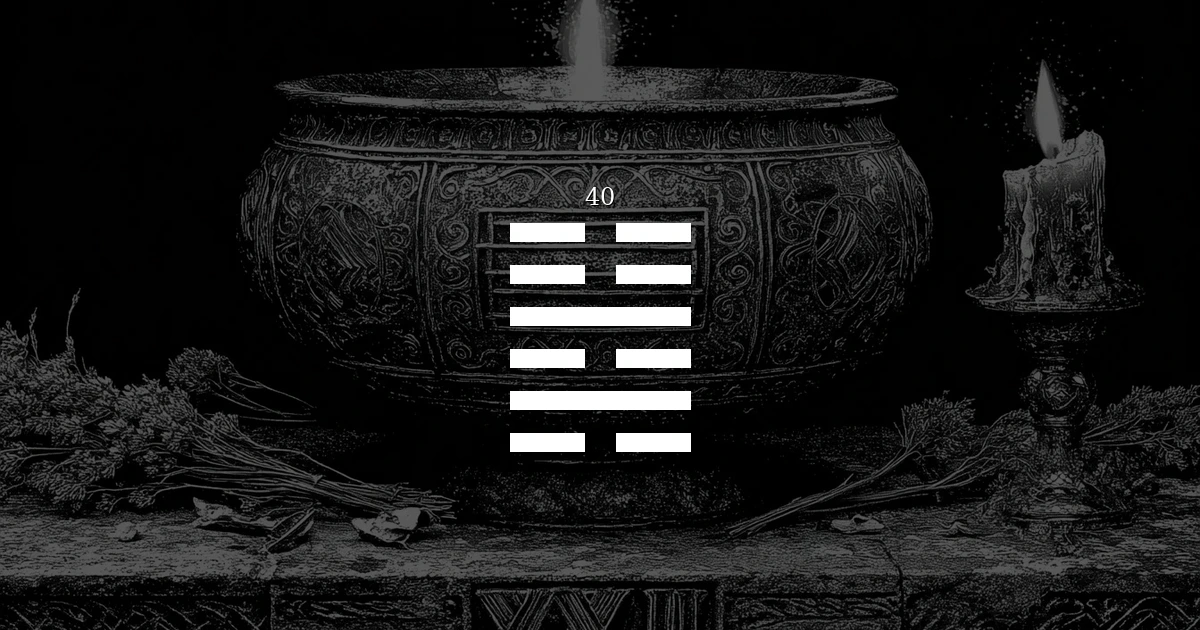
What is Hexagram 18, Work on the Decayed?
Hexagram 18 of the I Ching is 蠱 (Gǔ), translated as Work on What Has Been Spoiled, Correcting, or Decay. Its structure places Mountain (☶) above Wind (☴): the image of wind blocked beneath a mountain, unable to circulate freely, and the stagnation that results from this blockage over time. The original Chinese character 蠱 depicts worms or insects in a bowl — the image of what accumulates when something has been left unattended, when the decay has proceeded below the visible surface.
The I Ching is one of the oldest continuously consulted texts in human history, with origins in Zhou dynasty China approximately three thousand years ago. The Wilhelm/Baynes translation (1923/1950) is the primary Western reference, though original meanings continue to be debated by scholars. The Whisper engages with this tradition as a lens for self-reflection rather than a predictive system.
In The Whisper, your daily hexagram is determined by a hash of your birth date and today’s date — a deterministic draw framed as fated rather than random. When Hexagram 18 appears, the system is pointing toward the specific work of careful, patient correction of what has been allowed to deteriorate.
The two trigrams: Mountain above Wind
The trigram Gen (Mountain) above Xun (Wind) creates the image of obstruction: wind, which naturally moves and circulates, finds its movement blocked by the immovable mountain above it. What cannot circulate stagnates; what stagnates accumulates the decay that the hexagram’s name describes. The mountain is not malicious — it is simply fixed, and the wind below has been unable to find its natural movement.
This structural image is one of the I Ching’s most honest descriptions of how deterioration actually works: not through dramatic failure but through the gradual accumulation of what happens when natural circulation is blocked. The decay beneath the mountain is not sudden; it develops over time through the slow accumulation of what cannot be cleared, processed, or moved through. The correction required is similarly patient: not dramatic reform but the careful, systematic clearing of what has accumulated.
Wind (Xun) in its lower position carries the qualities of penetration and gentle persistence — precisely the qualities needed for the corrective work the hexagram describes. The work is not done by confronting the mountain directly; it is done by the persistent, careful clearing of what has accumulated beneath it, until circulation can begin again.
The core teaching of Work on the Decayed
The central teaching of Hexagram 18 is that the work of correcting inherited decay — repairing what has been allowed to deteriorate, usually through gradual neglect rather than dramatic failure — requires a specific quality of approach: careful diagnosis before action, patient correction rather than hasty reform, and the willingness to do the detailed, unglamorous work of actually clearing what has accumulated rather than simply changing the visible surface.
The hexagram’s traditional commentary specifically addresses the quality of inherited disorder — the decay that was allowed to develop by predecessors, or by earlier versions of oneself. This framing is important: the work is not about blame but about responsibility. The decay that has accumulated through inattention, through the passing of problems down the line, through the avoidance of the difficult correction that was needed earlier — all of this is now present and must be worked with. The question is not who caused it but how to approach the work of correcting it.
The instruction to examine carefully before acting — the three days before and three days after the turning point that the traditional commentary mentions — points toward the importance of genuine diagnosis. Hasty reform that does not understand the actual structure of the decay tends to produce new problems in the process of addressing the old ones. The corrective work that genuinely serves begins with the willingness to understand what has actually happened before attempting to change it.
The shadow of Hexagram 18 is the avoidance of necessary correction — the preference for the visible surface over the actual state of the underlying structure, the choice to not look at what has accumulated because looking is uncomfortable. The hexagram is consistently pointing toward the willingness to see what is actually there, to do the careful work of understanding the actual state of deterioration, before the corrective work can begin.
How Work on the Decayed appears in daily life
The pattern of Hexagram 18 in daily life appears most recognizably in situations where something that should have been tended to earlier has accumulated into a problem that must now be addressed — the relationship where unaddressed tensions have become structural; the practice or habit that has gradually deteriorated from its originally useful form; the system or process that has developed workarounds and compromises that have compounded over time into something that barely resembles what it was originally intended to be.
The specific quality the hexagram points toward in these situations is the willingness to actually look at what has accumulated — to do the genuine diagnostic work rather than jumping to the most obvious fix. The bowl of worms in the hexagram’s name is an image of this: the decay has been proceeding beneath the surface, and addressing it requires actually lifting the bowl and seeing what is there, which is less comfortable than pretending the surface presentation is the whole story.
Practically, the corrective work Hexagram 18 points toward is patient and iterative rather than dramatic. The three days before and three days after suggests a rhythm of preparation, action, and assessment — checking the work of correction to ensure it is actually addressing what needs addressing rather than creating new problems. The quality of the work matters more than its speed.
What Work on the Decayed means in The Whisper
In The Whisper’s synthesis, Hexagram 18 resonates with the Eight White Earth Star (八白土星) in Nine Star Ki — the mountain star associated with the work of turning points, the patient accumulation of what needs to be gathered before the next movement begins. When both systems point toward patient, careful corrective work, The Whisper may draw attention to where in the current situation the accumulated deterioration is calling for this specific quality of attention.
In BaZi, the resonance appears in configurations where the corrective, restraining elements are prominent — Metal restraining Wood, or Water bringing clarity to Fire excess. The day quality of careful correction and the patient clearing of what has accumulated.
From Western Astrology, Hexagram 18 carries qualities associated with Virgo and the sixth house — the detailed attention to what has been neglected, the patient work of actually repairing what is not functioning well rather than accepting the dysfunction as background condition, and the genuine service quality that finds satisfaction in making things work well again.
Frequently asked questions
Q: Why does the hexagram describe inherited decay from parents? Does this literally mean my parents? The traditional commentary’s reference to the work on what has decayed through parents reflects the historical context in which family roles and inherited responsibilities were primary. In contemporary application, the image extends to any inherited situation — the organization one has joined, the project one has taken over, the relationship pattern learned in childhood, the cultural or professional tradition one has inherited. The key quality is that the decay was allowed to develop before one was responsible for it, and now one is responsible for correcting it.
Q: What is the difference between the corrective work Hexagram 18 recommends and simple fixing? The distinction is in the depth and quality of the work. Simple fixing addresses the visible symptom; the corrective work of Hexagram 18 addresses the underlying condition that produced the symptom. The three days before and after image points toward this: genuine diagnosis before action, and assessment after action to ensure the correction is working. The work is iterative rather than one-time, and it is oriented toward genuine restoration rather than surface repair.
Q: Does the hexagram suggest I caused the decay that now needs correction? Not necessarily. Hexagram 18 is specifically about the work of correcting what has been allowed to deteriorate, regardless of who bears primary responsibility. The hexagram’s practical focus is on the work required rather than on the attribution of blame. If the decay is genuinely there, the question the hexagram poses is: who will do the work of patient, careful correction? And in the present situation, the answer is: you, now, with this quality of attention.