
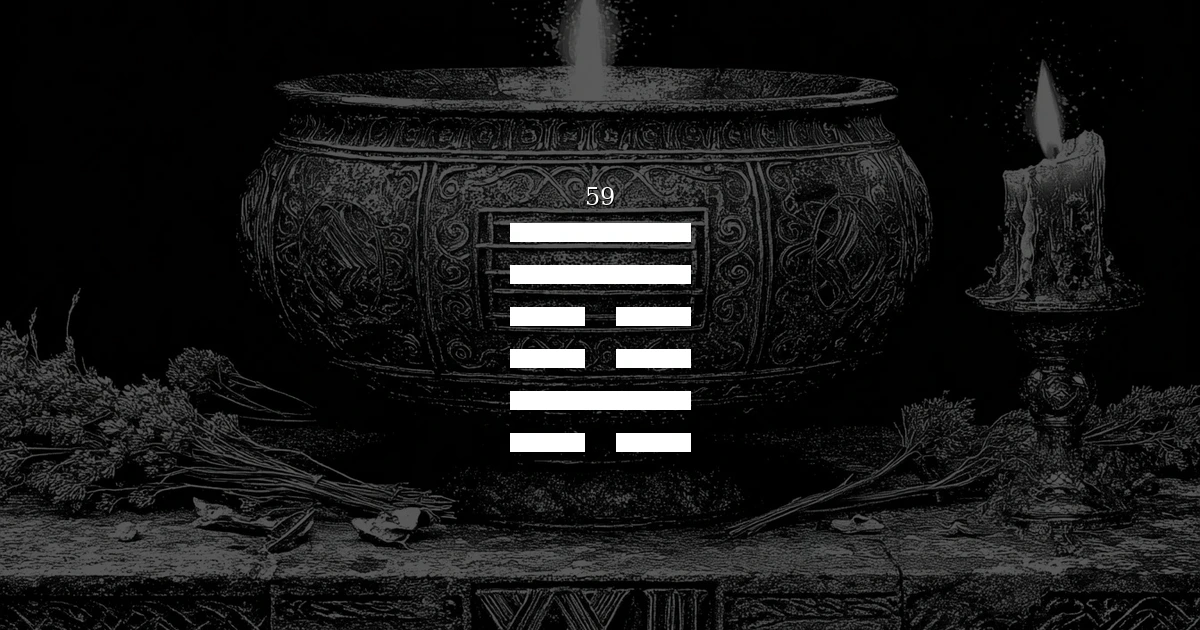
What is Hexagram 15, Modesty?
Hexagram 15 of the I Ching is 謙 (Qiān), translated as Modesty or Humility. Its structure places Earth (☷) above Mountain (☶): the high has made itself low. A mountain beneath the surface of the earth does not announce itself; it holds its height below rather than displaying it above. This is the hexagram’s central image — and it carries a distinction that is central to understanding what the I Ching means by genuine modesty. This hexagram is traditionally described as the only one of the sixty-four in which all six lines are favorable, in whatever position they appear. The I Ching makes no other claim of this kind.
The I Ching is one of the oldest continuously consulted texts in human history, with origins in Zhou dynasty China approximately three thousand years ago. The Wilhelm/Baynes translation (1923/1950) is the primary Western reference, though original meanings continue to be debated by scholars. The Whisper engages with this tradition as a lens for self-reflection rather than a predictive system.
In The Whisper, your daily hexagram is determined by a hash of your birth date and today’s date — a deterministic draw framed as fated rather than random. When Hexagram 15 appears, the system is pointing toward the specific quality and the specific power of genuine modesty in your current situation.
The two trigrams: Earth above Mountain
The trigram Kun (Earth) above Gen (Mountain) creates one of the I Ching’s structurally paradoxical images. Gen (Mountain) is the hexagram of height, stability, keeping still — the highest natural form. Kun (Earth) is the flat, receptive ground. When mountain is below earth, the height is concealed — the great has placed itself beneath the ordinary, the high has voluntarily assumed a low position.
The mountain’s height has not been reduced; it is genuinely there. The modesty of this hexagram is not the false self-deprecation that denies actual capacity or quality. It is the voluntary assumption of a low position by something that has genuine height — the choice to hold what is genuinely great without displaying it, without using it to elevate oneself above others, without requiring that others acknowledge it.
This is the specific quality that distinguishes genuine modesty from its counterfeit. False modesty performs lowness while actually seeking the recognition that comes from performing it well. Genuine modesty — the mountain beneath the earth — simply holds its height quietly, without performance, without the need for acknowledgment.
The core teaching of Modesty
The central teaching of Hexagram 15 is that genuine modesty — accurate self-assessment, neither inflated nor deflated — produces the leveling effect that resolves the tensions that all asymmetries create. The hexagram’s traditional imagery describes how modesty works: what has been exalted is brought to the level; what has been depressed is raised. Modesty is not uniformity — it is the restoration of appropriate proportion.
This leveling effect is why the hexagram is traditionally described as universally favorable. In any situation — whether one is in a position of strength or weakness, whether things are going well or poorly — the quality of genuine modesty is appropriate and beneficial. When one is strong, modesty prevents the arrogance that squanders strength. When one is weak, modesty prevents the self-pity and self-deprecation that amplifies weakness. In the middle, modesty produces the accurate self-assessment that allows for genuine response to what is actually present.
The shadow side of Hexagram 15 is not the ordinary failure of modesty (arrogance) but something more subtle: false modesty, the performance of humility that is actually a sophisticated form of attention-seeking. The person who constantly disclaims their abilities as a way of getting others to insist on them; the leader who defers so consistently that no genuine direction is provided — these are the shadow forms, not of Modesty but of performed modesty, which produces none of the leveling effect the hexagram describes.
Genuine modesty, as the hexagram describes it, is also the quality that allows genuine learning. The person who holds their current understanding modestly — not as the final truth but as the best available approximation — retains the openness to receive what would improve or correct it. The arrogant position cannot learn because it cannot acknowledge the gap; genuine modesty maintains precisely the openness through which learning enters.
How Modesty appears in daily life
The pattern of Hexagram 15 in daily life is recognizable in the experience of people who hold genuine competence and genuine quality without the need to display or assert it — whose modesty is evident not as performance but as the simple fact that they are not organized around being seen as great. These people tend to be disproportionately effective in ways that puzzle those who are organized around visibility: they are trusted precisely because they are not seeking trust; they are heard precisely because they are not insisting on being heard.
The hexagram also appears at moments when the question of how to hold genuine accomplishment or capacity is becoming relevant — when someone has achieved something real and is navigating the question of how to carry it. The mountain beneath the earth image points toward a specific answer: carry it quietly, without the need for display, without requiring that others acknowledge the height. The mountain does not become less by being beneath the surface; its height is what it is regardless of whether it is visible.
Practically, the counsel that often emerges from Hexagram 15 is the invitation to examine the relationship between genuine quality and the need for acknowledgment of that quality. Where genuine capacity is being held modestly — used in the service of what needs doing without requiring recognition — the hexagram’s leveling effect tends to produce results. Where genuine capacity is being deployed in the service of being seen, the results tend to be less reliable.
What Modesty means in The Whisper
In The Whisper’s synthesis, Hexagram 15 resonates with the Two Black Earth Star (二黒土星) in Nine Star Ki — the earth star of quiet nurturing, reliable service, and the steady devotion that does not require recognition to continue. When both systems point toward the quality of genuine modesty, The Whisper may draw attention to where the current situation benefits from holding what is genuinely there without the need for its display.
In BaZi, the resonance appears in configurations that favor genuine rootedness over external expression — particularly Ji Earth (己土) day masters, whose quality is the fertile, nourishing earth that supports what grows in it without drawing attention to itself. The quality of genuinely productive quietness.
From Western Astrology, Hexagram 15 carries qualities associated with Virgo — the discernment and genuine service that is interested in the work rather than the recognition, the precision that serves without requiring acknowledgment of its precision, and the genuine humility that is neither self-deprecation nor false modesty but accurate self-knowledge.
Frequently asked questions
Q: Why is Hexagram 15 described as the only universally favorable hexagram? The traditional characterization — that all six lines of Hexagram 15 are favorable — reflects the I Ching’s observation that genuine modesty is the one quality that serves appropriately in any condition. Other qualities are favorable in some conditions and unfavorable in others; the hexagram’s universal favorability is a statement about the universality of genuine modesty’s applicability. This is a strong claim, and it is worth sitting with: in what situation would accurate self-assessment — neither inflated nor deflated — be genuinely harmful?
Q: How does genuine modesty differ from low self-esteem or self-deprecation? The mountain beneath the earth image is helpful here: genuine modesty does not reduce the mountain’s height; it simply places it beneath the surface. Low self-esteem or self-deprecation actually reduces the mountain — it denies or undermines genuine quality and capacity rather than holding them without display. The distinction is that genuine modesty begins with accurate self-knowledge, including accurate recognition of genuine quality, and then holds that quality without requiring acknowledgment. False self-deprecation denies the quality; genuine modesty holds it quietly.
Q: Can modesty coexist with genuine confidence and assertiveness? Yes — this is one of the hexagram’s most important implications. The mountain beneath the earth is not uncertain about its height; its modesty is not confused with doubt about its own nature. Genuine modesty and genuine confidence are compatible because both rest on accurate self-knowledge. The confident modest person knows clearly what they can and cannot do, acts from that clear knowledge, and does not need the external confirmation that insecure assertion is seeking. The combination of genuine modesty and genuine confidence is one of the I Ching’s most consistently effective configurations.