
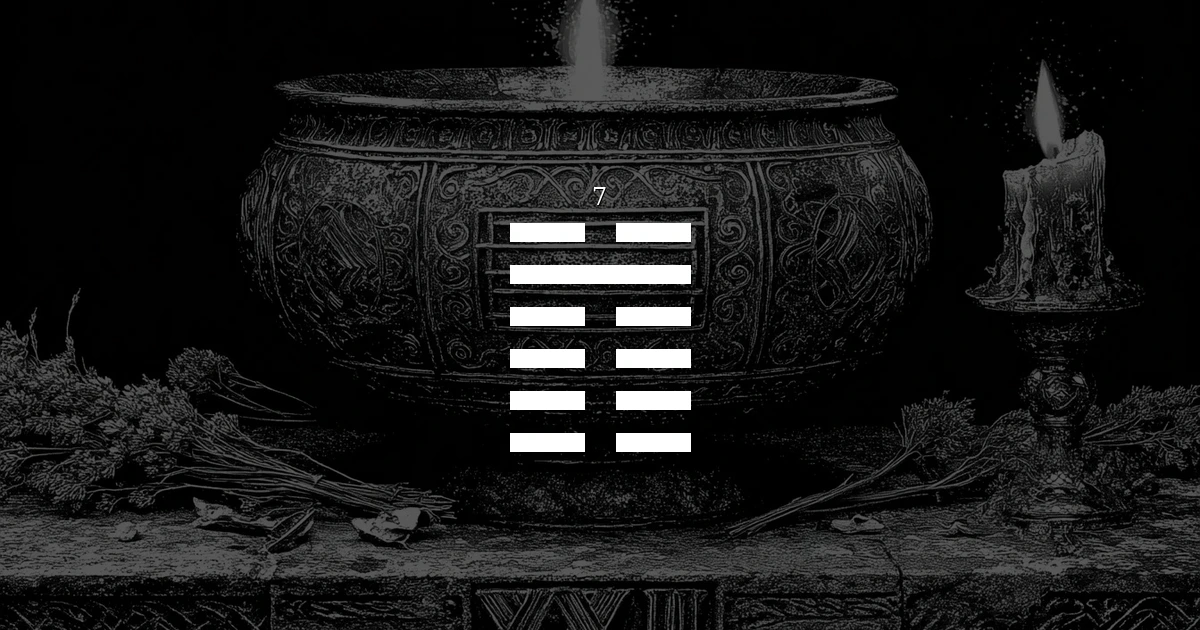
What is Hexagram 14, Great Possession?
Hexagram 14 of the I Ching is 大有 (Dà Yǒu), translated as Great Possession or Possession in Great Measure. Its structure places Fire (☲) above Heaven (☰): the clarity of fire at the highest position, illuminating from the summit. The hexagram describes the condition of genuine abundance — great capacity, great resources, great possibility — and the specific demands that such abundance places on the person who holds it.
The I Ching is one of the oldest continuously consulted texts in human history, with origins in Zhou dynasty China approximately three thousand years ago. The Wilhelm/Baynes translation (1923/1950) is the primary Western reference, though original meanings continue to be debated by scholars. The Whisper engages with this tradition as a lens for self-reflection rather than a predictive system.
In The Whisper, your daily hexagram is determined by a hash of your birth date and today’s date — a deterministic draw framed as fated rather than random. When Hexagram 14 appears, the system is pointing toward the quality of abundance and the particular demands of holding great capacity well.
The two trigrams: Fire above Heaven
The trigram Li (Fire) above Qian (Heaven) creates the image of fire at the summit of heaven — the sun at its zenith, the point of maximum illumination and maximum reach. Fire illuminates whatever is within its range; at the highest position, that range is broadest. Great Possession is not merely the condition of having abundance but the condition of having the clarity — the fire at the summit — to see what the abundance actually is and how it should be used.
Heaven below carries the quality of great creative strength, the inexhaustible generative impulse. Fire above carries the quality of clarity, discernment, the light that makes things visible. Together they describe the condition in which great power is held in the clarity of genuine vision rather than deployed blindly or accumulated for its own sake.
The combination is one of the I Ching’s most generally favorable hexagrams — but the traditional commentaries are careful to note that Great Possession carries its specific demands. The clarity of fire must illuminate the possession accurately; arrogance and the assumption that great possession is deserved permanently are the specific risks the hexagram identifies.
The core teaching of Great Possession
The central teaching of Hexagram 14 is that genuine abundance — in any form, whether material, relational, creative, or positional — requires specific qualities to be held well over time. The qualities the hexagram points toward are clarity (the fire that illuminates accurately), generosity (the willingness to distribute rather than hoard), and modesty (the accurate self-assessment that does not inflate what great possession tends to inflate).
The fire at the summit image points toward the first quality: genuine possession is held in clarity of understanding. The person who possesses greatly but does not see accurately — who does not understand what they actually have, what it is genuinely for, and what its natural limits are — is already in the process of losing it, because they cannot sustain what they cannot see. The clarity of fire is not ornamentation; it is what allows the possessor to understand and respond appropriately to what they hold.
Generosity is the hexagram’s second specific counsel. Great Possession that is hoarded rather than distributed tends to produce the arrogance and the static quality that the hexagram identifies as the path toward loss. The fire at the summit illuminates broadly; the possession that is shared broadly sustains the illumination. This is a practical observation, not only a moral one: the capacity to distribute what one genuinely has well tends to sustain and expand genuine possession, while the attempt to hold it all exclusively tends to produce the brittleness that precedes loss.
The shadow of Great Possession is the arrogance that great capacity tends to produce — the assumption that having much means deserving much, that the abundance is a reflection of permanent merit rather than of favorable conditions that must be worked with carefully. The hexagram’s warning against this is specific: it is precisely the error most natural to the state of great possession, and it is the error that most reliably produces the movement toward the hexagram’s reversal.
How Great Possession appears in daily life
The pattern of Hexagram 14 in daily life appears in moments when one is recognizing the genuine extent of what one has — capacity, resources, relationships, opportunity — and being asked to understand what is genuinely owed in return. The person who has developed significant skill in some domain; the leader who has earned genuine trust; the person in a relationship with deep, established trust — all are in conditions that Great Possession describes, and all are facing the specific demands the hexagram identifies.
The hexagram also appears as a kind of orientation during what might be called high-capacity periods — times when one’s abilities and circumstances are genuinely well-aligned and the results of effort are expanding. The appropriate response the hexagram points toward is not aggressive exploitation of the favorable conditions but the generous, clear, modest use of them that sustains what has been given.
Practically, Hexagram 14 often suggests a specific kind of generosity audit: what of the genuine abundance in one’s current situation is being distributed and what is being hoarded? What are the specific capacities, resources, or advantages one holds that could be genuinely shared without depleting what is genuinely one’s own to hold? The fire illuminates; illumination is not diminished by illuminating more.
What Great Possession means in The Whisper
In The Whisper’s synthesis, Hexagram 14 resonates with the Nine Purple Fire Star (九紫火星) in Nine Star Ki — the fire star of illumination, brilliance, and the clarity that makes visible what would otherwise remain hidden. When both systems point toward the quality of great clarity and generous illumination, The Whisper may draw attention to what the current genuine abundance makes possible and what quality of stewardship it requires.
In BaZi, the resonance appears in strongly favorable configurations — the Day Master well-supported, the year and month pillars productive, the general conditions genuinely aligned for expression and achievement. These are Great Possession moments in the BaZi sense: the alignment of capacity and opportunity that allows genuine results.
From Western Astrology, Hexagram 14 carries qualities associated with the Sun in Leo or in strong aspect to Jupiter — the quality of genuine radiance, generosity, and the natural authority that arises from being genuinely what one is, fully and without apology.
Frequently asked questions
Q: Does Hexagram 14 mean I am entering a period of material abundance? The hexagram describes great possession in the broad sense — great capacity, great resources, great opportunity — rather than predicting a specific form of material gain. The abundance it describes may be relational, creative, positional, or material; the specific form depends on the situation. What the hexagram is consistently pointing toward is the quality of what is already genuinely held and the demands it makes on its holder, rather than forecasting a specific external increase.
Q: How do clarity and generosity work together in holding great possession? Clarity is what allows the possessor to see accurately what they have and what it is genuinely for. Generosity is the action that clarity makes possible: when one sees clearly what one holds and what its natural reach and purpose are, the impulse to distribute what genuinely belongs to broader distribution arises naturally. Without clarity, generosity can be misdirected; without generosity, clarity becomes a tool for hoarding. Together they describe the quality of stewardship the hexagram recommends.
Q: What is the specific risk of arrogance that the hexagram warns against? The arrogance that Great Possession produces is the assumption that the abundance is permanent and deserved — that the fire at the summit is there by right rather than by favorable conditions and careful tending. The practical consequence of this arrogance is the gradual failure to maintain the clarity and generosity that sustain genuine possession: the person becomes less accurate in their self-assessment, less willing to distribute, and less responsive to the conditions around them. These failures accumulate until the conditions that supported great possession shift, and the person without the habits of clarity and generosity finds they have less capacity to navigate the shift.