
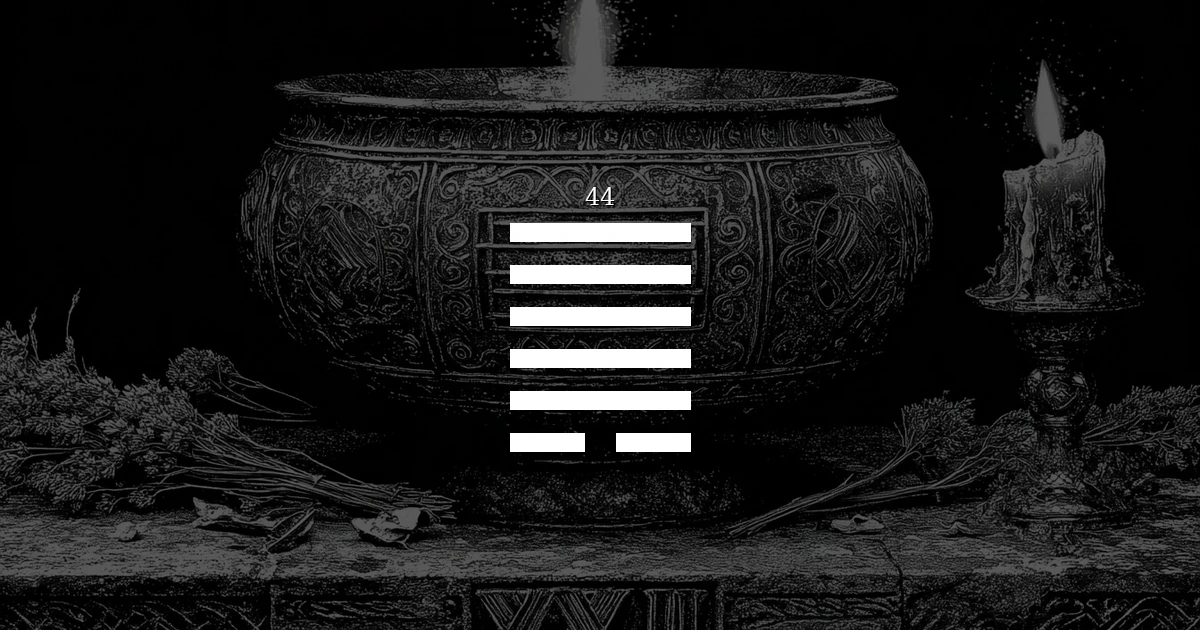
What is Hexagram 13, Fellowship?
Hexagram 13 of the I Ching is 同人 (Tóng Rén), translated as Fellowship or Fellowship with People. Its structure places Heaven (☰) above Fire (☲): the illuminating quality of fire rising toward the clarity and breadth of heaven. Fire’s nature is to illuminate — and what it illuminates here is the possibility of genuine human connection that extends beyond the clique, beyond the faction, beyond the comfortable group of those already like oneself, out into the open field under heaven.
The I Ching is among the oldest continuously consulted texts in human history, with origins in Zhou dynasty China approximately three thousand years ago. The Wilhelm/Baynes translation (1923/1950) is the primary Western reference, though original meanings continue to be debated by scholars. The Whisper engages with this tradition as a lens for self-reflection rather than a predictive system.
In The Whisper, your daily hexagram is determined by a hash of your birth date and today’s date — a deterministic draw framed as fated rather than random. When Hexagram 13 appears, the system is pointing toward the quality of genuine fellowship and the breadth of genuine human connection in your current situation.
The two trigrams: Heaven above Fire
The trigram Qian (Heaven) above Li (Fire) creates the image of light rising toward open sky — the fire that illuminates not just a small space but as far as conditions allow. Li, in its middle position, is associated with clarity of vision and the light that makes things visible. Qian above is the quality of breadth, of the great reach that extends across divisions and differences.
Together the trigrams describe a specific quality of fellowship: one that is illuminated by genuine clarity and extended by the reach of heaven. This is fellowship that sees accurately — that is not obscured by the distortions of faction and self-interest — and that reaches broadly, toward those who might not seem like natural allies, toward the possibilities that genuine openness makes available.
The traditional hexagram name, 同人 (tóng rén), literally means “same person” or “people of the same kind” — but the commentary is at pains to distinguish genuine fellowship from the fellowship that reduces community to those who are already the same. The hexagram’s positive quality is not the comfort of homogeneity but the achievement of genuine connection across difference.
The core teaching of Fellowship
The central teaching of Hexagram 13 is the distinction between genuine fellowship and its counterfeit. The counterfeit — fellowship by exclusion, the clique that calls itself community, the faction that calls itself fellowship — is comfortable and immediately available. It requires no genuine work of understanding or openness; it is simply the reinforcement of existing similarities. The hexagram is not interested in this version.
Genuine fellowship, as the hexagram describes it, is the community built in the open field rather than behind closed gates. It requires the willingness to move toward people who are genuinely different, to find the actual common ground that exists across surface differences, to allow the fire’s light to illuminate what is genuinely shared rather than projecting similarity onto a carefully curated group. This is more demanding, and it produces something more valuable.
The specific warning the hexagram carries is about the moment when fellowship becomes faction — when the community that began with genuine openness starts to define itself by exclusion, when the light of genuine connection narrows into the self-confirming warmth of those who agree with each other. The hexagram consistently points back toward the open field, the broad sky, the fellowship that could cross the great water because it is not limited by the boundaries of faction.
The practical application of this teaching involves regularly asking whether one’s actual community of connection has the breadth that genuine fellowship requires — or whether it has gradually narrowed into a group of people who share the same opinions, the same background, the same assumptions. The fire that illuminates only a small, self-selected area is not serving the quality that Hexagram 13 points toward.
How Fellowship appears in daily life
The pattern of Hexagram 13 in daily life is recognizable in experiences of genuine connection that cross expected boundaries — the conversation with someone from a very different background that produces real mutual recognition; the working relationship that develops genuine trust across differences that might have been expected to prevent it; the moment when a community discovers actual common ground beneath the surface differences that had kept people at arm angles from each other.
The hexagram also appears at moments when the question of who belongs is being actively decided — when a community is choosing whether to open or close, whether to define itself by what it includes or what it excludes. The hexagram is a consistent vote for the open field: the fellowship that extends toward genuine difference rather than contracting around comfortable similarity.
Internally, the pattern appears in the relationship between different dimensions of oneself — the person who can hold multiple, apparently contradictory aspects of their own nature in genuine fellowship, rather than requiring one to dominate and the others to hide. The inner fellowship of the complete person is not the victory of one part over the others but the genuine inclusion of all of them in the open field of a coherent identity.
What Fellowship means in The Whisper
In The Whisper’s synthesis, Hexagram 13 resonates with the Three Jade Wood Star (三碧木星) in Nine Star Ki — the yang wood star of direct communication, clear voice, and the initiative that breaks through what has been separating people. When both systems point toward the quality of genuine connection and clear communication, The Whisper may draw attention to where genuine fellowship is available in the current situation and what is preventing access to it.
In BaZi, the resonance appears in configurations that emphasize the fire element’s clarifying quality — Bing Fire (丙) day masters particularly, with their natural quality of illuminating broadly rather than selectively, of bringing warmth to what they encounter rather than reserving it for those already inside the circle.
From Western Astrology, Hexagram 13 carries qualities associated with Sagittarius and Jupiter — the broad reach, the philosophical generosity, the genuine interest in perspectives and people that expand rather than confirm what is already known, and the crossing of distances (literal and metaphorical) that genuine fellowship requires.
Frequently asked questions
Q: Does Hexagram 13 mean I should not have close or exclusive relationships? The hexagram’s emphasis on breadth of fellowship is not a counsel against deep individual relationships. The distinction it draws is between genuine fellowship and faction — not between broad community and close bonds. Close bonds that are genuinely honest and do not require the exclusion of others to maintain their quality are compatible with the hexagram’s teaching. The problem the hexagram identifies is the community that can only sustain itself by defining who is outside it.
Q: What does the “open field” image in the traditional commentary mean? The open field as opposed to the clan hall or the fortress is the image of fellowship that has no wall — that is genuinely available to encounter rather than protected by exclusion. Meeting in the open field means being willing to encounter whoever is genuinely there rather than only those who have been pre-selected for compatibility. The hexagram is pointing toward this quality of genuine openness as the condition for the most valuable form of fellowship.
Q: How does genuine fellowship survive genuine disagreement? The hexagram’s answer to this is that genuine fellowship is built on something more fundamental than agreement — on the genuine recognition of another person as a person, which survives disagreement because it doesn’t depend on agreement to exist. The fellowship that can only survive if everyone agrees is the fellowship of faction, which the hexagram distinguishes from the genuine article. Genuine connection across difference is specifically tested and demonstrated by the capacity to maintain it through the experience of disagreeing.