
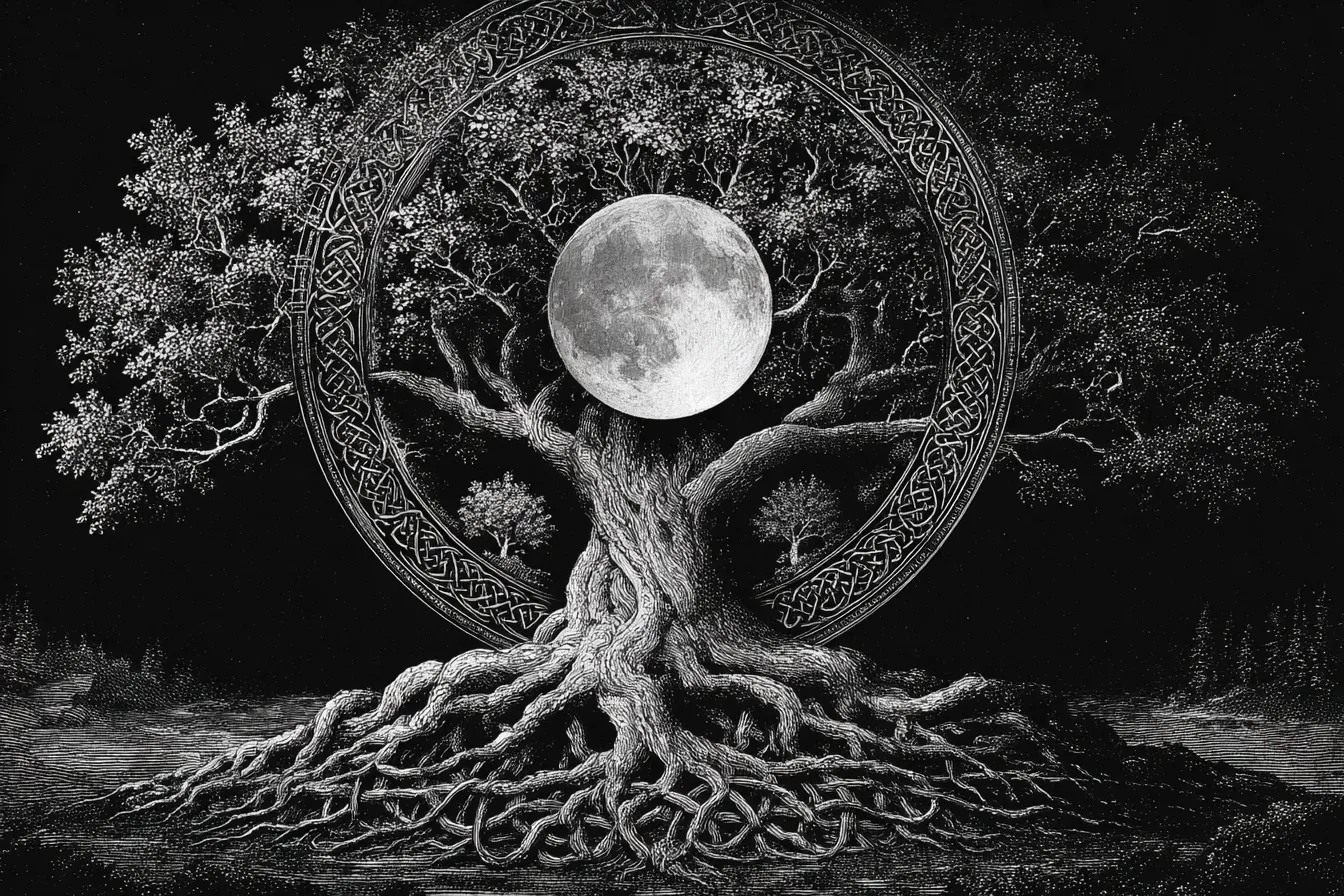
Western astrology divides the year by the sun’s position relative to constellations. The Celtic tradition did something different: it divided the year by the trees.
This isn’t metaphor. The ancient Celts lived in close relationship with the forest — practically and spiritually — and the trees of their landscape became a primary framework for understanding time, character, and the subtle qualities that change as the year turns. Each period of the lunar year was associated with a specific tree, and that association carried meaning: about the energies available in that season, and about the character of people born within it.
What’s now called Celtic Tree Astrology draws on two interlocking traditions: the Ogham alphabet — an early medieval Irish writing system where each letter is named for a tree — and the Celtic tree calendar, a lunisolar framework reconstructed from classical sources, medieval Irish texts, and most influentially, the poet Robert Graves’s 1948 book The White Goddess. It’s worth being honest that the tree calendar as commonly practiced today is partially a modern reconstruction — but it draws on genuine material, and the underlying logic of associating tree qualities with human character is very old.
How the Celtic Tree Calendar Works
The Celtic year is organized around 13 lunar months of approximately 28 days each, aligned to the moon’s cycle rather than the sun’s annual arc. Each month is governed by a sacred tree, and the qualities of that tree — its growth pattern, its fruit, its seasonal behavior, its role in the ecosystem — become the lens through which people born in that period are understood.
The sequence follows the Beth-Luis-Nion ordering of the Ogham letters. The year begins at the winter solstice, with the symbolic death and rebirth of the sun.
One note on dates: different sources give slightly different ranges for the 13 signs because the lunar calendar doesn’t map cleanly onto the Gregorian one, and different scholars have made different reconstruction choices. The dates below represent the most widely used modern system.
All 13 Celtic Tree Signs
1. Birch — The Achiever
December 24 – January 20 | Ogham: Beith (ᚁ)
The birch is the pioneer tree — the first to colonize cleared or burned ground, growing in conditions where nothing else will take hold. Birch people carry this quality: they are initiators, high achievers, and natural leaders who are most energized when working in difficult or unexplored territory. They thrive on challenge and tend to set ambitious standards for themselves and others.
The birch blooms in the darkest part of the year, which is characteristic of people born under this sign: they find their energy not despite difficulty but because of it. The shadow is a tendency to push relentlessly — toward themselves and toward others — without allowing for necessary rest or failure. Birch people are rarely comfortable with the status quo and tend to be the ones who initiate change in their environments.
2. Rowan — The Thinker
January 21 – February 17 | Ogham: Luis (ᚂ)
The rowan tree was considered one of the most protective trees in Celtic tradition — planted near homes and graves, its red berries seen as containing concentrated vital energy. Rowan people carry this protective, discerning quality: they are keen observers, independent thinkers, and natural skeptics who are difficult to fool and difficult to influence.
Rowan individuals tend to have strong personal vision and are often ahead of their time — they see connections and possibilities that others miss. The shadow is a tendency toward aloofness and a difficulty accepting that their particular kind of intelligence, while genuine, isn’t the only kind. The rowan’s thin form — surviving in exposed, windswept places where larger trees cannot — is a precise image for the resilient independence these individuals carry.
3. Ash — The Enchanter
February 18 – March 17 | Ogham: Nion (ᚃ)
In Norse cosmology the ash is Yggdrasil — the world tree, the axis connecting all realms. The Celtic tradition held the ash in similar regard: a tree mediating between what is above and below. Ash people are often gifted with an unusual capacity to move between worlds — imaginative, intuitive, and drawn to the big picture. They tend to think in systems and are often highly creative.
They can also be restless, easily bored, and difficult to pin down. The ash’s qualities of connection and mediation can tip into a diffuseness that prevents depth. Ash individuals do their best work when they find a project or relationship worthy of sustained attention rather than continuing to range across the surface of things. The ash blooms in late winter — before conditions seem favorable — speaking to the Ash person’s tendency to anticipate what’s coming before it arrives.
4. Alder — The Trailblazer
March 18 – April 14 | Ogham: Fearn (ᚄ)
The alder grows at the edge of water — it tolerates flooding that would kill other trees, and its wood hardens when submerged rather than rotting. In Celtic tradition, the alder was associated with the warrior, with courage under difficult conditions, and with the capacity to hold one’s ground under pressure.
Alder people are characteristically brave, decisive, and action-oriented. They are the natural pathfinders — confident enough to go first, resilient enough to handle what they encounter. They tend to be popular and persuasive, with a determined confidence others find reassuring. The shadow is impulsiveness and a difficulty tolerating inaction. They want to move, and the waiting required by strategy doesn’t come naturally.
5. Willow — The Observer
April 15 – May 12 | Ogham: Sail (ᚅ)
The willow is the tree of water, intuition, and the moon. In Celtic tradition it was associated with healing, grief, and the kind of knowledge that comes from deep feeling rather than rational analysis. Willow people are often gifted with extraordinary memory and intuition — they retain detail that others miss and perceive emotional undercurrents that others don’t consciously register.
They tend to be realistic rather than romantic about human nature, and they’re rarely surprised by people’s behavior. This can manifest as quiet wisdom, or — in the shadow — as a cynicism that closes off genuine openness. The willow’s association with grief gives these individuals a particular comfort with difficult emotional terrain that others avoid. They often become the person others turn to in crisis.
6. Hawthorn — The Illusionist
May 13 – June 9 | Ogham: Huath (ᚆ)
The hawthorn is one of the most significant trees in Celtic magical tradition — associated with the fairy realm, with boundaries between worlds, and with the power of May. It is both protective and threatening: its flowers are beautiful, its thorns severe, and it was considered unlucky to bring its blossoms indoors. Hawthorn people carry this duality: they are often quite different from how they appear on the surface.
They tend to have rich inner lives that aren’t immediately visible, a natural comfort with contradiction, and an unusual capacity for humor and perspective-taking. The Hawthorn person is rarely what they first appear to be — which can be experienced as delightful complexity or unsettling inconsistency depending on what you need from them. The hawthorn blooms at Beltane — the Celtic festival of the year’s turn toward summer — speaking to the Hawthorn person’s association with transitions and the potent energy that gathers at crossing points.
7. Oak — The Stabilizer
June 10 – July 7 | Ogham: Duir (ᚇ)
The oak was the most sacred tree in Celtic tradition — the druids’ name itself may derive from the Celtic word for oak. It is the tree of the midsummer sun, of strength, endurance, and protection. The oak grows slowly and lives for centuries; its wood is dense and durable; it supports more species of wildlife than almost any other tree in the European ecosystem.
Oak people are reliable, protective, and unusually persistent. They tend to be generous with their strength — carrying burdens for others that others couldn’t carry — and they form deep, lasting attachments. The shadow is rigidity. The oak that cannot bend can break, and Oak people sometimes struggle with change, particularly when it threatens structures they’ve spent years building.
8. Holly — The Ruler
July 8 – August 4 | Ogham: Tinne (ᚈ)
The holly is the counterpart to the oak in Celtic cosmology — where the oak rules the light half of the year, the holly rules the dark half. Holly is a tree of protection, testing, and the kind of strength that functions in adversity.
Holly people tend to be natural leaders with a competitive edge and a talent for navigating difficult situations. They are often the ones who step forward when conditions are hard. They can be generous and warm — the holly berries that feed birds through winter are an image of provision in scarcity — and they can also be demanding and difficult to satisfy. The holly’s evergreen quality — remaining vivid through the coldest months — is characteristic of Holly people’s particular resilience. They don’t just survive winter; they thrive in it.
9. Hazel — The Knower
August 5 – September 1 | Ogham: Coll (ᚉ)
In Celtic myth, nine hazel trees grew over the Well of Wisdom, and the salmon that ate the hazelnuts falling into the well acquired all knowledge. Hazel was associated with poetry, divination, and the kind of knowledge that arrives as sudden vision rather than laborious accumulation.
Hazel people tend to be highly intelligent, perceptive, and drawn to analysis. They often have an instinct for finding essential structure underneath apparent complexity, and a gift for making difficult ideas precise and transmissible. The shadow is a tendency toward perfectionism that prevents completion, and an over-reliance on mental activity that keeps emotional experience at arm’s length. The hazel nuts in late summer — concentrated, nutritious, storable — are a fitting image for the Hazel person’s characteristic orientation: finding and preserving what is genuinely essential.
10. Vine — The Equalizer
September 2 – September 29 | Ogham: Muin (ᚊ)
The vine is the only sign not associated with a tree native to the British Isles — its inclusion in the Celtic tree calendar reflects the Mediterranean influence on Celtic culture through trade. The vine is associated with the harvest, with abundance at the edge of loss, and with the ambivalence of peak ripeness that is also the beginning of decay.
Vine people are often charming, magnetic, and highly empathic — they read social situations with unusual accuracy and move between very different social worlds with ease. They can hold opposing viewpoints simultaneously, which makes them excellent mediators and excellent equivocators in equal measure. The vine’s characteristic quality is genuine ambivalence — the capacity to see the validity of multiple positions. The shadow is using that capacity to avoid taking a position of their own.
11. Ivy — The Survivor
September 30 – October 27 | Ogham: Gort (ᚋ)
Ivy grows in conditions that defeat other plants — in deep shade, on north-facing walls, through prolonged cold. It’s technically a vine that can behave like a tree, anchoring itself in stone and becoming structural over time. In Celtic tradition, ivy was associated with persistence, the spiral, and the kind of loyalty that outlasts adversity.
Ivy people are characteristically loyal, patient, and possessed of a resilience that isn’t immediately visible from the outside. They can seem soft or accommodating, but their capacity for endurance is extraordinary. They also have a gift for finding their way through complex social situations — like ivy finding cracks in stone. The shadow is a tendency to cling — to relationships or patterns that have run their course — because the security of attachment feels preferable to the vulnerability of release.
12. Reed — The Inquisitor
October 28 – November 24 | Ogham: Ngetal (ᚍ)
The reed was used in the Celtic world for musical instruments, for thatch, and for writing — it is the plant that makes sound out of breath, the medium through which voice and meaning are transmitted. Reed people tend to be probing, investigative, and drawn to understanding what’s hidden. They are often gifted storytellers and researchers, with an instinct for finding the narrative underneath the surface of events.
Reed individuals can be intensely curious and intensely determined once they’ve identified something worth understanding. They rarely accept the first explanation and have a gift for finding information others haven’t thought to look for. The shadow is a tendency toward manipulation — using the same capacity for investigation and narrative to control rather than illuminate. The reed’s hollowness is a striking image for the Reed person’s quality: their insight often comes not from accumulation but from a kind of receptive openness to what is actually there.
13. Elder — The Seeker
November 25 – December 23 | Ogham: Ruis (ᚏ)
The elder is the final tree of the Celtic year — the tree of the threshold, of endings and beginnings, of the crossover between what has been and what is coming. In Celtic tradition the elder was associated with death and regeneration, with the fairy realm, and with a wisdom that comes only from having traveled far. It was considered dangerous to cut elder without asking permission of the spirit that inhabited it.
Elder people tend to be restless, deeply philosophical, and drawn to the edges of experience. They are often highly perceptive and often outspoken — they see what others prefer not to see, and they say it. They carry an energy of threshold-dwelling: most at home in the in-between. The shadow is a tendency toward recklessness — a flirtation with extremity that can be generative or genuinely harmful depending on circumstances. At their best, Elder people are the ones who have the courage to go to the edge and come back with something worth knowing.
Celtic Tree Signs vs. Western Sun Signs
The most important structural difference is that Celtic Tree Astrology is lunar rather than solar — it follows the moon’s cycle rather than the sun’s annual arc. This gives it a different relationship to time: where Western astrology is interested in the solar year, the Celtic system is interested in the 28-day lunar rhythm and the qualitative differences between one moon-period and the next.
The second difference is that the symbolic language is ecological rather than astronomical. Western astrology looks up — to constellations and planetary positions. Celtic Tree Astrology looks at the landscape — at the growth patterns, seasonal behaviors, and ecological relationships of specific trees. The two are genuinely different metaphorical frameworks for understanding how human character relates to the natural world.
Neither is more “accurate” — they’re measuring different things. A person whose Western sun sign is Aries and whose Celtic sign is Alder may find that both speak to the same quality of boldness from different angles. A person whose Western sign is Pisces and whose Celtic sign is Alder may find genuine productive tension — and that tension, held consciously, is often where the most useful self-understanding lives.
How The Whisper Uses Celtic Tree Astrology
The Whisper includes your Celtic Tree Sign as one layer of your divination profile, reading it alongside your BaZi Day Master, Nine Star Ki stars, and other frameworks. Because the Celtic system is lunar — following the same moon cycle that drives many of The Whisper’s timing layers — your tree sign connects naturally to the monthly and seasonal dimensions of your reading.
Your tree’s ecological qualities — how it grows, what conditions it thrives in, what it provides to the ecosystem around it — are the primary lens. Not mystical attributes assigned arbitrarily, but specific, observable qualities of real organisms that the Celtic tradition found to be reliable metaphors for human character. That groundedness in the actual world is what makes the system worth returning to.
Some patterns only appear when the reading becomes personal.