
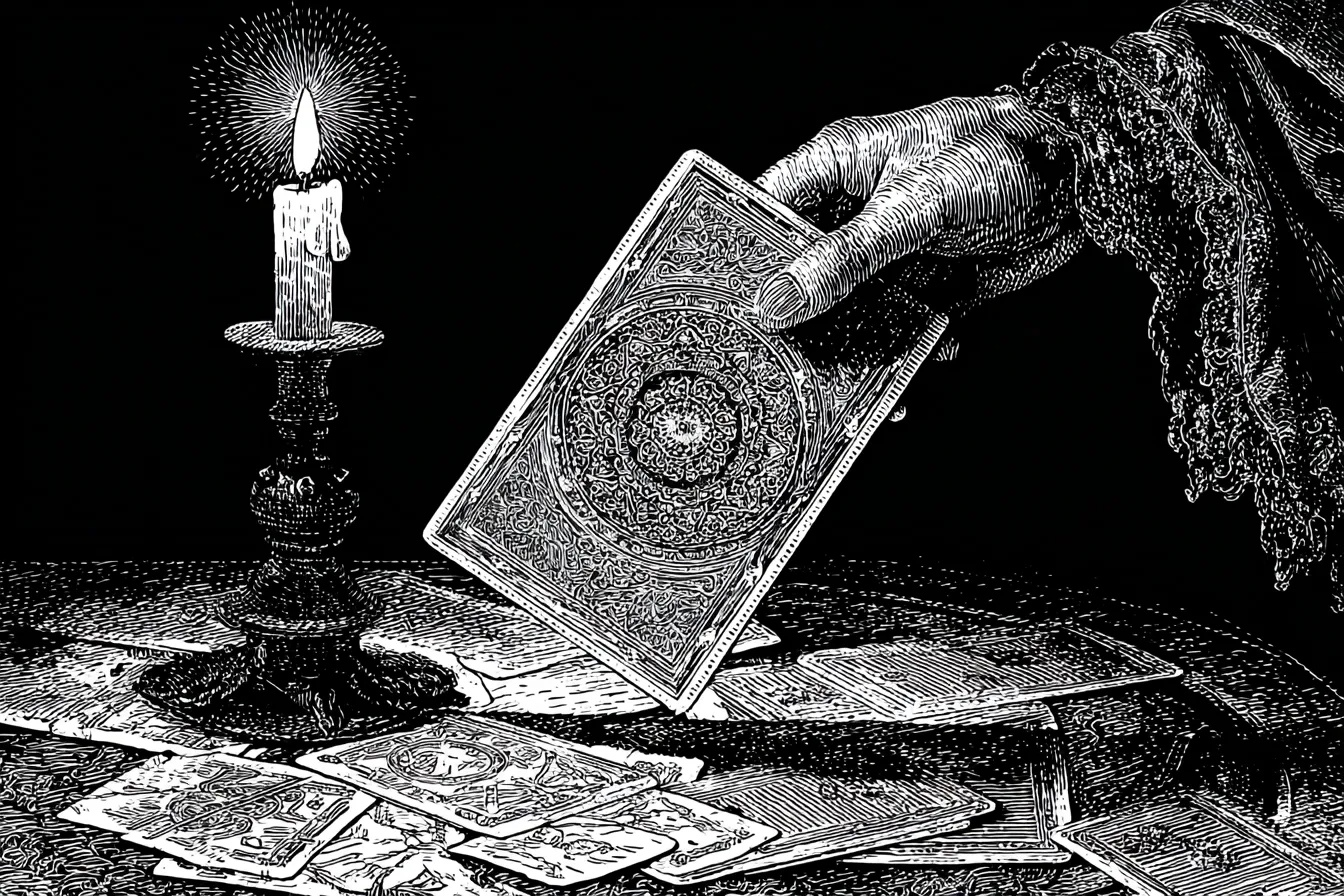
What is the High Priestess birth card?
The Tarot birth card is calculated by summing all digits of your complete birth date — day, month, and four-digit year — and reducing until you reach a number between 1 and 22. The resulting Major Arcana card is your birth card.
The High Priestess, numbered II, arises when this reduction produces 2. As a single-digit card, The High Priestess is a sole birth card when the sum reduces directly to 2 — there is no secondary partner card. She also appears as the secondary birth card for two other Major Arcana: Justice (XI), since 1+1=2, and Judgement (XX), since 2+0=2. People whose birth date sum is 11 carry Justice and The High Priestess; those whose sum is 20 carry Judgement and The High Priestess.
The birth card system is a modern interpretive framework developed primarily in the late 20th century at the intersection of numerology and tarot practice. The tarot’s Major Arcana originated in 15th-century northern Italy as part of a card game; the symbolism most associated with these cards today reflects the esoteric tradition built largely in the late 19th and early 20th centuries, crystallized in the 1909 Rider-Waite-Smith deck. The birth card method adds a contemporary self-reflection layer — a lens, not a prophecy.
The symbolism and field of The High Priestess
In the Rider-Waite-Smith tradition, The High Priestess is depicted seated between two pillars — one dark, one light — a veil behind her, a crescent moon at her feet, a scroll partially concealed. Everything about this image is about the threshold between the visible and the hidden: she sits at it, she guards it, and she does not cross it casually.
The Moon is The High Priestess’s traditional astrological correspondence. Not the Moon as merely intuitive or emotional (that is a common oversimplification), but the Moon as the principle of cyclical knowledge — the understanding that comes not all at once but in phases, that waxes and wanes with the natural rhythms of interior life. The High Priestess knows things that cannot yet be fully articulated; she is the custodian of knowing that has not yet completed its emergence.
The scroll in her lap in the RWS image is often labeled with references to Torah (divine law, hidden wisdom), but what matters for birth card purposes is the symbolism: she holds knowledge that she does not immediately share. This is sometimes misread as withholding. The tradition is more specific: it suggests that certain knowing needs to gestate fully before it can be offered, and that The High Priestess’s characteristic act of patience is a form of care for the knowledge rather than concealment.
The veil behind her separates the realm of ordinary perception from the deeper interior realm. The pomegranates on the veil are a traditional symbol of Persephone — the crossing between worlds, the knowledge gained only by those who have traveled to depths others avoid. The High Priestess birth card suggests a person for whom the depth of interior life is not merely a preference but a fundamental orientation: the world that matters most is the one not yet visible to others.
The shadow of this configuration is also worth naming directly. The High Priestess’s depth and interiority can become withholding as a form of power — holding knowledge without offering it, using mystery as a way of maintaining distance or control. The tradition distinguishes between the genuine stillness that allows deep knowing to emerge and the strategic opacity that prevents genuine connection.
The High Priestess in the daily tarot cycle
The Whisper generates a daily tarot draw through a deterministic method tied to birth date and today’s date. For a High Priestess birth card holder, the daily cycle introduces different qualities of energy that interact with the underlying depth-oriented nature.
Days when the daily draw brings The Moon, The Hermit, or The Hanged Man tend to feel most aligned — these cards share the interior, receptive, depth-oriented quality that is The High Priestess’s native ground. These are often the most productive days for the inner work, the processing, and the patient waiting-with-knowing that this birth card does best.
Days when the daily draw produces The Chariot, The Magician, or The Emperor introduce an outward-acting, directed energy that can feel either clarifying or discordant depending on context. The tradition notes that The High Priestess birth card sometimes needs these days as prompts to bring what is known inwardly into a form that can be shared or acted on — the invitation from stillness into expression.
Days when the daily draw produces The Lovers often surface the specific tension this birth card frequently navigates: between the interior world of deep knowing and the relational world that requires the interior to be translated into communication that others can receive. These days may be among the most informative about where the High Priestess birth card’s growth edge is currently most alive.
Strengths and growth edges of the High Priestess archetype
The genuine strengths of The High Priestess birth card are real and consequential in contexts that value depth, patience, and the kind of knowing that operates below the threshold of what can be immediately demonstrated. People with this birth card often describe being the person in a group who “knew something was wrong before anyone could name it” — the one whose intuitive read of a situation proved accurate despite the absence of conventional evidence.
The capacity for sustained interiority — for sitting with incomplete knowing without forcing premature resolution — is also a specific strength. In a culture that values quick outputs and immediate articulation, the High Priestess birth card’s ability to let understanding develop fully before expressing it is a form of intellectual and relational integrity that produces more reliable results over time.
The growth edges for The High Priestess birth card cluster around the relationship between interior depth and exterior engagement. The first is learning to translate interior knowing into a form that can be received by others — not compromising the depth, but developing the capacity to bridge it into communication. The High Priestess birth card can become so identified with the interior world that the translation step feels like a violation rather than an extension of the knowing.
The second growth edge involves developing discernment between genuine still-knowing and the avoidance of acting on what is already known. The High Priestess’s patience can be a genuine capacity to hold with complex knowing until the right moment; it can also be an unconscious strategy for avoiding the moment when the knowing requires a response.
The third edge is allowing relationship to access the interior world. The veil that separates the High Priestess’s depth from the visible world is necessary; it is not meant to be permanent. The growth work involves developing the trust that allows others to cross it — not all others, not always, but sufficiently that the depth is in relationship with the world rather than only ever in relationship with itself.
What this means in The Whisper
In The Whisper’s synthesis, The High Priestess birth card creates its most resonant interactions with systems that share its depth and receptive orientation. The numerological Life Path 2 carries significant thematic overlap — both are associated with sensitivity, cooperation, and the kind of relational attunement that operates through subtle perception rather than direct assertion. When both are active in your oracle stack, the daily Whisper tends to reflect themes of what is present below the surface of the current situation, and what patient attention to that register reveals.
The Moon correspondence connects The High Priestess directly to Western Astrology transits in The Whisper’s daily reading. New moon and full moon periods, lunar transits through water signs (Cancer, Scorpio, Pisces), and periods of Moon conjunct personal planets all interact particularly with this birth card. These days may produce Whispers that specifically address what is currently in the process of emerging from interior knowing into articulable understanding.
In Nine Star Ki, One White Water Star (一白水星) shares the deepest resonance with The High Priestess — both associated with hidden depth, unseen influence, and the particular wisdom of what flows beneath visible surfaces. When both are active in your stack and align on a given day, The Whisper may produce its most precisely interior message: less about what to do and more about what to know.
Frequently asked questions
Q: I calculated my birth date as summing to 11 or 20. Is The High Priestess still my birth card?
Yes, as a secondary card. If your sum is 11, your two birth cards are Justice (XI) and The High Priestess (II). If your sum is 20, your two birth cards are Judgement (XX) and The High Priestess (II). Both birth cards are meaningful lenses on your path — the primary card describes one dimension of the recurring themes, the secondary card describes another. The High Priestess as secondary to Justice produces a specific combination: the capacity for clear, balanced perception (Justice) combined with a deep interior knowing that grounds and complicates simple judgment (The High Priestess). The Judgement/High Priestess combination tends to produce an orientation toward awakening that is quiet rather than dramatic — the call is heard internally before it becomes externally visible.
Q: Does The High Priestess birth card mean I am psychic?
The tradition does not use that word, and neither does The Whisper. The High Priestess birth card suggests an unusually developed capacity for intuitive perception — for reading situations, people, and patterns through channels that are not purely rational. Whether this is called intuition, perceptiveness, sensitivity, or pattern recognition depends on the person and the context. It is a real quality that this birth card is associated with; it is not a supernatural claim.
Q: Why does this card feel like it describes me as passive or withdrawn?
This is a common reaction to The High Priestess’s description, and it reflects the cultural tendency to undervalue interiority and receptivity as active modes. The High Priestess’s stillness is not the stillness of absence — it is the stillness of a very active interior life that is not primarily visible from the outside. The withdrawal associated with this card is purposeful rather than avoidant: it is the condition under which genuine knowing develops. The growth edge for the birth card involves bringing that developed knowing back into the world — the stillness is not the endpoint, but a necessary phase.
A deeper look: The High Priestess and the threshold she guards
The two pillars in the High Priestess image — one dark, one light, often inscribed B and J in the RWS tradition for Boaz and Jachin, the pillars of Solomon’s Temple — encode the specific nature of the threshold she guards. It is not simply the threshold between known and unknown, though that is part of it. It is the threshold between the world of manifest, articulable reality and the world of what has not yet completed its emergence — what is in process, what is forming, what exists but cannot yet be named.
The High Priestess does not prevent crossing; she is the threshold itself. To cross from the ordinary perceptual world into the deeper interior requires passing through her, which is to say: through the quality of patient, receptive, non-forcing attention that she represents. What cannot be accessed by striving, by analysis, or by the direct application of will becomes available through this threshold — but only when the quality of attention shifts appropriately.
For High Priestess birth cards, this quality of attention is often recognizable as their characteristic mode: the ability to be genuinely present with something without immediately trying to do anything with it, to hold a question without forcing an answer, to allow understanding to arrive rather than pursuing it. This is a real and cultivated capacity; it also tends to be invisible to people who operate primarily in the active, outward-directed mode — which creates a specific challenge for High Priestess birth cards in environments that value visible productivity and immediate output.
The scroll that the High Priestess holds — partially revealed, partially concealed — is also relevant for birth card purposes. The tradition places great emphasis on the partial revelation: she holds the totality of what she knows, but what is offered at any given moment is calibrated to what can be received. This is not withholding as control; it is the understanding that certain forms of knowing require specific conditions of receptivity in the receiver before they can be genuinely transmitted. High Priestess birth cards often navigate this understanding in their relationships: the sense that there is more to offer than the current context can receive, and the ongoing question of whether the condition for fuller revelation has been reached.
Justice and Judgement share the High Priestess as secondary birth card — both cards that involve bringing what is interior or hidden into the light of clear assessment and response. This pattern is not coincidental: the High Priestess’s depth provides the ground from which Justice’s clear perception and Judgement’s awakening summons arise. Without the depth of interior knowing that the High Priestess represents, Justice becomes merely legalistic and Judgement becomes reactive; with it, both become genuinely wise.
In The Whisper’s synthesis, High Priestess birth cards during new moon phases, Neptune transit periods, and water-sign-emphasized nine-star readings often produce messages specifically about the current quality of the interior process — what is presently in formation, what conditions would support its emergence, and what the patient holding of the not-yet-fully-known is in service of.