
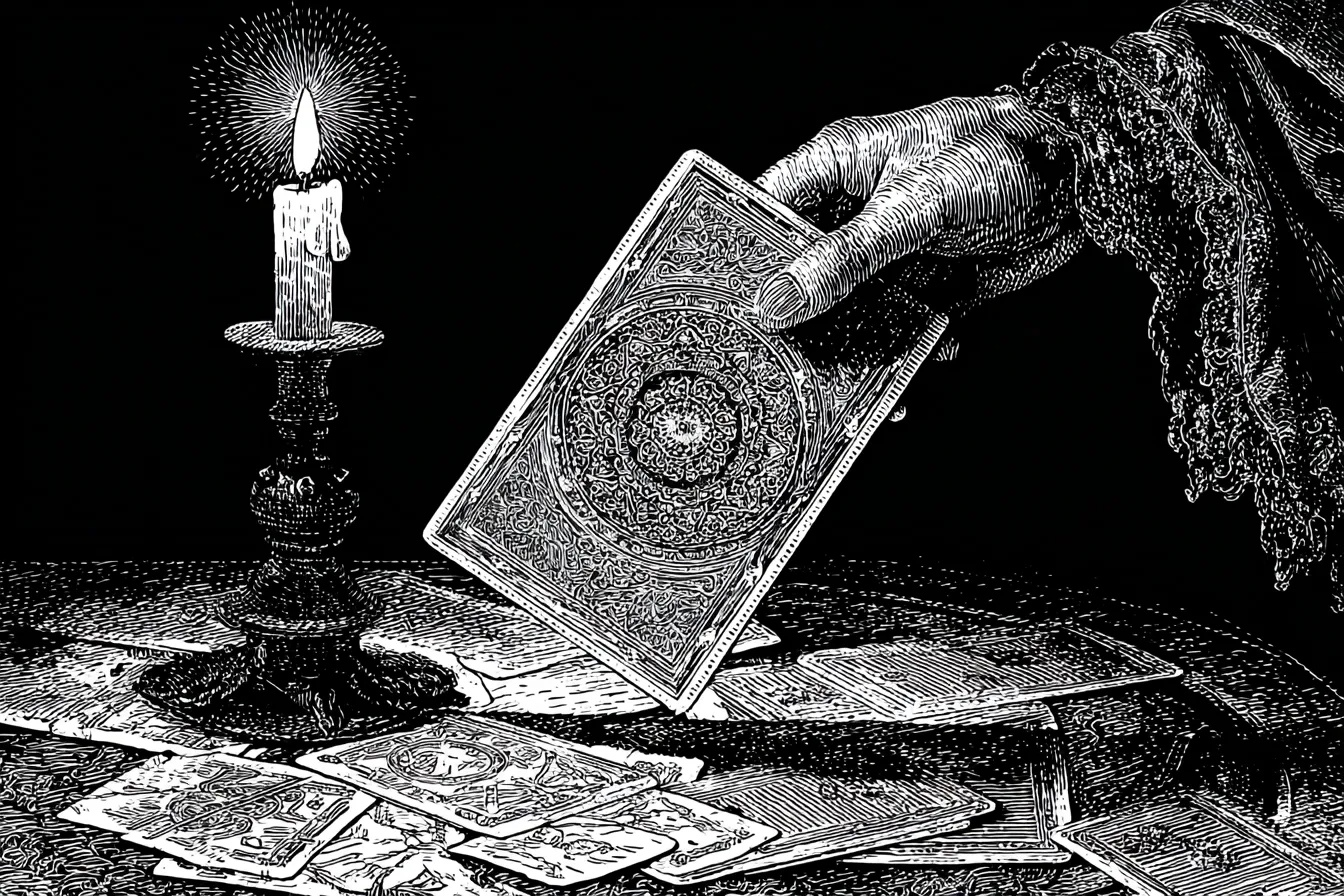
What is the Temperance birth card?
The Tarot birth card is calculated by summing all digits of your full birth date and reducing to a number between 1 and 22. Temperance, numbered XIV, arises when this sum produces 14. As a two-digit result, this becomes a two-birth-card set: Temperance (XIV) as primary and The Hierophant (V) as secondary, since 1+4=5. People whose birth date sum is 14 carry both Temperance and The Hierophant.
The symbolism and field of Temperance
The RWS Temperance shows a large angelic figure standing with one foot on land and one in water, pouring liquid between two cups. The liquid flows from lower to upper in a way that defies gravity, suggesting that what Temperance is doing is not simply mixing — it is transformative blending, alchemy rather than combination. A path winds toward mountains in the background; a crown of light marks the destination. This is not a static image; it depicts a continuous, active process.
Sagittarius is Temperance’s traditional astrological correspondence — the sign of philosophical breadth, of the capacity to hold opposing truths simultaneously, of the long journey toward synthesis. Where Scorpio (Death’s correspondence) goes down into the depths, Sagittarius reaches toward the horizon: the broader context, the more comprehensive understanding, the integration that holds more than any individual perspective can.
The Temperance birth card suggests a person with a recurring orientation toward integration — the patient, sustained work of combining what appears to be contradictory into something that holds both without forcing either to be other than it is. This is different from compromise, which tends to reduce both elements; Temperance produces synthesis, in which the combined result carries qualities that neither element possessed alone.
The word “temperance” itself comes from the Latin temperare — to mix in proper proportions. The alchemical tradition understood temperance as the art of combining elements correctly, not merely in equal amounts but in the right relationship for the specific purpose. The Temperance birth card carries this precision: not the blunt mixing of everything in equal measure, but the attentive work of finding the right proportions for what is being created.
The shadow of Temperance is moderation as avoidance: the refusal to commit fully to anything, the “middle path” that is actually the fear of the intensity on either side, the temperance that produces insipidity rather than integration.
Temperance in the daily tarot cycle
For a Temperance birth card holder, days when the daily draw emphasizes Sagittarius, Jupiter (Sagittarius’s ruler), or philosophical integration tend to feel aligned. Days when The Moon or Death appear in the daily draw introduce destabilizing or transformative qualities that can challenge Temperance’s patient integration work — these days may be surfacing the specific material that needs to be brought into the alchemical process.
Days when The Lovers appears in the daily draw create an interesting resonance: both cards deal with the relationship between opposites, but at different stages of the process. The Lovers faces the moment of choice; Temperance is already in the long work of integration that follows a series of choices. These days may address what choices have already been made and what their integration is actually requiring.
Strengths and growth edges of the Temperance archetype
The genuine strengths of the Temperance birth card: the capacity for patient, sustained work that produces genuine synthesis rather than forced resolution; the philosophical breadth that can hold opposing truths without being torn between them; the attentiveness to proportion and right relationship that produces unusually well-calibrated results; and the resilience of a person who has learned to work with the long time-horizon rather than expecting immediate resolution.
Temperance birth cards are often the people who produce the most genuinely integrated work — the syntheses that others could not achieve because they lacked either the breadth to hold multiple perspectives or the patience to let them genuinely combine.
The growth edges involve the relationship between integration and commitment. The first is developing the capacity to commit fully to specific directions within the integration work rather than remaining perpetually in the combining phase. The second is distinguishing between genuine patience and the avoidance of intensity — Temperance’s middle path should be a place of creative tension, not a strategy for remaining safe from the edges. The third involves developing tolerance for the periods when the integration has not yet produced legible results — the alchemical process has phases of apparent chaos before the synthesis becomes visible.
What this means in The Whisper
Temperance’s Sagittarius correspondence creates direct interactions with Western Astrology transits — Sagittarius season, Jupiter transits, and Fire-sign-emphasized periods all interact with this birth card. The Hierophant as secondary birth card adds the dimension of received wisdom: Temperance’s patient integration is informed by and in dialogue with what has been inherited from tradition. The pairing suggests a person who repeatedly works at the intersection of personal synthesis and received framework — finding what in the tradition is genuinely alive and bringing it into integration with personal experience.
In Nine Star Ki, Four Green Wood Star (四緑木星) resonates with Temperance’s connecting, bridge-building quality — both associated with the capacity to move between domains and bring them into productive relationship. Days when this star is prominent may produce Whispers that specifically address what is currently in the process of being integrated and what conditions would support that integration’s completion.
Frequently asked questions
Q: How do Temperance and The Hierophant work together as birth cards?
Temperance (XIV) and The Hierophant (V) form a pairing centered on the relationship between patient integration and inherited wisdom. The Hierophant provides the traditional framework — the accumulated teachings, the received structures, the transmitted understanding that comes from generations of human inquiry. Temperance provides the alchemical capacity to bring those frameworks into living relationship with personal experience, neither accepting them wholesale nor discarding them, but working with them until something genuinely new and integrated emerges. People who carry this pairing often find themselves repeatedly at the intersection of tradition and personal synthesis.
Q: Does Temperance as a birth card mean I am supposed to be moderate and avoid extremes?
Not in the sense of a behavioral prescription. The Temperance birth card describes a recurring orientation toward integration and the bringing of opposing elements into productive relationship — not a requirement to live without intensity or depth. Many Temperance birth cards have quite intense lives; the card’s quality shows up in how they work with that intensity — in the patient alchemical process of finding what the intensity is actually producing rather than either suppressing it or being swept away by it. Moderation, in the Temperance sense, is not the avoidance of extremes but the cultivation of the right relationship between them.
Q: I tend to be a mediator and peacemaker in my relationships. Is that related to Temperance?
Potentially, though the connection is less direct than it might appear. Temperance’s integration work is primarily interior — the alchemical combining that happens in the person’s own process. The relational expression of this (mediation, peacemaking, finding synthesis between opposing parties) is one way this quality shows up in the world. The connection to Life Path 2 (The High Priestess’s numerological correspondence) and The Lovers birth card may be more directly related to relational mediation; Temperance’s version of it tends to be less about managing conflict between others and more about the long interior process of bringing one’s own contradictions into integrated relationship.
A deeper look: Temperance and the intelligence of proportion
What makes Temperance’s integration different from simple mixing — or from the compromise that reduces both elements — is the attention to proportion. The alchemist does not combine everything in equal amounts; they develop, through sustained practice and attentive observation, the capacity to determine what ratio produces the specific result that is being aimed at. This is a form of intelligence that cannot be learned purely theoretically; it develops through the practice of combining, observing the result, adjusting, and combining again.
For Temperance birth cards, this quality tends to develop most strongly in the specific domains where the birth card’s pattern is most active. Some develop it in creative work — the capacity to know when a piece has the right balance of elements and when something is over- or under-represented. Others develop it in relational contexts — the attunement to when a conversation has the right quality of honesty and care, and when one dimension is crowding out the other. In some cases, the intelligence of proportion shows up in the person’s capacity to manage their own energy and attention — the developed understanding of how much depth is sustainable in a given period, and what needs to be lightened for the whole to remain functional.
The Sagittarius correspondence adds a specific dimension to this: Sagittarius’s philosophical breadth is what makes Temperance’s integration possible at scale. The capacity to hold opposing truths — to find what is true in contradictory positions rather than choosing one and dismissing the other — is a philosophical capacity before it is a practical one. Temperance birth cards often develop an unusual tolerance for genuine complexity: not the false equivalence that treats all positions as equally valid, but the discerning recognition that genuinely contradictory positions often each carry important truths that need to be in conversation with each other rather than in competition.
The Hierophant as secondary birth card adds the dimension of received wisdom to this alchemical capacity. The Temperance/Hierophant pairing produces people who are most fruitfully understood as integrators of tradition and personal experience — people who take what has been inherited seriously enough to genuinely engage with it, and whose integration work is informed by the depth of that inherited material rather than starting from scratch. The Whisper’s synthesis for this pairing often produces messages about the specific quality of the current integration: what elements are being combined, what proportion is currently needed, and whether the process is being allowed the time it requires.
A deeper look: Temperance and the alchemy that cannot be rushed
What makes the Temperance birth card’s integration work different from simple patience is the active quality of what is happening during the apparent stillness. The alchemist is not waiting for something external to happen; they are attending — with sustained, precise attention — to the process of combination that is occurring between elements they have deliberately brought into relationship. This is not passive waiting. It is one of the most demanding forms of active engagement: the refusal to force or rush, combined with the constant presence required to notice when the proportions have reached their optimal relationship.
For Temperance birth cards, this quality of sustained, non-forcing attention is often most clearly visible in how they work with contradictory or apparently irreconcilable elements in their own experience. The Sagittarian quality of being able to hold multiple truths simultaneously is the intellectual precondition; what Temperance adds is the sustained patience to allow those truths to move toward genuine synthesis rather than declaring victory for whichever one is currently most comfortable.
This quality is rarer than it appears. Most approaches to internal contradiction operate on a shorter timeline: either one perspective wins (suppression), or the two perspectives are held in apparent balance that never actually produces anything (false equilibrium), or the tension is declared productive and left unresolved indefinitely (avoidance in philosophical clothing). Genuine integration — the kind that produces something that carries qualities neither element possessed alone — requires the longer engagement and the willingness to remain genuinely uncertain about the outcome until the synthesis has actually arrived.
The Hierophant as secondary birth card adds the dimension of received wisdom to this alchemical process. For Temperance/Hierophant birth cards, the integration work is often specifically about the relationship between inherited frameworks and personal experience — the question of what in the tradition is genuinely alive and what has calcified, and how to develop a synthesis that honors what the tradition actually carries while allowing it to be updated by the pressure of living experience. This is among the most culturally important forms of the Temperance work: the alchemy between what has been passed down and what is currently being discovered.
The specific Sagittarian quality in the card’s astrological correspondence also addresses what the synthesis is for. Sagittarius is not merely philosophical for its own sake; it is philosophical in the direction of wisdom that can be lived and offered. The Temperance birth card’s integration work is not primarily personal — it tends toward something that can be shared, taught, or embodied in ways that make the synthesis available to others. The alchemist who keeps the gold locked in the laboratory has not completed the Temperance arc; the completion involves the offering of what was produced.
In The Whisper’s synthesis, Temperance birth cards during Sagittarius season, Jupiter transit periods, and when the nine-star reading emphasizes the bridging or Wind quality of Four Green Wood, often produce messages about the current state of an ongoing integration: what elements are presently in the alchemical process, what proportion is currently needed, and whether the synthesis that is forming is being given the time it requires to genuinely complete.